Christmas Eve · One service · No second chances
Is your system ready for Christmas Eve?
The biggest room of the year. The most first-time guests. Grandparents watching the stream from three time zones away. Volunteers running cues they see once a year, in a room lit by candles. December 24 is the service you cannot redo — and readiness is evidence, not a feeling.
The check is a free 30-minute review of your actual system with a person who runs church production. No card, no commitment — you keep the findings either way.
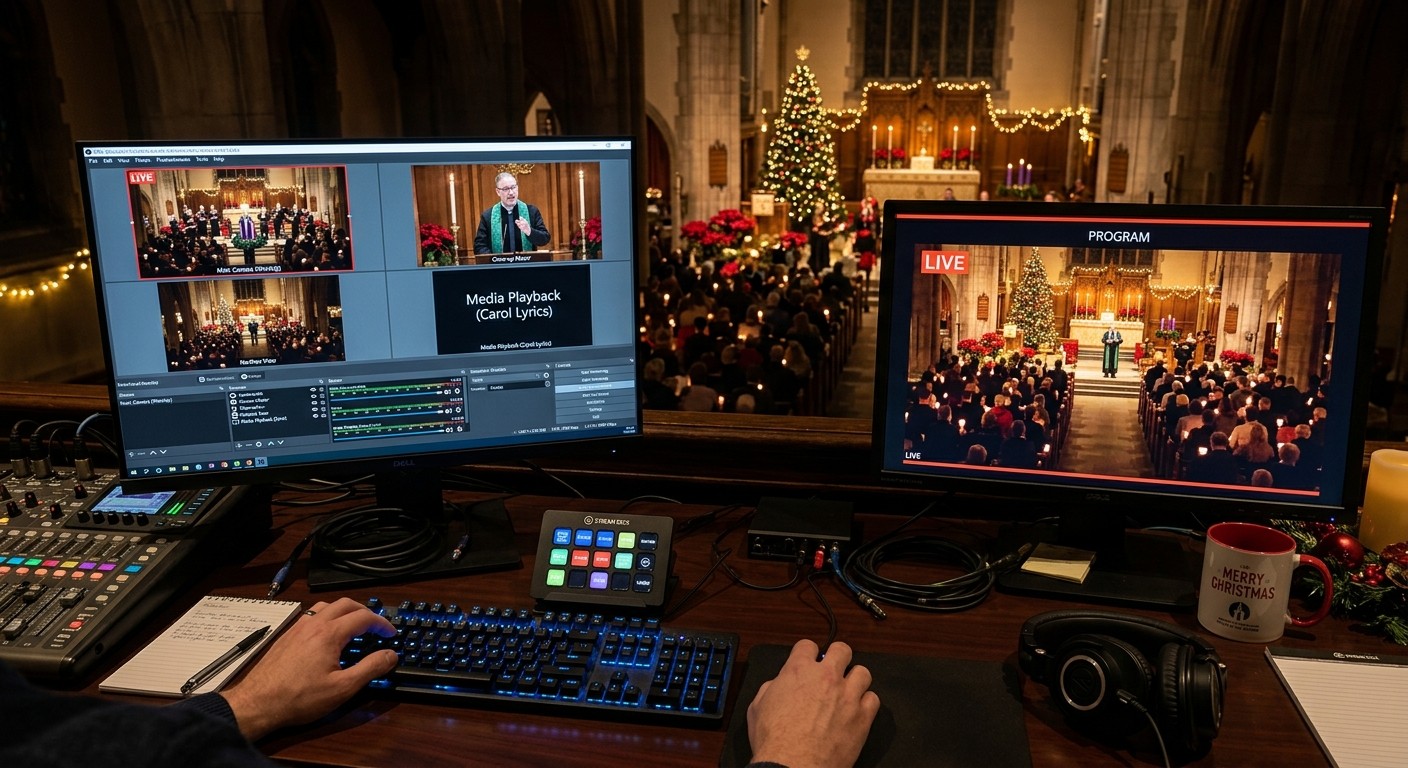
Twice the attendance means overflow feeds, lobby screens, and a booth that can't hide a mistake.
More people watch a church's Christmas Eve stream than any other service — many of them the relatives of the people in the room.
The most beautiful lighting of the year is the hardest to expose, and nobody tests for it in November's rehearsals.
Your most experienced operator has a one-in-four chance of being at their in-laws' on the 24th. The plan has to survive that.
· worshipmetrics.com/christmas-eve-readiness
Church Owner
Prove the system, not the hope
- Stream a full-length test at Christmas settings — candlelight-dark room, full band, real graphics
- Turn on monitoring for every booth machine and every camera, console, and encoder that matters
- Save known-good baselines: encoder profile, mixer scene, switcher config, presentation looks — dated files
- Walk the Signal Map (or draw it): every cable labeled, every input assignment written down
- Book gear purchases NOW — new equipment needs three Sundays of real services before the 24th
Close the gaps people cause
- Confirm the volunteer roster against holiday travel — name a backup for every position
- Schedule the platform event early (YouTube processes new events slowly in December)
- Test the stream at the real service time — December networks behave differently at night
- Verify backup internet: hotspot charged, tested, credentials written where anyone can find them
- Print the run sheet and the morning checklist; walk the newest volunteer through both
The night itself
- Run the full pre-service checklist with double margins — start 90 minutes out, not 45
- Camera exposure check under actual candlelight before the doors open
- Fresh batteries in every wireless mic — no exceptions on the one night with no second chance
- Recording redundancy on: local recording plus the platform's, two copies before you sleep
- Know who answers the phone if something breaks — and have the number taped to the desk
The morning-of routine lives on its own sheet: worshipmetrics.com/sunday-checklist · Free monitoring & alerts: worshipmetrics.com · Help any hour: 910-WORSHIP
What the free Readiness Check covers
Thirty minutes, your actual system, a person who runs church production. Together we look at:
- Coverage — is every machine, camera, console, and encoder that matters actually being watched, with alerts routed to phones that will be awake?
- Evidence — what do your last month of stream health reports say about where the system is fragile?
- Baselines — are the known-good settings saved as files someone can restore at 4 p.m. on the 24th?
- The map — can a substitute volunteer follow the signal path without calling the person who built it?
- The night plan — who runs each position, who backs them up, and who answers the phone when something breaks?
You leave with a written punch list, ranked by risk. Fix it yourselves, or ask us to help — the ladder runs from free monitoring to a pro on call for the night itself. Book the check here.
Why six weeks matters: the baseline problem
Monitoring proves readiness only after it has watched some real Sundays — alert thresholds, stream health scores, and "what does normal look like for us" all need history. Turn Pulse on now and December 24 arrives with a month of evidence behind it; turn it on December 20 and you're guessing with better tools. The same logic applies to settings baselines, new gear, and volunteers: everything trustworthy on Christmas Eve got that way in November. When something does break in the run-up, the seven troubleshooting front doors and the Sunday morning checklist are the fast path back.
Replacing the streaming computer before Christmas? Start early, so a new system has Sundays to settle in before December 24. Our Livestream Systems are built, tested and burned in before they ship, and you can map what you already have so we only replace what needs it.
The booth is half of Christmas Eve. The other half is the invitation: see the six-week Christmas social media plan and how to invite people to Christmas Eve online.
Questions churches ask
What is a Christmas Eve Readiness Check?
A free 30-minute review of your actual system with a person who runs church production: monitoring coverage, stream health history, settings baselines, alert routing, and your volunteer coverage plan for the night. You leave with a written list of what is solid and what needs attention before December 24 — whether or not you ever pay us anything.
Why start six weeks before Christmas Eve?
Because readiness is evidence, not confidence. Monitoring needs a few real Sundays to establish what normal looks like for your system, new gear needs services under its belt before the highest-stakes night of the year, and volunteer gaps need time to fill. A check in mid-November leaves time to fix what it finds; a check on December 20 mostly documents the risk.
What does it cost to get ready?
The readiness check is free, and so is the foundation: AV monitoring, instant alerts, and the Signal Map are free forever in WorshipMetrics, for unlimited users. If you want a person standing behind your team on the night itself, that is what the Sunday Assurance add-on exists for — but the free tier alone catches the failures that ruin most Christmas Eves.
Walk into December 24 calm.
Start the free monitoring today so the system has a baseline by Advent, put the countdown on the booth wall, and let a person look over the whole thing with you — free, in thirty minutes.
Book the free Readiness Check