The resignation letter every tech booth eventually gets
It arrives as good news, usually. A job offer in another city. A house closer to family. A season of life that finally demands the Sundays back. Your vMix person — the one who built the booth, knows its moods, and has run it alone for years — is moving on, with love and six weeks’ notice.
And now the church discovers what it actually had. Not a volunteer with a skill: a single point of failure with a personality. The gear stays; what leaves is everything the gear doesn’t know about itself — which port feeds the confidence monitor, why input four is named that, what the fix was the last time the stream died during communion. If that knowledge lives only in the departing head, the six weeks become a frantic brain-dump and the first month after becomes a series of small archaeologies.
Here’s the succession plan that avoids that — and the honest part is that every piece of it is worth doing now, whether or not anyone ever resigns.
Move 1: get the knowledge out of the head and into the system
The difference between a smooth handoff and a crisis is almost entirely where the knowledge lives. Three homes for it:
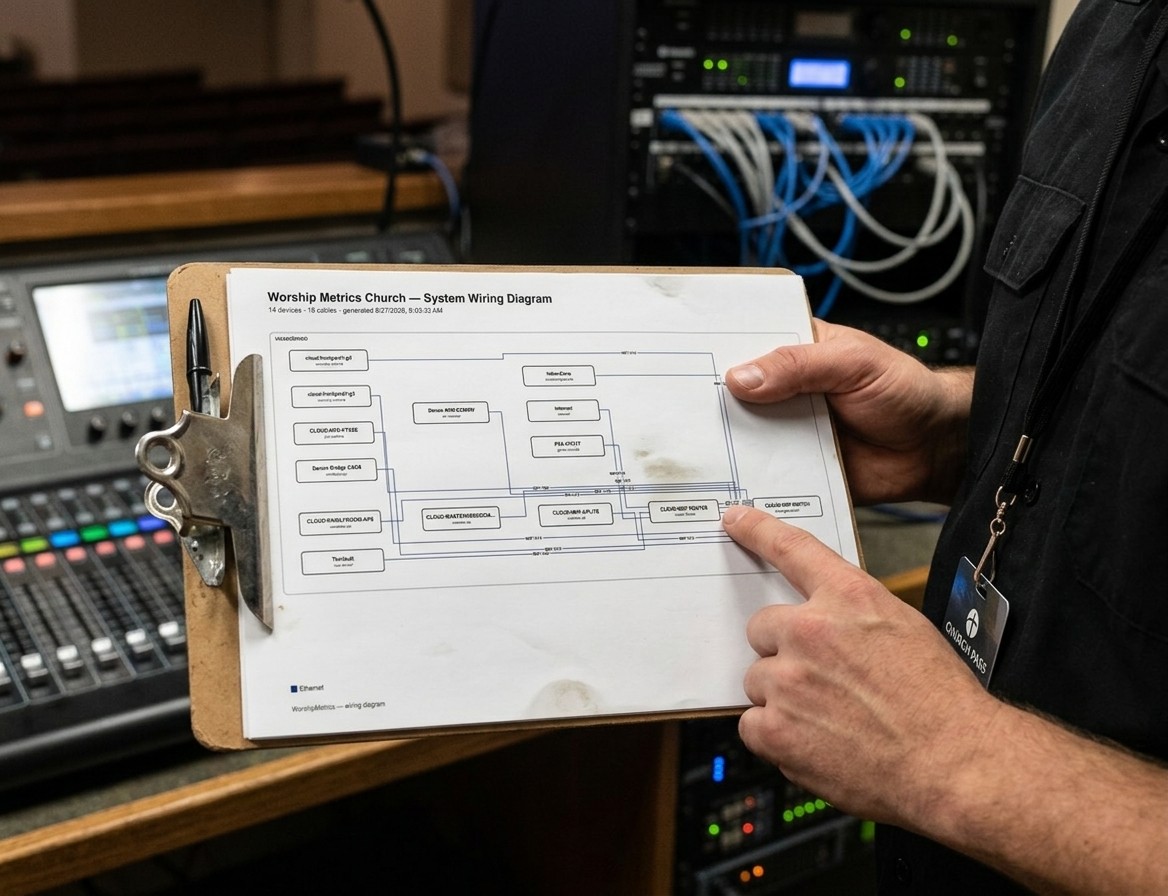
- The Signal Map documents every device, port, and labeled cable run — so “which cable feeds the confidence monitor” is a lookup, not a memory. It prints, too: a wiring diagram and cable-by-cable patch sheet, stamped with the moment they were made. If your gear list is a whiteboard photo, this is the single most valuable thing your current tech person can do in their remaining tenure. (Connect a UniFi controller and the network layer documents itself.)
- The support history is institutional memory nobody has to write: every Self Healing restart offer and answer, every alert, every remote intervention, timestamped. The next person inherits not just a system but its medical records — what fails, how often, what fixed it.
- The health reports carry the baselines: what a good Sunday looks like on this network with these settings. The successor doesn’t have to rediscover normal; it’s on file.
Notice what all three share: they accumulate automatically once set up. Documentation that depends on discipline dies with the person who had it. Documentation the system keeps is succession-proof.
Move 2: succeed to a team, not a replacement
The instinct is to search for “another vMix person” — one unicorn to replace the old one. The better answer is the one running through this whole series: the job that’s leaving was never one job. Split it into seats — lyrics, cameras, the clips queue, monitoring, the switcher — and suddenly you’re not recruiting a wizard; you’re asking several ordinary people for one small yes each. The training machinery — draft runs, the mentor panel, telemetry debriefs — turns the outgoing person’s final weeks into a teaching residency instead of a panic.
And if the deadline is real and the bench is thin, remember where the bench actually is: the youth ministry, one specific invitation away.
Move 3: build the bridges for the gap
Between the goodbye and the fully-trained team, three bridges hold weight:
- The automation floor. Self Healing doesn’t resign. A dropped stream or stopped recording is flagged instantly with a one-tap restart, and alerts reach whoever’s on call — the routine failures stay handled while humans reorganize.
- The alum on the panel. Here’s the gentle secret of cloud control: moving away no longer means leaving the team. Your departed vMix person — still invited, still trusted — can watch preview and program from their new city and coach the rookie through the big Easter service. Many alumni want this; nobody builds a booth for years without loving it. Let the goodbye be a change of seat, not an exit.
- The professional floor. With the Sunday Assurance add-on, a production pro from the WorshipMetrics team is on call every Sunday and can see your system — the real Signal Map, the real support history — the moment you call 910-WORSHIP. The gap between tech directors stops being a free-fall.
The churches that never have this crisis
Some churches read this post as a fire drill. The wiser read is a design principle: the churches that shrug off a departure are the ones where succession was always running — documentation accumulating by default, a ladder of students climbing seats, older volunteers training younger ones, and the booth understood as a ministry that produces people rather than consuming one.
In those churches, the vMix person still leaves someday — for the new city, the new season, with the send-off they’ve earned. The difference is what they leave behind: not a hole shaped exactly like themselves, but a team they trained, records that remember, and a fifteen-year-old on camera two who already knows who she’s going to train next.
Share the vMix PC with more volunteers: Splitting vMix roles for church volunteers. See also from the Web Controller to WorshipMetrics · the vMix Web Controller for volunteers.
Related questions
- What actually gets lost when a church tech director leaves?
- Almost never the gear knowledge you'd expect — it's the connective tissue: which cable feeds what, why that one setting is that way, what was tried the last time the stream failed, who to call. Knowledge that lived in one head instead of in documentation is the real resignation letter.
- How do we prepare before our tech person gives notice?
- Three moves, all valuable even if they never leave: document the system while they're available (the Signal Map turns tribal memory into a shared map), split their job into seats and train one person per seat, and get remote-mentor accounts set up so help can see the system from anywhere.
- Can a church survive the gap between tech directors?
- Yes, with bridges: Self Healing flags routine failures instantly with a one-tap restart, a departed volunteer or trusted remote helper can assist through the cloud panel from wherever life took them, and the Sunday Assurance add-on puts a production pro on call who sees your system the moment you dial.
How Do We Train New vMix Operators Without Risking Sunday?
NextWhere Does My Kid Fit at Church? A Parent's Field Guide
Related Articles

Making a Complicated Church AV System Easy to Run, Without Hiring an AV Company
Many church AV systems aren't too old or too small. They're too complicated for a volunteer. A simple button panel built with Bitfocus Companion can hide that complexity behind plain-word buttons, and a church can often build it themselves. Here's when that works, when to call a professional, and how to start.

Your Church Livestream Team, Connected Even When They're Not at Church
A three-person livestream team only works if everyone shares the same plan, the same wiring diagram, and the same news when something breaks. Here's how WorshipMetrics connects the director, slides, and camera volunteers through the week: chat, alerts, documentation, AI help, scheduling, and cloud control for OBS and vMix.

The Three-Person Church Livestream Team: Director, Slides, and Cameras
A church livestream runs best with three clear jobs: a director on OBS or vMix, a slides operator, and a camera operator. Here's what each role does before, during, and after the service, what skills it takes, and how the three talk to each other.