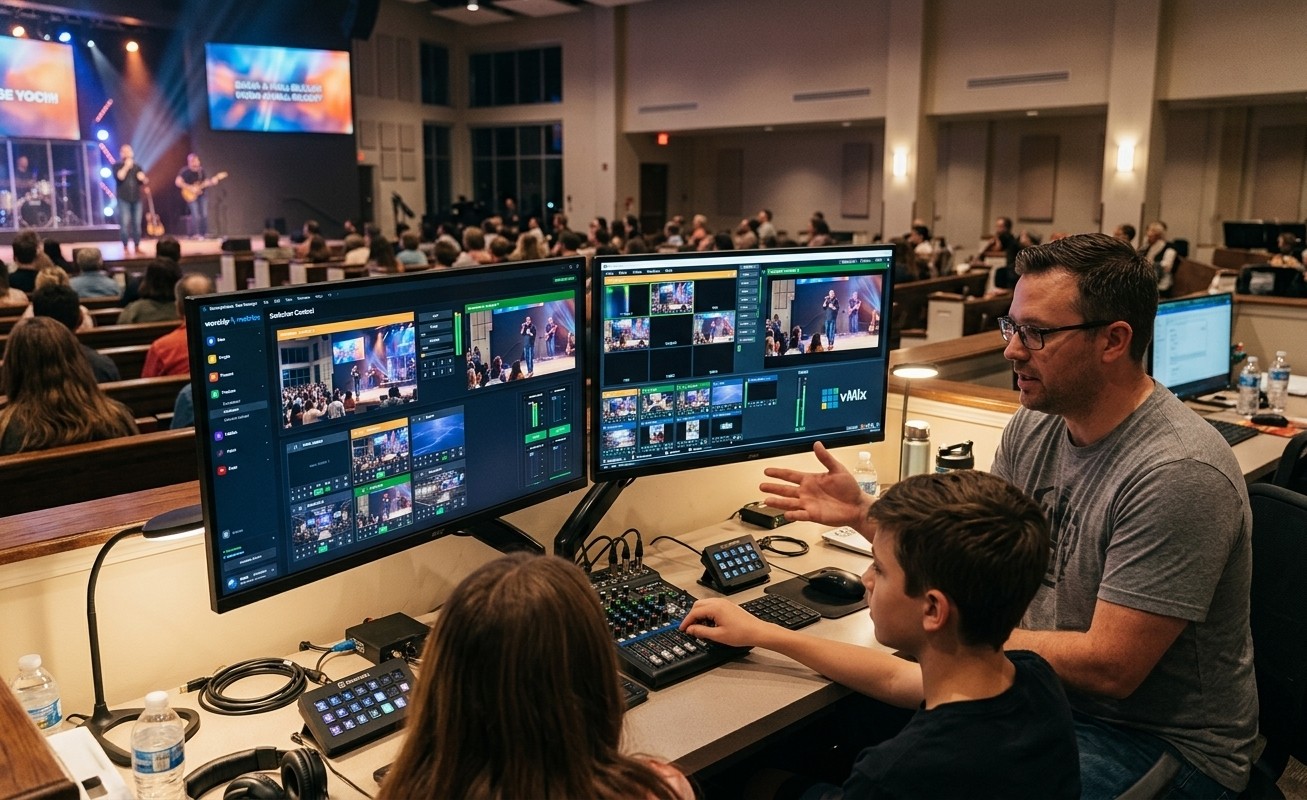
The kid in the third row who isn’t singing
Every church knows this kid. They’re in the third row at youth group, phone in hand, editing something. They will never join the worship team — not because they lack devotion, but because their gifts point somewhere the stage doesn’t reach. They can hear when a mix is muddy. They notice when the lyrics are late. They’ve run a stream for forty strangers on a Tuesday night and thought nothing of it.
Most churches have no door for this kid. There’s a stage, a nursery, a greeting rotation — and a tech booth with one overworked adult in it, radiating do not touch. So the kid stays in the third row, quietly holding a gift the church never asked to see.
This post is the case for building the door — and it’s the reason the rest of this series exists. The staffing benefits are real. The succession planning is real. But the actual treasure is this: the tech booth is one of the few places in a church where a young person who will never stand on stage can serve the whole congregation, visibly, every single week. That’s not a staffing hack. That’s a youth ministry.
What the booth teaches that a classroom can’t
Watch a student who’s owned a real seat for six months and you can list the formation happening in them:
Responsibility with witnesses. When the camera seat is yours, the whole room sees your work — and Sunday comes whether you’re ready or not. That’s a weight most teenagers are never trusted with, and they grow to fit it. The trick is sizing it honestly: one seat, one clear job, matched to age and maturity.
Excellence as devotion. A student who frames a shot carefully because worship deserves care is learning something about offering God their craft that no lesson plan delivers. The booth makes it concrete: this is what “whatever you do, do it heartily” looks like with a T-bar in your hand.
Failure without shame. Booths built on the modern pattern debrief from a timeline, not a memory — the health report shows what happened and when, the Self Healing log shows what stopped and who restarted it, and Monday’s conversation is curiosity instead of blame. A community that handles mistakes that way is teaching grace with production tools.
Mentorship in both directions. The adult who coaches from the next chair — or from a phone, watching preview and program live — is discipling, whether they’d use the word or not. And the 17-year-old training a 14-year-old on the tablet seat is learning to lead by the only method that has ever worked: being trusted to.
Belonging through usefulness. Teenagers can smell manufactured belonging instantly. The booth offers the real kind: the room needed you, and you were there. Recognition seals it — the students thanked from stage, named after the big Sunday. That’s when a task becomes an identity: I serve here.
Why this is suddenly practical
None of this is a new idea; churches have wished for it for decades. What’s new is that the supervision economics finally work. A generation ago, every student in the booth meant an adult glued beside them and a Sunday that could be sunk by one wrong click. Now a stopped stream or recording is flagged instantly with a one-tap restart, a mentor sees the whole surface from anywhere, access is scoped, actions are logged, and mistakes surface in preview — where they cost nothing. The church that already owns a vMix system owns the clubhouse; the ecosystem around it is what makes handing students the keys responsible instead of reckless.
That’s why the seats multiply so gracefully: the tablet for the twelve-year-old, the clips queue for the creative who can’t make Sunday mornings, the camera for the steady hands, the documentation for the detail-lover, and eventually — earned, mentored, celebrated — the switcher itself. A ladder like that doesn’t just staff your booth for the next decade. It hands a specific kind of kid a place in the body they’d otherwise never find.
The quiet succession story
One more thing the booth-as-ministry produces, almost as a byproduct: your next tech director. Not hired in a panic when the current one moves away, but grown — a student who started on the tablet at twelve, ran camera at fourteen, learned the T-bar at sixteen, and trained their successor before leaving for college. Churches that build the ladder stop having a single point of failure and start having a lineage.
So build the door. Name the club, define the seats, find the two adults who’ll mentor, and go find the kid in the third row. The gear you already own is waiting to become what it was always capable of being: not one person’s burden, but a place where young people find out they were needed all along.
Designing the space? See make room for one more: a church booth that welcomes new volunteers.
Related questions
- Is putting teenagers in the tech booth really 'ministry,' or just free labor?
- The difference is design. Free labor is a vague task with no ladder and no recognition. Ministry is a real seat the room depends on, a mentor who watches and coaches, a visible path to grow, and public recognition — the same ingredients as any discipleship environment, applied to a booth.
- What about the students who aren't 'tech kids'?
- The seats have different shapes on purpose. The detail-lover fits documentation, the social kid fits the check-in tablet, the creative fits clips, the steady one fits cameras. 'Tech kid' is a stereotype; a good ladder has a first rung for almost any student.
- How does a church start without overloading the tech director?
- Start with two or three students, one seat each, and let the system carry the supervision — Self Healing's one-tap restarts for routine failures, the cloud panel so a mentor sees everything, logged actions, and health reports for the debrief. The AV Club structure is designed to generate margin, not consume it.
The Students Who Stay: Why Serving Teens Don't Drift After Graduation
NextYour Teen's Gaming and Video Skills Belong at Church
Related Articles

Making a Complicated Church AV System Easy to Run, Without Hiring an AV Company
Many church AV systems aren't too old or too small. They're too complicated for a volunteer. A simple button panel built with Bitfocus Companion can hide that complexity behind plain-word buttons, and a church can often build it themselves. Here's when that works, when to call a professional, and how to start.

Your Church Livestream Team, Connected Even When They're Not at Church
A three-person livestream team only works if everyone shares the same plan, the same wiring diagram, and the same news when something breaks. Here's how WorshipMetrics connects the director, slides, and camera volunteers through the week: chat, alerts, documentation, AI help, scheduling, and cloud control for OBS and vMix.

The Three-Person Church Livestream Team: Director, Slides, and Cameras
A church livestream runs best with three clear jobs: a director on OBS or vMix, a slides operator, and a camera operator. Here's what each role does before, during, and after the service, what skills it takes, and how the three talk to each other.