The drift, measured
Every pastor knows the shape of the loss; the research puts numbers on it. Lifeway Research found that 66% of American young adults who attended a Protestant church regularly in high school stopped attending for at least a year between 18 and 22. The detail that should reorganize our strategy meetings, though, is the why: about seven in ten of those who left said it wasn’t an intentional decision. They didn’t storm out over doctrine. They moved, schedules shifted, the routine broke — and nothing pulled them back.
Read that carefully, because it reframes the problem. If most departures are drift rather than defection, then the decisive question isn’t “how do we make church more convincing?” It’s “what does a student have that survives a broken routine?”
Attendance is a habit. A role is an identity.
Here’s the distinction underneath the statistic. Attendance is a habit — powerful while intact, fragile in transition. Move to a new city, take a Sunday shift, hit one strange semester, and a habit simply fails to reassemble. Nobody decides anything; 71% of the dropouts told Lifeway exactly this story.
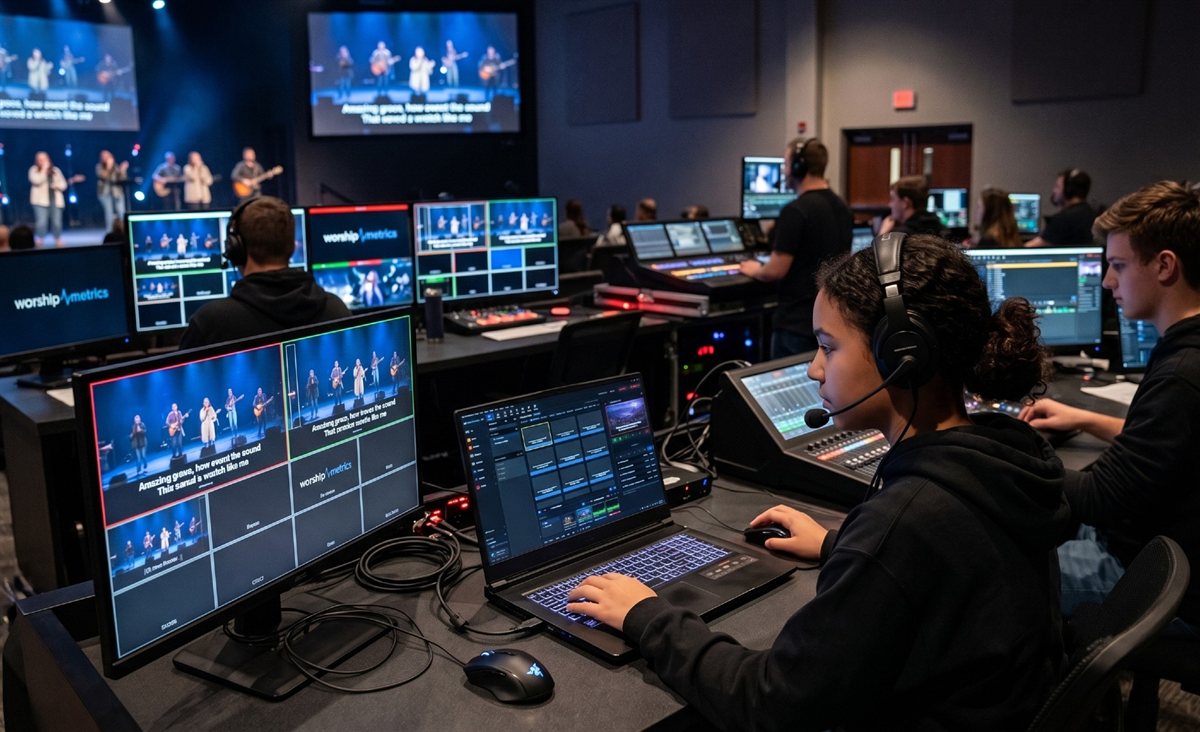
A role is different. The student who spent four years as the camera operator — who was trained, trusted, thanked by name, and missed when absent — didn’t just attend a church. They were part of one, in the load-bearing sense. That’s an identity, and identities travel: the freshman who ran her home church’s stream walks into a new church knowing she has something to offer, and knowing churches need it. The connective question shifts from “will I find a service I like?” to “where’s the booth?”
This is why the retention conversation keeps circling back to belonging and contribution — young adults long for community, and community forms fastest around shared work. We didn’t invent that insight; we’ve just watched it play out in tech booths, where it’s unusually easy to give a teenager work that matters.
What the students-who-stay pattern looks like
Churches where students hold real roles share a recognizable architecture — and none of it is a retention program:
- The role is genuine. The test: if the student didn’t show, everyone would notice. Booth seats pass automatically; token roles don’t fool anyone, least of all the student.
- The responsibility is sized and supported. One seat, one job, a mentor beside them — with modern systems carrying the risk so a student genuinely can’t sink Sunday.
- There’s a ladder. Tablet to lyrics to camera to the switcher, volunteer to trainer. A role with a future keeps a student leaning forward through the exact years the drift usually claims.
- Seniors train freshmen. The AV Club structure turns the departing student’s last year into a teaching year — which does something remarkable to their attachment, and hands the next class a mentor their own age.
- The send-off includes a commissioning. The graduate who’s told “find the booth at your next church — they need you” leaves with a mission instead of just a goodbye.
The two-ministry alignment this requires
Here’s the leadership insight hiding in all of this: retention isn’t solely the youth pastor’s problem, and the solution isn’t solely in the youth budget. The richest supply of real student roles in your church sits in the AV booth — usually understaffed, usually run by one adult approaching burnout. Aligning those two ministries — the pipeline in one direction, the discipleship in the other — solves both problems with one structure.
The drift statistic isn’t destiny. It’s a description of what happens to students who were only ever the audience. Give them the booth, and you give them the thing that 66% never had when the routine broke: a reason someone would text them, “we need you Sunday.” For the board conversation, the printable AV Club proposal puts this whole pattern — outcomes, requirements, and a one-semester pilot ask — on a single page.
Sources: Lifeway Research, “Most Teenagers Drop Out of Church as Young Adults” (2019).
Related questions
- How many young people actually leave church after high school?
- Lifeway Research (2019) found 66% of American young adults who attended a Protestant church regularly in high school dropped out for at least a year between ages 18 and 22 — and about 70% of those said the departure wasn't an intentional decision. The habit broke; nothing held.
- Why does serving change retention?
- Because attendance is a habit and habits break under transition, while a role is an identity and identities travel. A student who was needed — whose crew noticed their absence, whose skill had a place — has reasons to reconnect that outlast the Sunday routine.
- Where do we start if we want more students serving?
- With real roles, not token ones. The tech booth is the richest supply in most churches: seven seats sized for students, each with training, a mentor, and work the congregation genuinely depends on. Start two students this month and build the ladder from there.
Related Articles

Making a Complicated Church AV System Easy to Run, Without Hiring an AV Company
Many church AV systems aren't too old or too small. They're too complicated for a volunteer. A simple button panel built with Bitfocus Companion can hide that complexity behind plain-word buttons, and a church can often build it themselves. Here's when that works, when to call a professional, and how to start.

Your Church Livestream Team, Connected Even When They're Not at Church
A three-person livestream team only works if everyone shares the same plan, the same wiring diagram, and the same news when something breaks. Here's how WorshipMetrics connects the director, slides, and camera volunteers through the week: chat, alerts, documentation, AI help, scheduling, and cloud control for OBS and vMix.

The Three-Person Church Livestream Team: Director, Slides, and Cameras
A church livestream runs best with three clear jobs: a director on OBS or vMix, a slides operator, and a camera operator. Here's what each role does before, during, and after the service, what skills it takes, and how the three talk to each other.