The direction of the arrow
Sketch the average youth ministry as a diagram and the arrows all point one way: adults plan, teach, cook, drive, produce — students receive. It’s done with love, and much of it is right. But every youth worker knows the ceiling it creates: you can attend a ministry for six years as its beneficiary and never once be needed by it.
“Ministry by teenagers” is the phrase for the reversed arrow — and there’s a growing conviction across youth ministry that the reversal is where formation actually accelerates. The problem was never the theology; it’s the logistics. Where, practically, can a fifteen-year-old hold responsibility that’s real — not manufactured for them, not decorative — with stakes an adult would genuinely feel?
Your church has been staring at the answer every Sunday. It’s the booth.
Real, not performative — the test
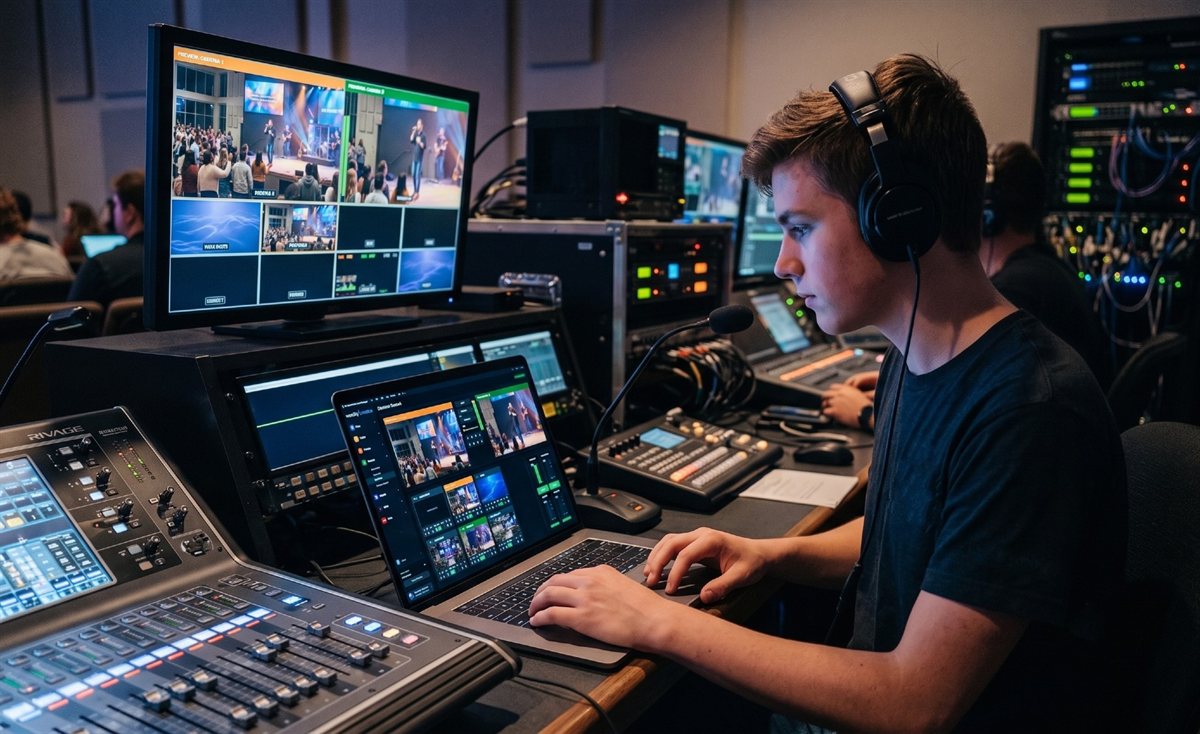
Here’s the honest test of whether a student role is ministry by them or an activity for them: if they didn’t show up, would anyone notice? Handing a student a clipboard nobody reads fails the test. A booth seat passes it every single week. No camera operator, no shot. No lyrics operator, no singing congregation. No stream operator, and the homebound member’s Sunday simply doesn’t arrive.
Students can smell the difference instantly. Manufactured responsibility produces boredom; real responsibility produces people. The seat is real, so the growth is.
What the reversed arrow produces
Watch a student six months into owning a seat and you can see the formation compound: competence (a craft, deliberately practiced, in service of worship), dependability (Sunday comes whether they’re ready or not — a weight teenagers grow to fit), mentored maturity (an adult beside them, coaching, in the most natural discipleship posture there is), and eventually leadership — the seventeen-year-old training a fourteen-year-old, the arrow now pointing outward from them. That’s the full progression laid out in the tech booth is a youth ministry, and it ends in the place every youth pastor is aiming for: a student who knows the body needs what they bring.
That knowledge, incidentally, is what survives graduation. A faith habit consumed can lapse quietly; a role held — a crew that texts “we need you Sunday” — is a different kind of anchor. More on that in the students who stay.
Why this finally became practical
The honest reason churches defaulted to ministry to teenagers in the booth: the risk math didn’t work. One wrong click could sink the service, so responsibility stayed with the one adult who couldn’t afford to share it — the burnout cycle, viewed from the youth wing.
The math changed. Modern booths flag a stopped stream or recording instantly and offer a one-tap restart, let a mentor watch a student’s actual controls live from anywhere, surface mistakes in preview where they cost nothing, and produce an after-service report that turns the debrief into a lesson. The full safety case is worth reading before the leadership meeting — because the objection it answers is the only thing still holding the arrow in its old direction.
Reverse one arrow this month
Start smaller than your ambition: one student, one seat, one mentor. Use the seat finder to match a name to a role, read the AV Club launch guide with your tech director, and put a student’s hands on something the congregation depends on.
Then watch what happens in them — because the first Sunday a teenager realizes the church needed me today is the Sunday ministry stopped being something done to them.
Related questions
- What does 'ministry by teenagers' actually look like in practice?
- Students holding real responsibility the congregation depends on — running cameras, lyrics, audio, the stream, the recording — with adult mentors beside them rather than in place of them. The test is simple: if the students didn't show up, would anyone notice? In a booth crew, everyone would.
- Isn't giving students real responsibility risky?
- Less than it used to be, by design: one seat per student sized to their maturity, routine technical failures flagged the instant they happen with a one-tap fix, mentors who can watch the student's actual controls live from anywhere, and mistakes that surface in preview before the congregation sees anything.
- How does producing the service form a student's faith?
- It moves them from audience to contributor. A student whose work carries worship to the whole church learns — bodily, weekly — that the body of Christ needs what they bring. That conviction is precisely what survives graduation when consumption-based habits don't.
Your Media Team and Youth Ministry Should Be One Pipeline
NextCan More Than One Person Run Our vMix System?
Related Articles

Making a Complicated Church AV System Easy to Run, Without Hiring an AV Company
Many church AV systems aren't too old or too small. They're too complicated for a volunteer. A simple button panel built with Bitfocus Companion can hide that complexity behind plain-word buttons, and a church can often build it themselves. Here's when that works, when to call a professional, and how to start.

Your Church Livestream Team, Connected Even When They're Not at Church
A three-person livestream team only works if everyone shares the same plan, the same wiring diagram, and the same news when something breaks. Here's how WorshipMetrics connects the director, slides, and camera volunteers through the week: chat, alerts, documentation, AI help, scheduling, and cloud control for OBS and vMix.

The Three-Person Church Livestream Team: Director, Slides, and Cameras
A church livestream runs best with three clear jobs: a director on OBS or vMix, a slides operator, and a camera operator. Here's what each role does before, during, and after the service, what skills it takes, and how the three talk to each other.