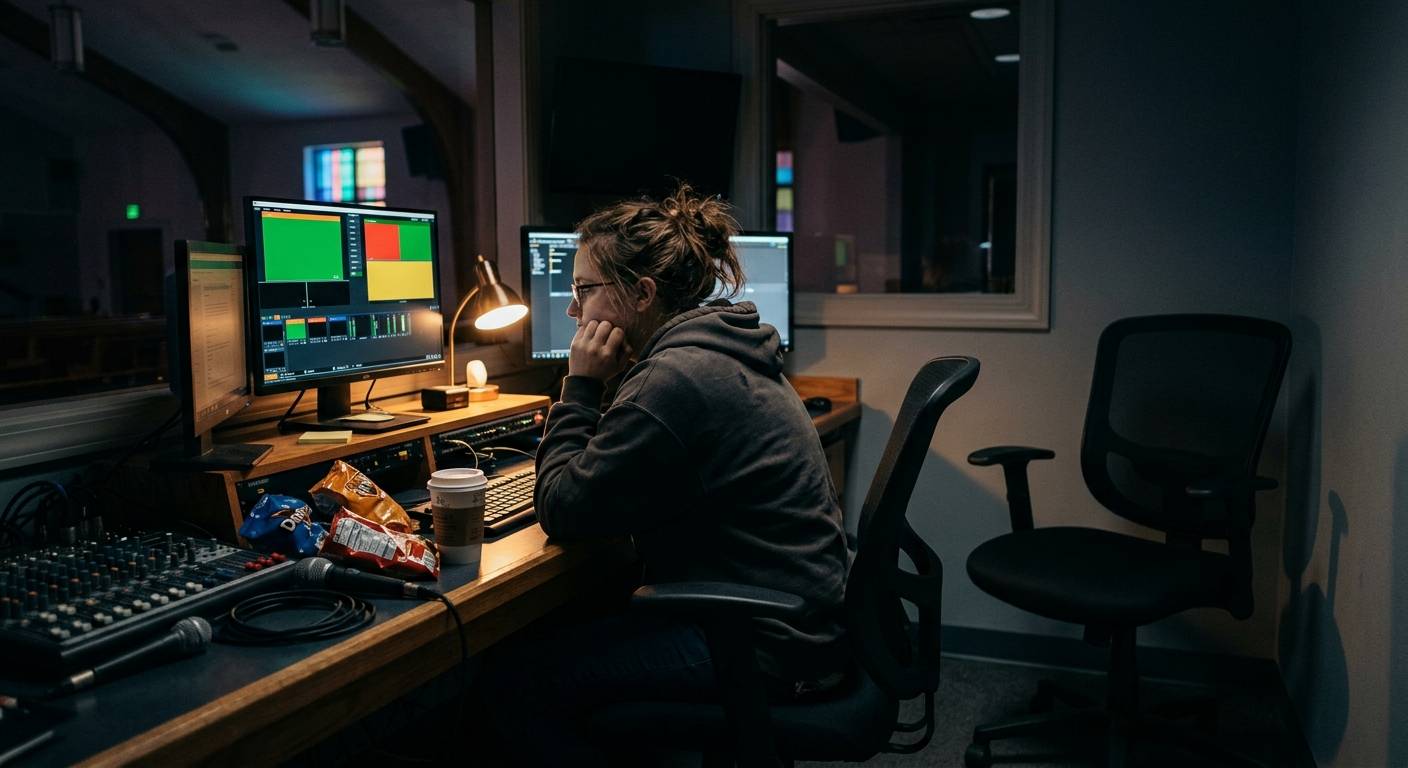
The cycle, named
There’s a specific spiral that catches church tech people, and it deserves to be named, because half its power is that it feels like a personal failing instead of a structural one:
- You do everything, because you’re the one who knows how.
- You have no margin, because you do everything.
- You can’t train anyone, because training takes margin you don’t have.
- Nobody else becomes qualified, because nobody gets trained.
- So you keep doing everything — now with a year more fatigue and a year more evidence that it all depends on you.
Add the ratchet effect — every Sunday you survive raises the streak you’re afraid to break — and you get the quiet arithmetic so many tech directors are doing in the parking lot: how long can I keep this up? If that’s you, the first thing to hear is that the cycle isn’t a character flaw. It’s a system with a missing piece, and systems can be fixed.
Why “try harder” and “find help” both fail
The two standard fixes fail for the same reason: they attack steps 1 and 4 while ignoring steps 2 and 3. Try harder spends margin you don’t have. Find help runs into the qualification myth — every candidate looks unqualified for a job that’s actually five jobs wearing one headset — and even a willing recruit needs training hours the cycle already consumed.
The cycle breaks at step 2 or nowhere. Margin has to come back before anything else can be built — and margin, it turns out, is mostly a technology problem, which makes it the easiest part to solve.
Break point 1: stop being the safety net
Audit an exhausted operator’s Sunday and most of the load isn’t craft — it’s vigilance. Watching the bitrate. Wondering if the recording is still rolling. Glancing at the encoder during the sermon. That’s the part Tech Manager simply takes: the moment a stream or recording stops unexpectedly, it tells you and offers a one-tap restart — from the booth or your phone — while bitrate and disk space are watched continuously; every offer and answer logged, nothing silent. Meanwhile Pulse watches the whole booth server-side and pushes an alert to your phone for the things that genuinely need a human.
The practical result reads small and lives huge: you can stop watching. The vigilance tax — the thing that made Sunday exhausting even when nothing went wrong — is what the automation actually refunds. That refund is your seed capital.
Break point 2: shrink the job you’re handing off
With margin recovered, the training step stops being impossible — if you shrink the unit. Nobody trains a successor for “the booth.” You train one person for one seat: one camera, the lyrics, the clips queue, the tablet. One seat takes an hour to teach and a month to own, and your vMix system has nine of them once the ecosystem is wrapped around it.
The mechanics that make each hour count: the trainee sits at the controls while you watch the same live surface — preview, program, every input — from the next chair or your living room; mistakes surface in preview, where they cost nothing; and the health report debriefs the service for you with timestamps instead of memory. You’re no longer buying safety with your presence. That’s the trade that makes a genuine Sunday off — the thing you haven’t had in years — an ordinary event instead of a gamble.
Break point 3: install a pipeline so it never re-forms
The cycle’s last trick is reforming around your first trained volunteer — one helper becomes the new bottleneck. The permanent fix is a pipeline that produces people continuously, and it’s probably meeting in your youth room on Wednesdays. An AV Club built on one-seat-per-student, older students mentoring younger, and a visible ladder from tablet to T-bar doesn’t just staff the booth — it keeps staffing it, class after class, with the scheduling matrix handling the invites, reminders, and declines that used to be your Thursday night.
And for the Sundays when you’re genuinely down a person and the depth chart runs out, the Sunday Assurance add-on keeps a production pro on call who can see your system the moment you dial — a floor under the whole structure, so no single absence is ever a crisis again.
A year from now
Directors who work this sequence describe the same arc: month one, the vigilance lifts and Sundays get strangely quieter. Month three, the first volunteer owns a seat outright. Month six, a student trains another student without being asked. Month twelve, the director takes two consecutive Sundays off, watches the stream from a lake house, and feels something they’d forgotten: interest in the work, instead of dread of it.
The cycle was never about your dedication — you’ve proven that many times over. It was about a missing system. Build the system, and the dedication finally gets to do what it was for.
Related questions
- Why do church tech volunteers burn out more than other ministry roles?
- Because the role concentrates in one person what other ministries spread across teams: weekly deadlines that can't slip, invisible work that's only noticed when it fails, no understudy, and no off-season. Sundays arrive whether you're rested or not, and the streak itself becomes the trap.
- What's the first practical step out of tech burnout?
- Get out of the firefighting business before the training business: let automation catch the routine failures (a dropped stream or stopped recording gets a one-tap restart offer; a filling disk gets an alert) and let server-side monitoring watch the booth so you don't have to hover. Margin comes first; everything else is built with it.
- Isn't training volunteers just more work on top of everything?
- Training the old way, yes — which is why it never happens. Training one person for one seat, with a mentor panel you can watch from home and health reports that debrief the service for you, costs a fraction of what doing the job yourself costs every single week.
A Worship Leader's Thursday: One Planning Hour, Start to Finish
NextIntergenerational Ministry Happens in the Tech Booth
Related Articles

Making a Complicated Church AV System Easy to Run, Without Hiring an AV Company
Many church AV systems aren't too old or too small. They're too complicated for a volunteer. A simple button panel built with Bitfocus Companion can hide that complexity behind plain-word buttons, and a church can often build it themselves. Here's when that works, when to call a professional, and how to start.

Your Church Livestream Team, Connected Even When They're Not at Church
A three-person livestream team only works if everyone shares the same plan, the same wiring diagram, and the same news when something breaks. Here's how WorshipMetrics connects the director, slides, and camera volunteers through the week: chat, alerts, documentation, AI help, scheduling, and cloud control for OBS and vMix.

The Three-Person Church Livestream Team: Director, Slides, and Cameras
A church livestream runs best with three clear jobs: a director on OBS or vMix, a slides operator, and a camera operator. Here's what each role does before, during, and after the service, what skills it takes, and how the three talk to each other.