The mixer-event problem
Every church leadership team eventually names the gap: the generations occupy the same building and barely know each other. So we engineer contact — pancake breakfasts, adopt-a-grandparent programs, service projects with deliberately mixed teams. Good instincts, real effort. And mostly, polite results: structured proximity produces conversation, but rarely relationship, because everyone knows the contact was the point. Connection that’s scheduled feels like what it is.
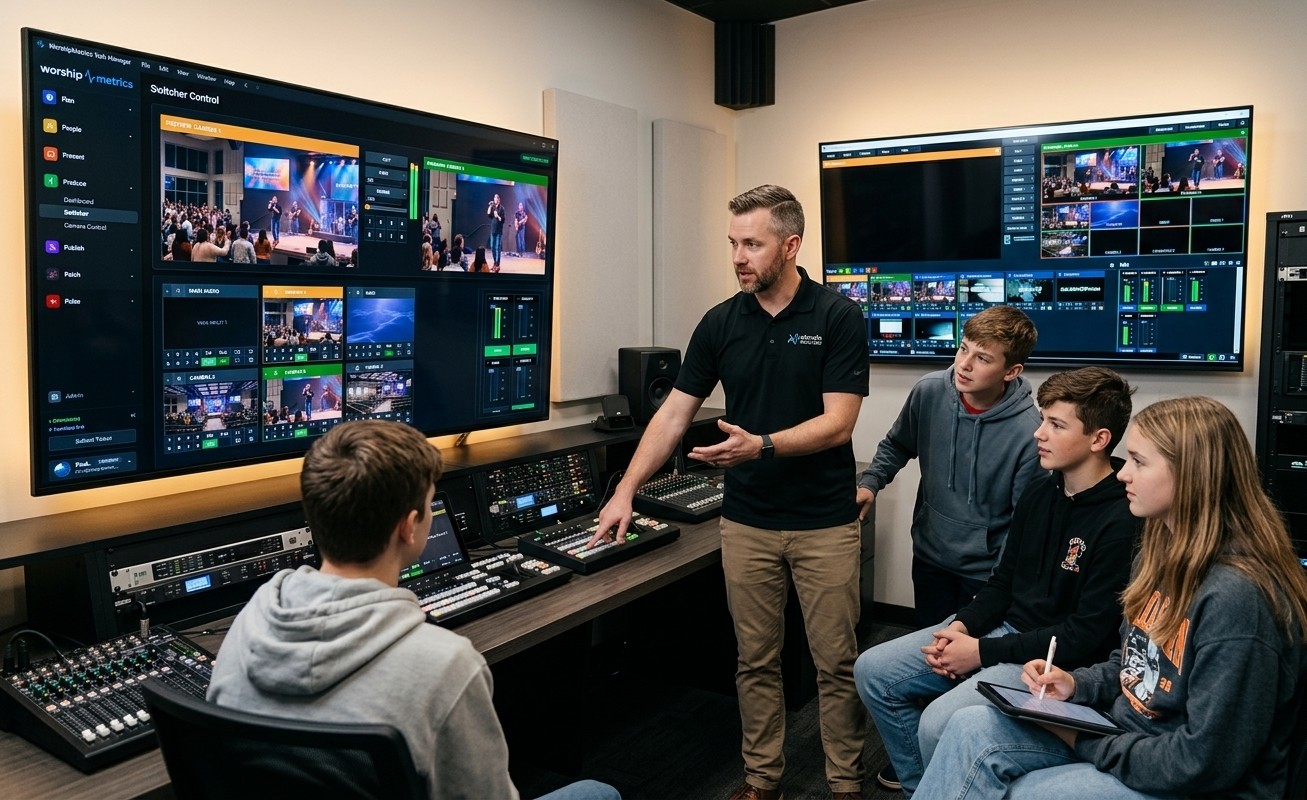
Meanwhile, at the back of the sanctuary, a 55-year-old sound veteran and a 15-year-old on her second month of camera work are on the same headset channel, solving the same feedback problem, sharing the same quiet fist-bump when the service lands clean. Nobody engineered a relationship. They just share work — and shared work is how humans have always actually bonded across age.
Why the booth does what programs can’t
The booth has four structural advantages no mixer event can replicate:
The generations arrive as genuine collaborators. Not performer and audience, not server and served — crew. The student isn’t there to be ministered to and the veteran isn’t there to be honored; they’re both there because Sunday needs them. Equal stakes flatten the age hierarchy the way nothing else does.
Each generation holds real currency the other wants. The veteran carries twenty years of judgment — why that mic placement, what happens to the room at Christmas, how to stay calm at 10:58. The student carries native fluency the veteran openly admires — and frequently, skills built through years of gaming and video that transfer straight to the booth. The exchange runs both directions, which is exactly what makes it a relationship instead of a program.
The time together is recurring and unforced. Not one event but every week, with a shared task absorbing the social pressure. The relationship accretes the way real ones do — sideways, over months, while ostensibly doing something else.
There’s a built-in account of growth. The veteran who watches a nervous kid become the operator who trains the next kid gets the mentor’s reward in full: visible fruit. Ask the veterans — many will tell you training a student is the thing that made the booth feel like ministry again, their knowledge finally multiplying instead of bottlenecking.
The tools quietly widened the doorway
A practical note for the skeptical: this pairing used to be hard to sustain, because supervision demanded physical presence — the veteran chained to the booth precisely when the student most needed room to try. Modern systems changed the geometry. A mentor can now watch a student’s actual live controls — preview, program, every input — from anywhere, while automation flags a stopped stream or recording the instant it happens — with a one-tap restart either of them can answer, so neither has to be a hero about it. The relationship keeps its closeness; the supervision loses its leash. Veterans mentor from vacation. Students stretch without being hovered over. The safety case holds either way.
Making it church strategy instead of happy accident
If your leadership team has “intergenerational connection” anywhere on its priorities, the move is almost embarrassingly simple: treat the booth as the program. Pair every veteran with a student — one pair, one seat, to start. Let the AV Club structure make older-training-younger the default culture rather than a favor. Name it from the stage occasionally, because the congregation should see what it’s looking at: a 55-year-old and a 15-year-old, serving as peers.
The pancake breakfast is lovely. But the relationship your church is trying to engineer already exists in embryonic form thirty feet behind the last pew — every Sunday, wearing headsets, waiting to be noticed and multiplied.
Make room for both generations. See designing a church booth that welcomes new volunteers.
Related questions
- Why is the tech booth good for intergenerational connection?
- Because it produces the rarest ingredient: generations working as genuine collaborators, not as program and audience. Shared work — same headset channel, same problems, same win when Sunday goes well — builds the kind of cross-age relationships that planned mixer events can't manufacture.
- What does the older generation get out of it?
- Renewal, mostly. Veteran operators consistently describe training a student as the thing that made the booth feel like ministry again — their decades of knowledge suddenly multiplying instead of bottlenecking, and a front-row seat to a young person's growth.
- How do we start intergenerational pairs in the booth?
- One pair at a time: one veteran, one student, one seat. The mentor teaches beside them at first, then supervises from the live panel as independence grows. The AV Club structure formalizes it — older training younger as the club's default culture.
The Church Tech Burnout Cycle — and the System That Breaks It
NextYour Media Team and Youth Ministry Should Be One Pipeline
Related Articles

Making a Complicated Church AV System Easy to Run, Without Hiring an AV Company
Many church AV systems aren't too old or too small. They're too complicated for a volunteer. A simple button panel built with Bitfocus Companion can hide that complexity behind plain-word buttons, and a church can often build it themselves. Here's when that works, when to call a professional, and how to start.

Your Church Livestream Team, Connected Even When They're Not at Church
A three-person livestream team only works if everyone shares the same plan, the same wiring diagram, and the same news when something breaks. Here's how WorshipMetrics connects the director, slides, and camera volunteers through the week: chat, alerts, documentation, AI help, scheduling, and cloud control for OBS and vMix.

The Three-Person Church Livestream Team: Director, Slides, and Cameras
A church livestream runs best with three clear jobs: a director on OBS or vMix, a slides operator, and a camera operator. Here's what each role does before, during, and after the service, what skills it takes, and how the three talk to each other.