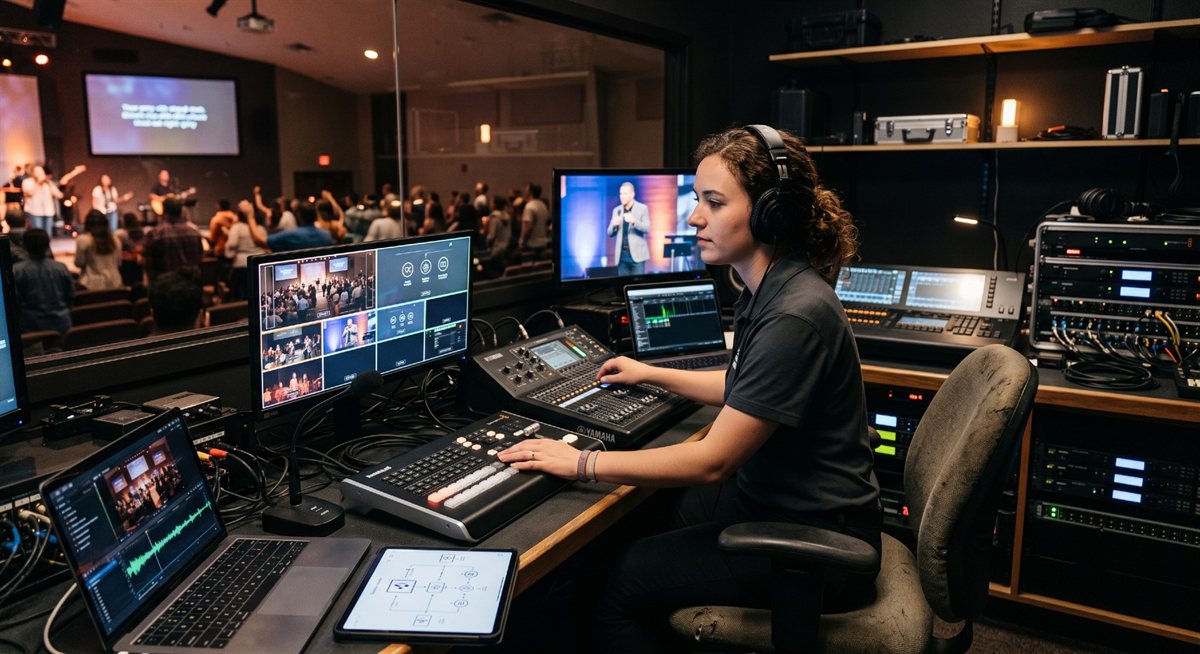
Two ministries, praying for each other’s answer
Walk your church’s hallways on a Wednesday and you’ll find two leaders carrying mirror-image burdens, usually without ever comparing notes.
In one room: the media/AV lead, running on fumes, praying for people — anyone teachable, anyone faithful, anyone who might take a seat before the next resignation letter writes itself.
In the other: the youth pastor, rich in people and praying for substance — some form of real responsibility to disciple with, something beyond another game night, something that makes students needed instead of entertained, something that might keep them connected past graduation.
Each leader’s surplus is the other’s shortage. The media team has real jobs and no people; the youth ministry has people and no real jobs. Kept separate, both problems are chronic. Connected, they annihilate each other. That connection has a name — a pipeline — and building it is less work than either leader is currently spending on their half of the problem.
The pipeline, drawn plainly
From the youth ministry flows: named students, matched to seats by gifting (the seat finder makes this a two-minute conversation); parental trust, because the invitation comes through a ministry families already know; and the discipleship framing — this is serving, not free labor, and the youth pastor keeps saying so.
From the media team flows: the seats themselves — seven real roles the congregation depends on; the training, made cheap by modern structure (one seat at a time, draft-run rehearsals, mentors on the live panel); and the ladder — tablet to lyrics to camera to switcher, volunteer to trainer.
Underneath both, the shared machinery that keeps the pipeline from consuming either leader: instant stop alerts with a one-tap restart that help make student Sundays safe by design, month-ahead scheduling with blockouts students manage themselves, and mentor visibility from anywhere. The AV Club is the pipeline’s visible form — the name, the monthly rhythm, the pizza, the culture of older students training younger ones that eventually makes the whole thing self-sustaining.
What each leader gets back
The media lead gets the thing no recruiting announcement ever delivered: a continuous supply of teachable people — plus the unexpected gift veterans keep reporting, that mentoring a student made the booth feel like ministry again. The burnout cycle breaks and stays broken, because the pipeline replaces every graduate.
The youth pastor gets discipleship infrastructure they didn’t have to build: real responsibility, adult mentors outside the youth staff, visible growth, public recognition — ministry by teenagers with the risk already engineered out. And a retention story: students with roles have something habit-proof when the routine breaks at 18.
The church gets the compounding returns: a booth that survives any single departure, one of the only genuinely intergenerational rooms in the building, and — quietly, over years — its next generation of tech directors, grown instead of hunted.
The one-meeting start
Pipelines fail when they’re launched as programs and thrive when they’re launched as agreements. So: one meeting, two leaders, two lists. The media lead brings the three most understaffed seats, described in one sentence each. The youth pastor brings the students whose gifts already point at screens, sound, cameras, or detail — the gamer, the editor, the playlist kid. Match one pair. Pick a start Sunday. Put the mentor beside them.
Then let the first success do the recruiting — because it will. A student wearing a headset tells their friends; a relieved media lead tells the elders; a parent tells another parent. That’s the pipeline priming itself.
Two ministries have been praying at each other across a hallway. Introduce them — and when it’s time to bring leadership in, the printable AV Club proposal carries the whole case into the elder meeting on one page.
Next: see how students can find and share your sermon’s best moments, from church or from home, on the Youth Clip Team page.
Related questions
- What does a media-team-plus-youth-ministry pipeline actually look like?
- A standing agreement between two leaders: the youth ministry supplies named students matched to booth seats, the media team supplies training, mentors, and a ladder — with shared structure underneath (one seat per student, scheduled rotations, mentor visibility, monthly AV Club rhythm) so neither leader carries it alone.
- Who should own the pipeline — the tech director or the youth pastor?
- Both, with different halves: the youth pastor owns recruiting, pastoral care, and the discipleship framing; the tech director owns seats, training, and Sunday standards. The monthly AV Club gathering is where the two halves meet. Pipelines die when either leader tries to own the whole thing.
- What's the first step to merging the two efforts?
- One meeting between the two leaders with two lists: the media team's three most understaffed seats, and the youth ministry's students whose gifts point at screens, sound, or detail. Match one pair, set a start Sunday, and let the first success recruit the rest.
Intergenerational Ministry Happens in the Tech Booth
NextMinistry BY Teenagers, Not Just TO Them
Related Articles

Making a Complicated Church AV System Easy to Run, Without Hiring an AV Company
Many church AV systems aren't too old or too small. They're too complicated for a volunteer. A simple button panel built with Bitfocus Companion can hide that complexity behind plain-word buttons, and a church can often build it themselves. Here's when that works, when to call a professional, and how to start.

Your Church Livestream Team, Connected Even When They're Not at Church
A three-person livestream team only works if everyone shares the same plan, the same wiring diagram, and the same news when something breaks. Here's how WorshipMetrics connects the director, slides, and camera volunteers through the week: chat, alerts, documentation, AI help, scheduling, and cloud control for OBS and vMix.

The Three-Person Church Livestream Team: Director, Slides, and Cameras
A church livestream runs best with three clear jobs: a director on OBS or vMix, a slides operator, and a camera operator. Here's what each role does before, during, and after the service, what skills it takes, and how the three talk to each other.