The game-night ceiling
Every youth leader eventually hits it. The games are good, the pizza budget is real, attendance on fun nights is fine — and yet something’s thin. The students who come, come for the event; when the event’s over, so is the reason. Planning gets harder every semester because fun is an arms race: you’re competing with the entire entertainment industry on its home field, with a folding-table budget.
Here’s the reframe that changes the game (so to speak): games gather; jobs keep. Games are a superb front door — welcome, laughter, low stakes for the nervous first-timer. But formation and retention run on a different fuel entirely: being needed. And “needed” is not something you can manufacture with a bigger inflatable. It has to be true.
What a real job does that an activity can’t
Compare the questions each one leaves a student with. An activity asks: was it fun? — a question with a shelf life, always one better option away from a no. A job answers: was I needed? — and that answer compounds week over week into three things activities never produce:
- Skill. A student who runs a camera for a season has a craft. Nobody leaves game night with a craft.
- Identity. “I’m on the tech crew” is a sentence a student says about themselves. “I attend youth group” is a sentence about their schedule.
- A crew. The strongest belonging in adolescence comes from shared work — the team that set up together, solved the problem together, and got thanked together. A booth crew is that, weekly, with headsets.
None of this is anti-fun. It’s the discovery that the deepest fun students have at church is usually disguised as responsibility.
Your church already owns the jobs
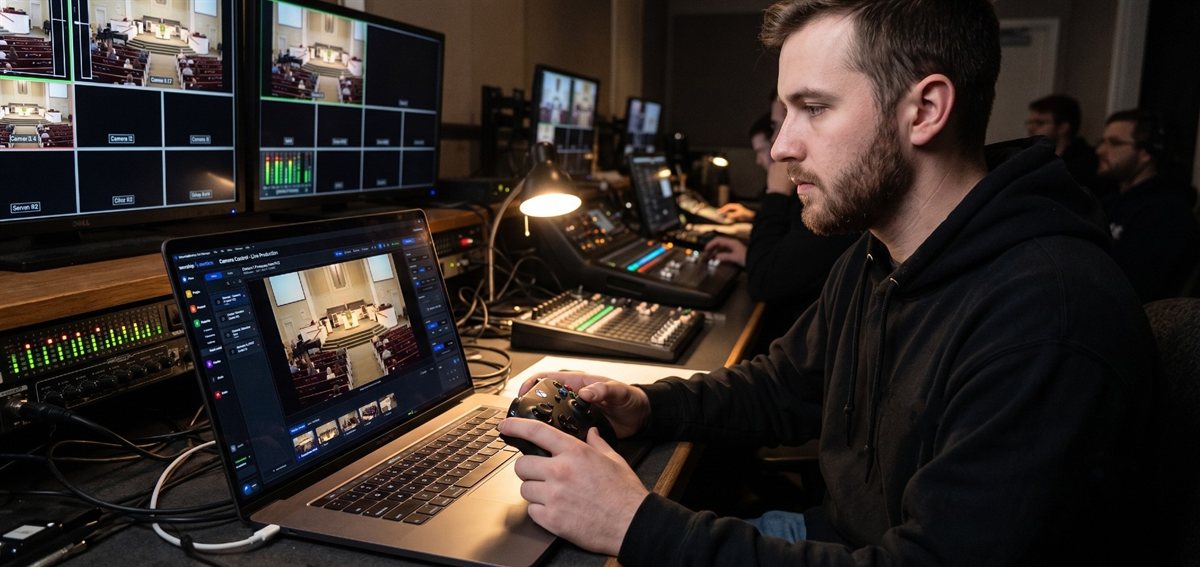
The beautiful part: you don’t need to invent a program. The jobs exist, every Sunday, in the booth at the back — seven seats from camera to lyrics to audio to the stream, plus the sermon-clips seat for the editor kid and the check-in tablet for the greeter kid. Each one is genuinely needed (the test: if the student didn’t show, everyone would notice), sized for a beginner, and connected to a ladder worth climbing.
Matching students to seats takes two minutes with the seat finder, and the safety question — the one your senior pastor will ask — has a thorough, honest answer: routine failures are flagged instantly with a one-tap fix, mentors watch the student’s actual controls live, and mistakes surface in preview where no one but the mentor sees them.
The structure: keep game night, add the club
Practically, this isn’t a replacement — it’s an addition with a name. Game night stays as the front door. Alongside it, an AV Club: two or three students to start, one seat each, an adult mentor, a monthly rhythm (yes, with pizza — the club gets pizza too), and serving rotations scheduled a month ahead so families can plan and reminders send themselves.
The flywheel starts fast: the first students recruit their friends (“come see what I do”), older students begin training younger ones, and the youth ministry quietly becomes the volunteer pipeline your tech director has been praying for — two ministries solving each other’s biggest problem.
The Sunday-night test
Here’s how you’ll know it’s working. On an ordinary Sunday night, a student who used to leave the moment the event ended will text the group chat about next week — because they’re on camera two, and the crew is counting on them. That’s the moment youth group stopped being a show they attend and became a ministry they carry.
Game night gathered them. The job kept them. Run both.
Next: see how students can find and share your sermon’s best moments, from church or from home, on the Youth Clip Team page.
Related questions
- Should youth ministry stop doing games?
- No — games are great at what they're for: gathering, welcome, laughter, the front door. The mistake is asking games to also do retention and formation, which they can't. Keep game night; add the thing that gives students a reason to be there beyond it.
- What kinds of 'real jobs' can a youth ministry offer?
- The strongest ones already exist at your church: tech booth seats — camera, lyrics, audio, stream, recording — plus sermon-clip editing and welcome-desk check-in. Real jobs the congregation depends on, sized for students, each with training and a mentor.
- How is a job more engaging than an activity?
- An activity asks 'was it fun?' A job answers 'was I needed?' Fun runs out and gets compared to better fun elsewhere; being needed compounds — into skill, identity, and a crew that notices when you're gone.
You Already Have vMix. Here's the Team It Can Carry.
NextMy Teen Wants to Run Church Tech. Should I Worry About the AI?
Related Articles

Making a Complicated Church AV System Easy to Run, Without Hiring an AV Company
Many church AV systems aren't too old or too small. They're too complicated for a volunteer. A simple button panel built with Bitfocus Companion can hide that complexity behind plain-word buttons, and a church can often build it themselves. Here's when that works, when to call a professional, and how to start.

Your Church Livestream Team, Connected Even When They're Not at Church
A three-person livestream team only works if everyone shares the same plan, the same wiring diagram, and the same news when something breaks. Here's how WorshipMetrics connects the director, slides, and camera volunteers through the week: chat, alerts, documentation, AI help, scheduling, and cloud control for OBS and vMix.

The Three-Person Church Livestream Team: Director, Slides, and Cameras
A church livestream runs best with three clear jobs: a director on OBS or vMix, a slides operator, and a camera operator. Here's what each role does before, during, and after the service, what skills it takes, and how the three talk to each other.