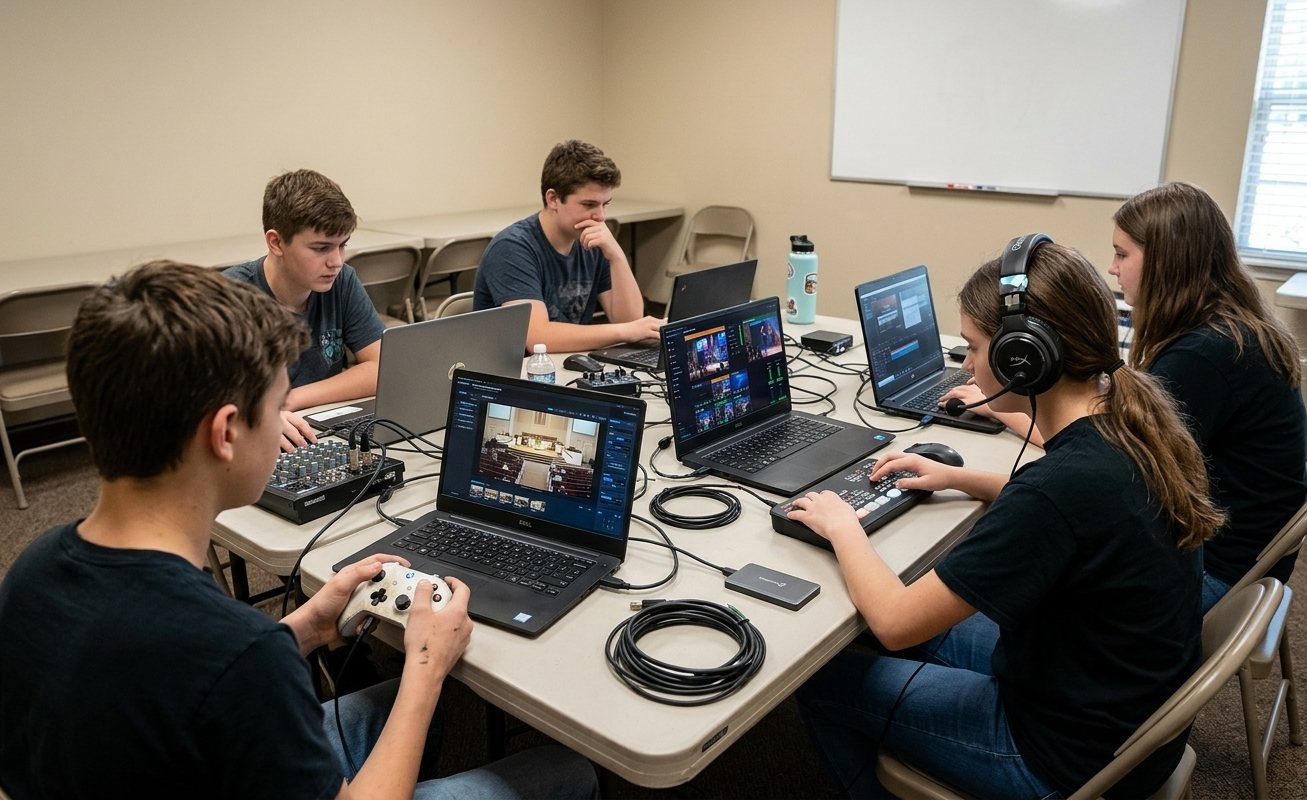
The serve list has a blind spot
Open almost any list of ways teenagers can serve at church and you’ll find the same roster: greet, usher, nursery, worship team, mission trip. All good. All — notice — extroverted, people-facing, and mostly stage-adjacent. Then look around your youth room at the students those lists quietly skip: the one editing video on their phone, the one in headphones dissecting a mix, the one who’d rather organize the supply closet than play the icebreaker.
Their gifts are real, they’re just pointed away from the spotlight — and your church already owns the place where those exact gifts become ministry. It’s the booth at the back of the room, and it holds more seats than anyone realizes.
Seven seats, seven kinds of student
Each of these is a real job, with a page describing what the seat runs and who tends to fit it:
- Camera Operator — for the student who photographs everything. Steady hands, patient eye, work the whole congregation sees without ever seeing them.
- Lyrics Operator — for the focused, dependable one. The room sings because this seat never misses a cue.
- Audio Engineer — for the headphones kid who hears what others miss. Deep craft, long ladder.
- Stream Operator — for the gamer-streamer. They already understand live; now live means carrying the service to the homebound and the not-yet-visiting.
- Lighting Operator — for the one who sets the mood of every room they enter.
- Recording / Archivist — for the detail-lover. Nothing is lost on their watch, and Monday’s sermon clips start from their work.
- Service Director — the seat students grow into: the coordinator who calls the service and carries the calm.
And two adjacent seats outside the booth proper: the clips editor who turns Sunday’s sermon into shareable moments from a couch on Monday, and the welcome-desk tablet — hospitality with a screen, often the best very first seat of all.
Not sure which student fits where? The two-minute seat finder turns “how they already spend their attention” into a starting seat.
Why these seats disciple differently
A serving role does its formational work when three things are true: the job is real (the room actually depends on it), the responsibility is sized honestly, and there’s somewhere to grow. Booth seats are unusually strong on all three. A camera seat isn’t busywork — if the shot’s not there, everyone knows. One seat with one clear job means a student is never handed more than they’re ready for. And the seats form a visible ladder — tablet to lyrics to camera to the switcher — so serving comes with a future attached.
There’s also a quieter distinctive: the booth serves everyone, every week, invisibly. For a student learning that ministry isn’t applause, there may be no better classroom — the full case is in the tech booth is a youth ministry.
The safety question, answered before it’s asked
The hesitation is always some version of what if they break Sunday? — and it deserves a real answer, not reassurance. The short version: modern church production systems carry the risk that used to sit on the student. Routine failures are flagged instantly with a one-tap fix, a mentor can watch the student’s actual controls live from anywhere, mistakes surface in preview before the congregation ever sees them, and every service produces a report that turns the debrief into teaching instead of blame. The long version, written for the leader who has to convince a board: can students safely run a church livestream?
Start with two students and a pizza
You don’t need a program to begin — you need two or three named students, one seat each, an adult mentor, and a monthly rhythm. That’s an AV Club, and the step-by-step launch guide covers recruiting, the ladder, and how the club eventually trains itself. If you’re the youth leader, take this post and the seat finder to your tech director this week; if you’re the tech director, the youth room is your volunteer pipeline — and either way, the kid in the third row is waiting for a serve list that finally includes them.
Related questions
- What serving roles exist for teens who won't sing or speak?
- The tech booth alone holds seven: camera operator, lyrics/presentation, audio, stream operator, lighting, recording/archiving, and service directing — plus adjacent seats like sermon-clip editing and the welcome-desk check-in tablet. Each is a real job the congregation depends on, done without standing on stage.
- At what age can a student start serving in tech?
- Earlier than most churches assume, when the seat is matched to the student: the check-in tablet and clips review have low floors, a 14-year-old can run one camera well, and older teens grow into audio, streaming, and eventually directing.
- How do we know which seat fits which student?
- Watch how they already spend their attention — the playlist obsessive hears like an audio engineer, the phone photographer frames like a camera operator. Or use the two-minute seat finder quiz, then confirm with a couple of trial Sundays beside a mentor.
How to Ask for Tech Volunteers So People Actually Say Yes
NextSponsor an AV Club: The Gift That Builds Your Church's Next Generation
Related Articles

Making a Complicated Church AV System Easy to Run, Without Hiring an AV Company
Many church AV systems aren't too old or too small. They're too complicated for a volunteer. A simple button panel built with Bitfocus Companion can hide that complexity behind plain-word buttons, and a church can often build it themselves. Here's when that works, when to call a professional, and how to start.

Your Church Livestream Team, Connected Even When They're Not at Church
A three-person livestream team only works if everyone shares the same plan, the same wiring diagram, and the same news when something breaks. Here's how WorshipMetrics connects the director, slides, and camera volunteers through the week: chat, alerts, documentation, AI help, scheduling, and cloud control for OBS and vMix.

The Three-Person Church Livestream Team: Director, Slides, and Cameras
A church livestream runs best with three clear jobs: a director on OBS or vMix, a slides operator, and a camera operator. Here's what each role does before, during, and after the service, what skills it takes, and how the three talk to each other.