The ad you keep almost writing
Every burnt-out streaming operator has mentally drafted the same announcement: “Volunteers needed for the tech team. No experience necessary. See Dave.” And every one of them knows how it goes: three weeks of silence, one well-meaning adult who vanishes after two Sundays, and Dave back at the switcher alone, now with less hope than before.
Here’s the reframe this whole article hangs on: you don’t have a volunteer shortage. You have a pipeline shortage. The people who could run your vMix system are already in your building — most of them are in the youth room on Wednesday night. What’s missing is the structure that turns their interest into your Sunday crew: seats sized for beginners, training that doesn’t consume the margin you don’t have, and an invitation specific enough to say yes to.
Why the usual ask fails
“Volunteers needed for tech” fails for a reason worth understanding: it asks people to volunteer for everything. From the outside, your booth looks like one giant, fragile, expert-only job — and honest people correctly conclude they’re not qualified for it. The vague ask filters out exactly the humble, teachable people you want, and the myth that nobody else is qualified gets another year of confirmation.
The fix is to stop recruiting for the booth and start recruiting for one seat. A seat is specific: run this one camera. Own the lyrics. Review the clips queue on Monday. A seat has a floor a beginner can stand on and a ladder above it. And once your booth is connected to the WorshipMetrics ecosystem, your one vMix system has nine of them — most reachable by a teenager with a mentor.
Why youth ministry is the pipeline
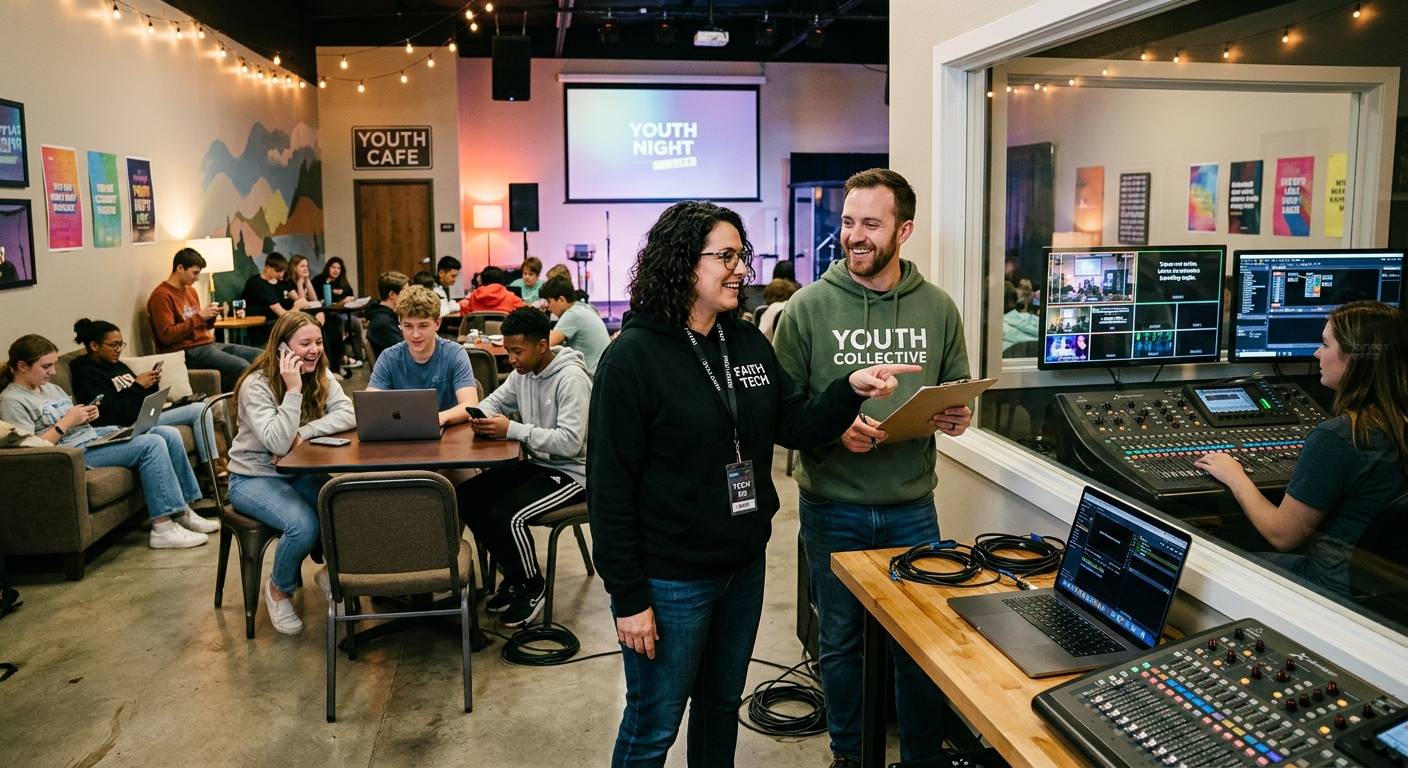
Walk through the youth room with a tech director’s eyes and the pipeline becomes obvious. The student editing videos on their phone is a clips editor who hasn’t been asked. The one who runs sound for their band’s garage rehearsals is a camera operator in waiting. The one streaming games to eleven viewers every night has more live-production hours than most of your adults.
The AV Club model is how you formalize the ask: recruit where interest already exists — youth group, homeschool families, the students who love video, audio, and gaming — give every member one seat with one clear job, match responsibility to age, and let older students train younger ones. That last part is the pipeline’s engine: a club that mentors internally recruits and trains itself, which is precisely what a burnt-out director needs — a system that grows without consuming them.
And the payoff runs deeper than staffing. The booth is one of the few places a kid who’ll never sing on stage can serve the whole congregation visibly, every week — a youth ministry in its own right, hiding inside your production problem.
The foundations that make it work: communication and training
A pipeline needs plumbing. Two systems carry the load:
Communication that doesn’t live in your phone. Recruiting collapses when scheduling is a weekly text scramble — volunteers experience chaos and quietly leave. The scheduling matrix replaces it: draft a month silently, send every invite in one batch, one-tap accept/decline with no login, declines automatically notify the team leader, and day-before reminders send themselves. Students mark exam weeks with self-serve blockouts; parents can plan. And team chat keeps the “who’s got Saturday run-through?” conversation with the team instead of in one person’s SMS thread.
Training that rides on the system, not on you. This is where the ecosystem earns its keep for the exhausted director: Self Healing flags a dropped stream or stopped recording the instant it happens and offers a one-tap restart, so a rookie’s Sunday doesn’t hinge on veteran vigilance; the cloud panel shows a mentor preview, program, and every input live from anywhere, so coaching happens from a couch; and the health report turns every service into review material with timestamps instead of blame. You’re no longer the safety net — you’re the coach, and coaching scales in a way that firefighting never did. The full safety case is in can students safely run a church livestream?
Your first three moves
- Name three seats you’d hand off tomorrow if training cost you nothing — typically the tablet, the lyrics, and one camera. Write one sentence per seat describing the job.
- Take those sentences to the youth leader, not the pulpit. Ask for names, not volunteers: “who do you have that loves video, audio, or gaming?” Invite those students by name to one specific seat.
- Let the system carry week one. Schedule them through the matrix, pair each with a mentor on the panel, and debrief from the health report. Their second Sunday will be better than your announcement strategy’s second year.
The exhaustion you’re feeling isn’t proof that nobody can help. It’s proof you’ve been the whole system — and the moment there is a system, the building turns out to be full of help that was waiting to be asked properly. If the burnout itself is the thing you need addressed first, start with the burnout cycle and how it breaks.
Share the vMix PC with more volunteers: Splitting vMix roles for church volunteers. See also a titles volunteer for vMix · who starts the stream?.
Related questions
- Where do you actually find church livestream volunteers?
- In the youth ministry, almost every time. The students who edit videos, run Discord streams, and obsess over game audio already have the interest and half the instincts — what they've been missing is a specific invitation to a specific seat with real training behind it.
- How do you train livestream volunteers when you have no spare time?
- Shrink the unit of training. Nobody trains a replacement for 'the whole booth' — you train one person for one seat with one clear job, while the system carries the rest: Self Healing flags routine failures instantly with a one-tap restart, a mentor watches the live panel from anywhere, and health reports turn each Sunday into review material.
- What if a volunteer makes a mistake during the service?
- The design absorbs it. Choices appear in preview before they hit program, a mentor watching remotely catches them with a text, a dropped stream or stopped recording triggers an instant one-tap restart offer on the booth and the mentor's phone, and the after-service report turns any rough moment into a teaching timeline instead of a crisis.
Can More Than One Person Run Our vMix System?
Next"Nobody Else Is Qualified" — the Belief That Keeps Church Tech Directors Trapped
Related Articles

Making a Complicated Church AV System Easy to Run, Without Hiring an AV Company
Many church AV systems aren't too old or too small. They're too complicated for a volunteer. A simple button panel built with Bitfocus Companion can hide that complexity behind plain-word buttons, and a church can often build it themselves. Here's when that works, when to call a professional, and how to start.

Your Church Livestream Team, Connected Even When They're Not at Church
A three-person livestream team only works if everyone shares the same plan, the same wiring diagram, and the same news when something breaks. Here's how WorshipMetrics connects the director, slides, and camera volunteers through the week: chat, alerts, documentation, AI help, scheduling, and cloud control for OBS and vMix.

The Three-Person Church Livestream Team: Director, Slides, and Cameras
A church livestream runs best with three clear jobs: a director on OBS or vMix, a slides operator, and a camera operator. Here's what each role does before, during, and after the service, what skills it takes, and how the three talk to each other.