The skills were never wasted
If you’re the parent of a teenager whose natural habitat is a screen — the gamer, the streamer, the one who edits videos you never see posted — you’ve probably run the quiet math of worry: so much time, and what’s it for? And if that same teenager seems to shrink at church, half-present, gifts invisible in a place built around singing and speaking, the worry doubles.
Here’s a reframe from the people who run church production booths: those hours have been job training. The gamer has built live reflexes and calm under pressure. The streamer understands an audience on the other side of a screen. The phone photographer has been practicing framing for years. The playlist obsessive has ears most adults never develop. These aren’t distractions from the person your teen is becoming — they’re early drafts of gifts. What’s been missing isn’t discipline. It’s a destination.
The destination is thirty feet from the back pew
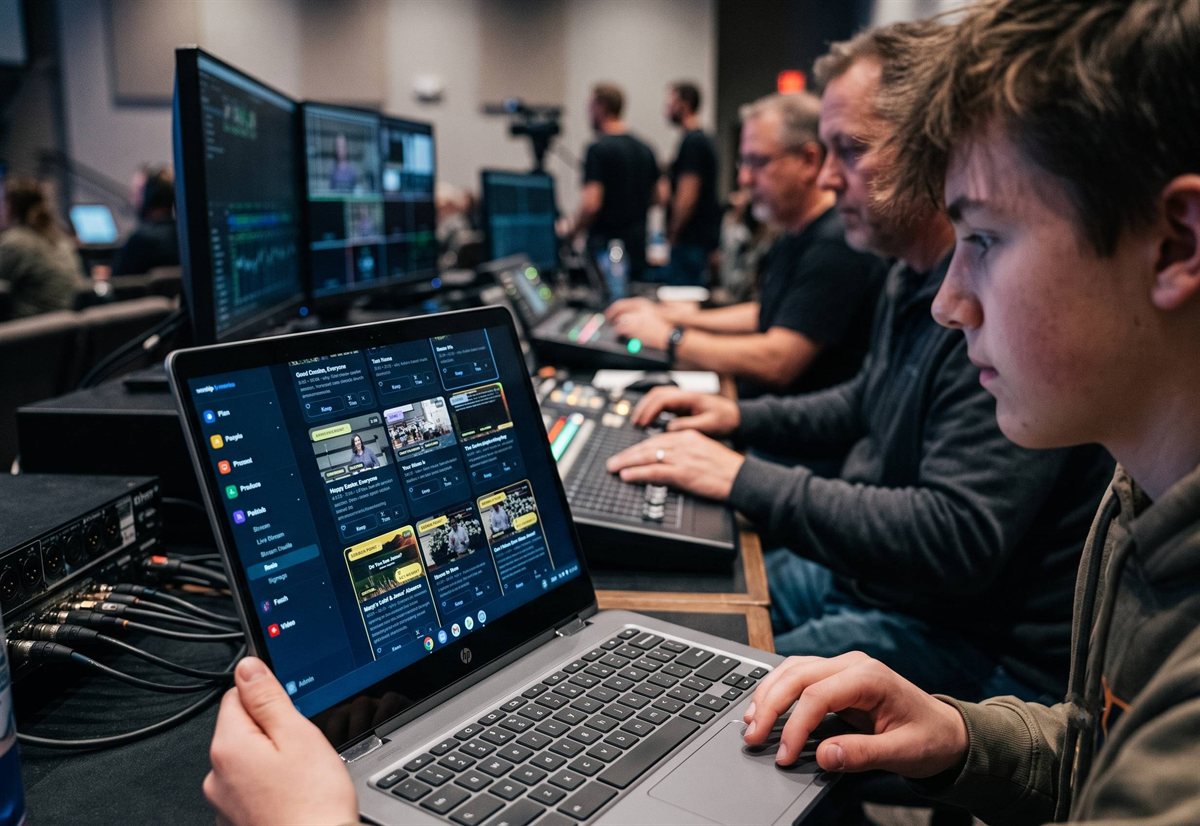
Every Sunday, your church produces a live broadcast, a soundtrack, a lyrics presentation, and a recording — real production, with real seats: camera, lyrics, audio, the stream, recording and clips. Most of those seats are understaffed in most churches, filled by one tired adult who would be overjoyed to train a teenager who already halfway knows this world.
And here’s what happens to a screen-native kid in one of those seats — the thing parents tell us they didn’t expect. The isolation flips. The same skills that kept them alone in their room put them on a crew: headsets, shared work, an adult mentor who thinks their instincts are impressive, and a whole congregation depending on them by name. Researchers who study gaming will tell you much of its pull is belonging — a community with a shared ritual. A booth crew is that, except the ritual is worship and the community can see them grow.
What it looks like when it’s done well
You’re right to ask whether this is safe and supported rather than a kid thrown at a mixing board. The healthy pattern, which you can ask any church about directly:
- One seat, one clear job — not “help with tech.” A defined role, matched to their age and wiring.
- A mentor, present or watching — beside them at first, and able to see their actual controls live even from home as they grow. Mistakes surface in preview, where nobody but the mentor sees them.
- A safety net under everything — modern systems catch the routine failures automatically, so a new volunteer genuinely can’t sink Sunday.
- Recognition — crews get thanked; students get named. Belonging gets sealed out loud.
If your church runs something like an AV Club, all of this is already structured. If it doesn’t, forwarding the starter guide to your youth pastor or tech director is genuinely how several of these clubs have begun — and the printable one-page proposal means your suggestion arrives with its homework already done.
The conversation to have this week
Skip the screen-time framing entirely — this isn’t a trade or a bribe. Try the invitation the booth would give them: “You know how you’re good at [the actual thing — streaming, video, sound]? The church actually needs that. Want to try one Sunday, sitting next to the person who runs it?”
Specific. Honoring. One Sunday. Teenagers can refuse a program, but very few can fully refuse being needed for something they’re already good at.
And a season from now, you may get the moment other parents of booth kids describe: watching the congregation sing, and realizing the reason the words are on the screen — on time, every time — is your kid, at the back, wearing a headset, exactly where they belong.
Related questions
- Is there really a place at church for a teen who mostly likes screens?
- Yes — several. The tech booth runs on exactly the instincts screen-native teens have already built: live awareness for the streamer, framing for the phone photographer, editing for the video kid, focus for the deep-diver. Most churches have open seats and don't know how to say so.
- How do I bring it up without it becoming another thing I'm pushing?
- Make it an invitation to be needed, not a screen-time negotiation: 'The church could really use someone with your skills on the stream team — want to try one Sunday next to the mentor?' Specific, low-commitment, and honoring what they're already good at.
- Will an adult actually be with them, or are they thrown in alone?
- The healthy pattern is one seat, one clear job, and a mentor beside them — literally or watching the same live controls remotely — while the system itself catches routine failures. Ask the tech director how training works; a good answer mentions mentors and starts small.
The Tech Booth Is a Youth Ministry
NextHow Do We Train New vMix Operators Without Risking Sunday?
Related Articles

Making a Complicated Church AV System Easy to Run, Without Hiring an AV Company
Many church AV systems aren't too old or too small. They're too complicated for a volunteer. A simple button panel built with Bitfocus Companion can hide that complexity behind plain-word buttons, and a church can often build it themselves. Here's when that works, when to call a professional, and how to start.

Your Church Livestream Team, Connected Even When They're Not at Church
A three-person livestream team only works if everyone shares the same plan, the same wiring diagram, and the same news when something breaks. Here's how WorshipMetrics connects the director, slides, and camera volunteers through the week: chat, alerts, documentation, AI help, scheduling, and cloud control for OBS and vMix.

The Three-Person Church Livestream Team: Director, Slides, and Cameras
A church livestream runs best with three clear jobs: a director on OBS or vMix, a slides operator, and a camera operator. Here's what each role does before, during, and after the service, what skills it takes, and how the three talk to each other.