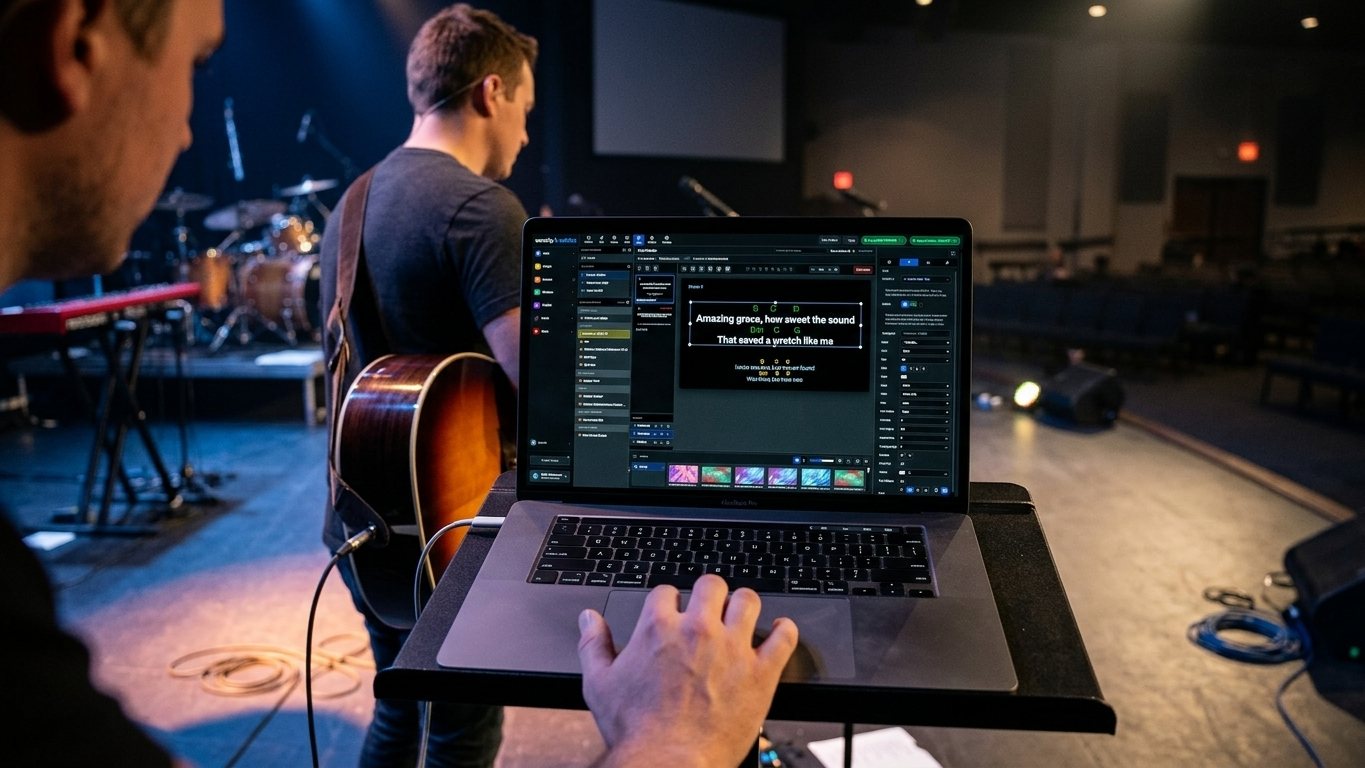
1:00 p.m. — the blank order of service
A composite hour, assembled from the Thursday routines of worship leaders who got their evenings back.
Jordan leads worship at a two-service church, and Thursday, 1:00 to 2:00, is the planning hour — all of it, for the coming Sunday and a light pass over the month. It used to sprawl across four evenings and three apps. Here’s where the hour goes now.
1:05 — songs and keys
The setlist comes together in the song library: two familiar congregation songs, the new one they’ve been teaching for three weeks, and a hymn for communion. Each song in the library carries its arrangement, default key, and — the part Jordan never thinks about until renewal season — its CCLI number, authors, and copyright line as structured fields.
Keys take thirty seconds instead of a rechart. The charts are stored as ChordPro — one chart, every key — so setting Sunday’s key to D means the vocalist sees D, the guitarist capos from C, and nobody maintains a second document. When Jordan fixed a wrong chord in the bridge last month, it fixed itself in every key at once.
(The library came over from their old presentation software in one import, CCLI metadata riding along — the one-time job that makes every Thursday after it shorter.)
1:20 — the plan, and both service times
The order of service goes onto the plan: songs, scripture, transitions, the baptism at the 11:00 only. The 9:00 and 11:00 are distinct service times on one plan, which matters twice — once now, for per-time volunteer coverage, and once on Sunday, when each service’s live run keeps its own record.
Jordan’s drummer can only make the 9:00 this week. The plan says so honestly: 9:00 covered, 11:00 an open cell that still needs a name — not a date column that lies green while the second service quietly has no drummer.
1:25 — staffing the month, silently
Twenty minutes in the scheduling matrix: vocals, band, and production positions down the left, the next four Sundays across the top. Jordan pencils in the rotation — the matrix flags one blockout (bass player, fall break) and one genuine double-booking, warns, and blocks nothing, because the software assumes the leader knows things it doesn’t.
Nothing has emailed anyone. That’s the feature Jordan would defend with their life: drafting is thinking, and thinking is private. At 1:45 the month looks right, and one Send batches every invite — each volunteer receiving their whole month at once, with one-tap accept and decline links that need no login. Declines will reopen cells and notify the team leader automatically; day-before reminders will send themselves. The scramble is structurally over.
1:50 — Sunday’s charts reach the stage
Last five minutes: confirming what the musicians see. Sunday morning, the stage display will carry each player’s chart in their key, advancing with the service — and the rehearsal runthrough on Saturday will be a draft run, so it never pollutes the service history. Only Sunday’s committed runs become the permanent record of what was actually sung.
The part nobody sees
That committed-run detail is quietly doing Jordan’s least favorite job. Every song performed in a real service accumulates as evidence; the spontaneous chorus the band flowed into two weeks ago took thirty seconds to log afterward and now lives in a ledger no plan-cleanup can erase. When the CCLI renewal email arrives next spring, the trailing-year export — date, title, authors, CCLI number, evidence level — is a download, not a reconstruction.
Jordan closes the laptop at 2:01. Setlist planned, keys set, charts live, a month staffed, and a copyright report filing itself as a byproduct of Sunday happening. The planning hour is an hour again — which was the whole point: the service planning exists so Thursday afternoons can go back to writing the things the plans are for.
Related questions
- How does one chart work for musicians in different keys?
- Store the song as a ChordPro chart once, and each musician views it in the key they need — the transposition is display-time, not a second document. The vocalist's D and the capoed guitarist's C read from the same source, so a lyric fix lands everywhere at once.
- Do volunteers see the schedule while it's still being juggled?
- No. Drafting in the scheduling matrix is silent by design — names can be penciled in, swapped, and rethought freely, with blockout and conflict warnings inline. Nothing emails anyone until one deliberate Send, and then each volunteer gets their whole month in one coherent invite.
- What happens when the band plays something that wasn't on the plan?
- Log it after the service — thirty seconds — and it becomes a durable ledger entry that survives even if the plan is later edited or deleted. Come renewal time, the CCLI export includes it alongside everything the committed runs recorded automatically.
A Tech Director's Tuesday: The Maintenance Rhythm That Saves Sundays
NextThe Church Tech Burnout Cycle — and the System That Breaks It
Related Articles

Making a Complicated Church AV System Easy to Run, Without Hiring an AV Company
Many church AV systems aren't too old or too small. They're too complicated for a volunteer. A simple button panel built with Bitfocus Companion can hide that complexity behind plain-word buttons, and a church can often build it themselves. Here's when that works, when to call a professional, and how to start.

Your Church Livestream Team, Connected Even When They're Not at Church
A three-person livestream team only works if everyone shares the same plan, the same wiring diagram, and the same news when something breaks. Here's how WorshipMetrics connects the director, slides, and camera volunteers through the week: chat, alerts, documentation, AI help, scheduling, and cloud control for OBS and vMix.

The Three-Person Church Livestream Team: Director, Slides, and Cameras
A church livestream runs best with three clear jobs: a director on OBS or vMix, a slides operator, and a camera operator. Here's what each role does before, during, and after the service, what skills it takes, and how the three talk to each other.