Why schedule a month at a time
Most volunteer scheduling pain comes from doing it one Sunday at a time. You fill this week, invites go out, someone declines, you scramble, and by the time the dust settles it is Thursday and next week is still empty. The volunteers feel it too: a Tuesday-night invite for a Sunday-morning slot reads as an emergency, not a plan.
Scheduling a month (or a quarter) at a time flips the experience for everyone. Volunteers see their whole month at once and can plan childcare, travel, and rest around it. Leaders see patterns — the drummer who is quietly carrying every single week, the position that has been vacant three Sundays running — that are invisible when you only ever look at one date.
The workflow that makes this practical has two phases: draft quietly, where you sketch assignments across the whole window without a single email going out, and send once, where every outstanding invite leaves in one batch. In WorshipMetrics, that workflow lives in the scheduling matrix.
The grid: positions down, dates across
The matrix is a grid. Down the left side are your teams and their named positions — Band with Acoustic Guitar, Bass, Drums; Vocals with its parts; Production with Camera 1, ProPresenter, FOH Audio. Across the top are your upcoming service dates. Every cell is one question: who is serving in this position on this date?
Teams and positions live under each service type, so your Sunday AM structure and your Wednesday-night structure stay separate and each matrix shows only the positions that gathering actually uses. The date window can stretch a long way — up to 400 days — though in practice most leaders work four to eight weeks ahead.
Each position also carries a needed count: how many people that role requires per service, anywhere from zero to 99. A vocal team that wants three singers shows as short-staffed until all three cells for that date are filled, not just the first one. Positions you keep in the structure but do not need this season can sit at zero without cluttering the grid with false vacancies.
If your teams are not in the system yet, the fastest starting point is a spreadsheet: the member CSV import guide walks through bringing your people list across before you build teams on top of it.
Reading the cells: four states
Every filled cell is in one of four states, and the distinction is what makes month-at-a-time scheduling safe:
| State | What it means |
|---|---|
| Draft | You have penciled this person in. They have not been notified. Nothing has left the building. |
| Invited | The invite email has gone out and you are waiting on a response. |
| Confirmed | They accepted. This cell is settled. |
| Declined | They said no. The position is effectively open again and needs a new name. |
If you have scheduled in Planning Center Services, these states will feel immediately familiar — the matrix deliberately speaks the same language, which makes it easy for leaders moving between tools (and if your plans themselves live in Planning Center, they sync into WorshipMetrics automatically, so the dates in your matrix are the plans your worship leader actually published).
Behind the scenes, each assignment moves through a simple lifecycle: unfilled, then invited, then confirmed or declined — with no-show and completed recorded after the fact. When someone declines and you invite a replacement, the chain is tracked, so you can always see how a slot ended up with the person who ultimately served.
Draft quietly, then send once
Here is the workflow itself.
Phase one: draft. Work through the grid and pencil people in. Click a cell, pick a name, move on. Every assignment you create this way is a draft — silent by design. You can fill four weeks of Band, change your mind about week three, swap two vocalists, delete a row, and start over, and no volunteer ever sees the churn. This is the single most important property of the matrix: drafting is thinking, and thinking should be private.
This matters more than it sounds. Schedulers who know every click fires an email schedule timidly — they under-fill rather than risk inviting and un-inviting someone. When drafting is silent, you can be ambitious: sketch the whole month, balance the load, and only commit when the picture looks right.
Phase two: send. When the month looks good, one Send action batch-invites everything outstanding — every draft cell across the whole window, up to 200 plans in a single send. Each volunteer gets their invites at once, so someone drafted for three Sundays receives a coherent picture of their month rather than three separate surprise emails spread over a week.
The rhythm most teams settle into: draft the coming month during a quiet hour early in the previous month, sleep on it, give it one more read, then send. Total notification events per volunteer per month: one.
Warnings that inform, never block
As you draft, the matrix surfaces three kinds of signals inline, right in the cell.
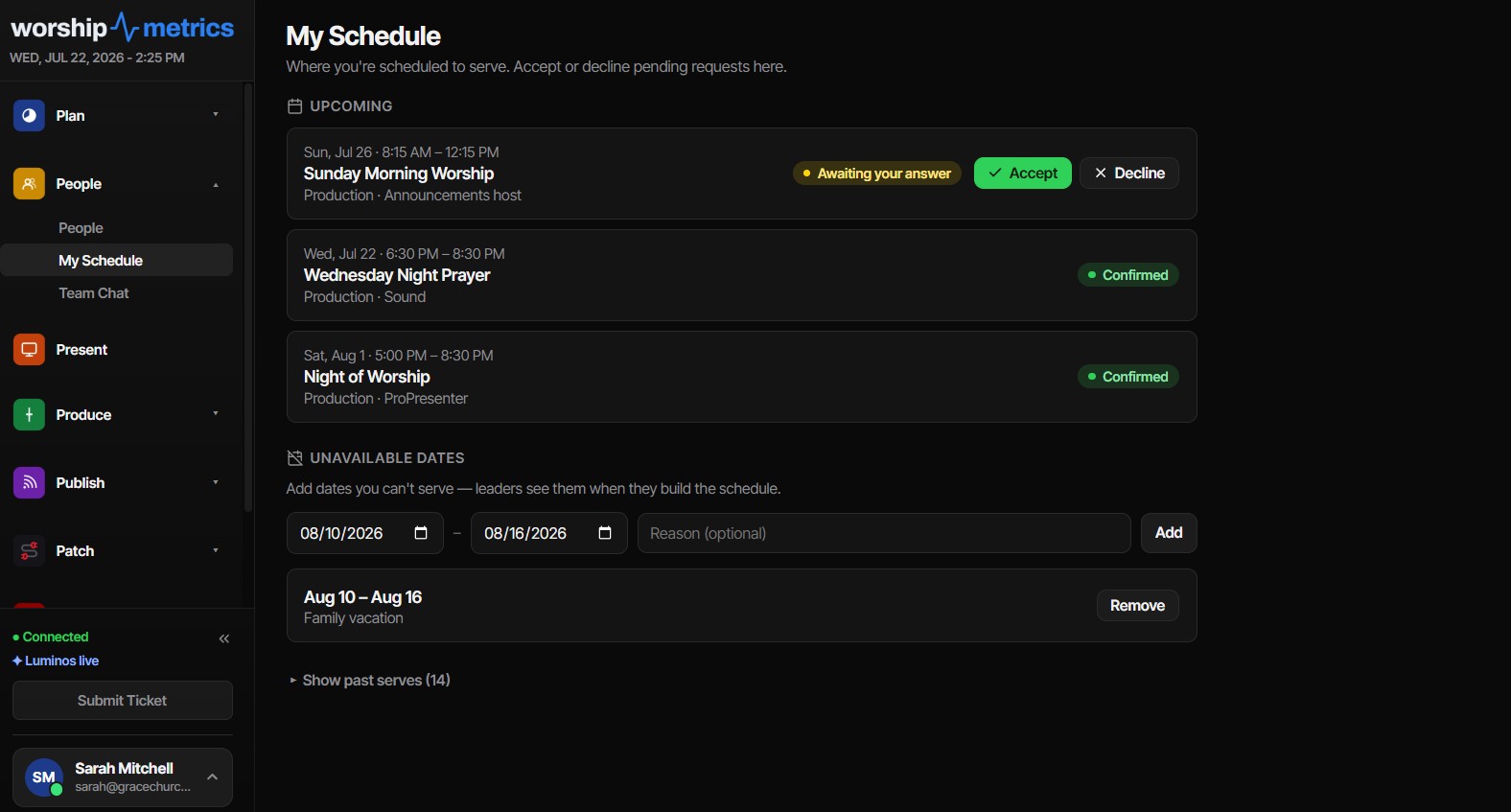
Blockouts. Volunteers manage their own unavailability from their My Schedule page — a date range for vacation, exams, or a season of rest, entered once, self-serve, with no email to the coordinator required. When you pencil someone into a date they have blocked out, the cell tells you immediately.
Double-booking. If someone is already assigned somewhere else at an overlapping time on the same day, you see a conflict signal. The overlap check is deliberately precise: it treats time ranges as half-open, so an assignment ending at 10:30 and another starting at 10:30 do not conflict — back-to-back is fine. And critically, it does not false-alarm on the most common pattern in church scheduling: the volunteer serving both the 9am and the 11am. Serving two distinct service times on the same Sunday is normal life, not a conflict.
Eligibility. The matrix also flags whether the person you are picking actually belongs to the team and position you are filling, so a mistyped assignment surfaces before it ships.
All three are warnings, never hard blocks. The system assumes you know things it does not. Maybe the blockout was entered before plans changed; maybe the “conflict” is a rehearsal the volunteer is happy to leave early. The software’s job is to make sure you decide with full information — not to overrule you. That posture matters for the pastoral side of scheduling: a tool that hard-blocks turns every edge case into a workaround, while a tool that warns keeps the leader in charge.
Per-service-time coverage
A plan often carries more than one service time — 9am, 11am, maybe a Saturday rehearsal. Assignments in WorshipMetrics are time-aware: a volunteer can be assigned to specific times rather than the whole plan.
The payoff is honest coverage math. If your guitarist can only make the 9am on a two-service Sunday, the matrix does not smear that across the whole date and report “team full.” The 9am shows covered; the 11am shows a real vacancy that still needs a name. Without per-time coverage, this exact scenario is how churches discover at 10:45 on Sunday that nobody is playing guitar at 11 — the schedule looked full all week.
When you review a drafted month, scan coverage per service time, not just per date. A date column can look green while one of its service times is quietly short.
The email loop that follows
Sending the batch is not the end of the workflow — it starts a loop, and the loop runs itself.
Accept and decline, no login required. Each invite email carries tokenized accept and decline links. Volunteers respond with one tap from their phone — no password, no app install, no “I couldn’t remember my login so I just didn’t answer.” The links stay valid right up until the service starts, so even a late responder can still confirm cleanly. (Scheduling notifications are email today, so it is worth a quick pass to make sure your volunteers’ email addresses are current before your first big send.)
Declines reopen the slot — and tell the right person. When someone declines, two things happen instantly: the position reopens as a vacancy in the matrix, and the team leader is notified — not just whoever happened to click send. This closes the classic gap where a decline lands in one staff member’s inbox on their day off and nobody else knows the slot is open again.
Automatic reminders. A recurring sweep on the server handles the follow-through humans forget: day-before serve reminders to everyone confirmed, cancellation notices when an assignment is withdrawn, and nudges to leaders about positions still unfilled as the date approaches. The reminder machinery is built to be double-send-proof, so nobody gets the same “you serve tomorrow” email twice.
Your week-of rhythm becomes simple: watch for decline notifications, fill reopened slots (a targeted invite, not another month-wide batch), and let the reminders run.
Reuse the work: templates and copy-forward
Once a well-staffed month exists, you should never rebuild it from nothing. When you copy a plan forward, you choose what happens to staffing: skip it entirely, carry the positions across as unfilled (same structure, fresh names), or re-invite the same volunteers who served last time. For teams with a stable rotation, “re-invite the same people” turns next month’s draft into a five-minute review. Recurrence goes further, spawning up to a year of future plans on a weekly, biweekly, or monthly pattern — and monthly means “the second Sunday,” not “the 14th,” which is how churches actually think.
The month-at-a-time matrix pairs naturally with month-at-a-time training, too — if you are building the production side of the roster, our guide to training volunteer AV teams covers how to grow the people the matrix schedules.
How WorshipMetrics handles this
The scheduling matrix, serving teams, blockouts, and the invite email loop are part of the People side of WorshipMetrics, and the plans and service times the matrix schedules against live in Services. Teams and positions sit under each service type, drafts stay silent until you send, and the reminder sweep keeps the loop running after the batch goes out — so the hour you spend drafting a month is the only hour scheduling asks of you.
Why One Bad Network Path Never Pages Your Whole Team: Multi-Observer Health
NextSDI Generations Explained: HD, 3G, 6G, and 12G for Church Video
Related Articles

Making a Complicated Church AV System Easy to Run, Without Hiring an AV Company
Many church AV systems aren't too old or too small. They're too complicated for a volunteer. A simple button panel built with Bitfocus Companion can hide that complexity behind plain-word buttons, and a church can often build it themselves. Here's when that works, when to call a professional, and how to start.

Your Church Livestream Team, Connected Even When They're Not at Church
A three-person livestream team only works if everyone shares the same plan, the same wiring diagram, and the same news when something breaks. Here's how WorshipMetrics connects the director, slides, and camera volunteers through the week: chat, alerts, documentation, AI help, scheduling, and cloud control for OBS and vMix.

The Three-Person Church Livestream Team: Director, Slides, and Cameras
A church livestream runs best with three clear jobs: a director on OBS or vMix, a slides operator, and a camera operator. Here's what each role does before, during, and after the service, what skills it takes, and how the three talk to each other.