Count your logins
Do a quick inventory of what your church pays for to get through a Sunday. A typical list:
- A streaming or restreaming service, to reach YouTube and Facebook.
- A clipping tool, if anyone’s making sermon shorts.
- Presentation and lyrics software.
- A volunteer scheduling app.
- A chat app or group texts to coordinate the team.
- Monitoring and documentation — usually nothing, a gap you’re just absorbing.
That’s five or six subscriptions, five or six logins, five or six bills renewing on five or six dates — and, worst of all, five or six tools that don’t talk to each other. The setlist gets typed into presentation software, then again into the stream’s lower-thirds, then referenced by hand for the clip titles. The schedule lives one place, the chat about the schedule another. Every seam between tools is a place where a volunteer gets lost and work gets redone.
This post is the case for closing the seams — not because bundling is trendy, but because for a volunteer-run church specifically, the disconnection is the actual tax.
The hidden costs of a scattered stack
The subscription total is the visible cost. Three invisible ones usually hurt more:
- The volunteer friction tax. Six tools means six accounts a new volunteer needs, six interfaces to learn, six places something can be “set wrong.” The scattered stack is quietly why recruiting and training are so hard — you’re not onboarding someone to a role, you’re onboarding them to a software collection.
- The re-entry tax. Data typed more than once is data that drifts and time that’s wasted. When the service plan is the single source and the slides, the stream, and the clips all read from it, the re-typing — and the mismatches — disappear.
- The nobody-can-see-it-all tax. When something breaks, no single tool (and no support line behind any of them) can see the whole picture. Six vendors each know their slice; none knows your system. That’s the gap context-aware support exists to close — and it’s only possible when the pieces live together.
What “one platform” actually consolidates
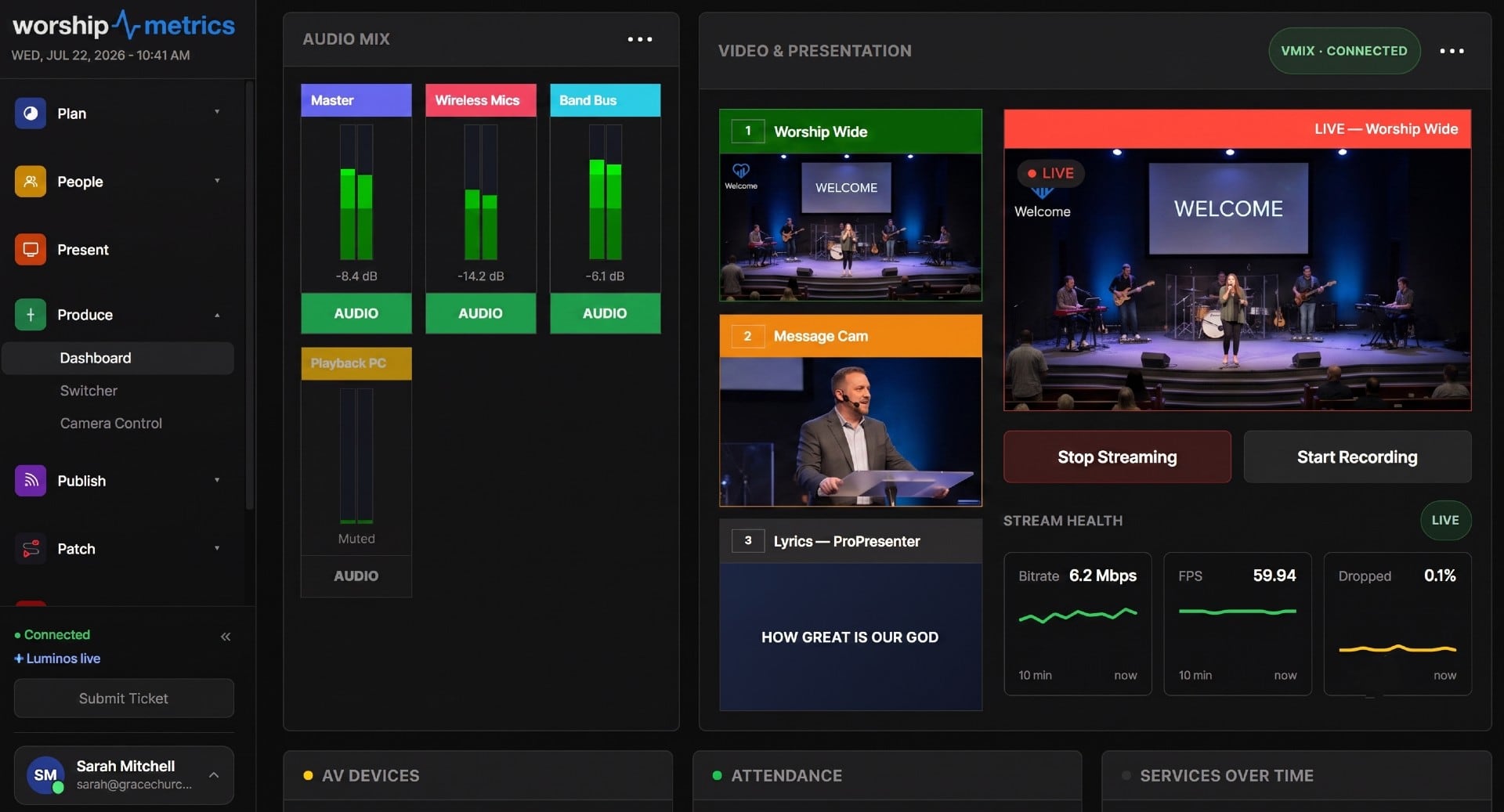
WorshipMetrics is built to replace that stack with one login and one bill — and, more importantly, one shared spine of data:
- Live streaming — one feed in, fan-out to YouTube, Facebook, and your site, with automatic recordings.
- Worship Clips — sermon moments found, rendered, and cataloged, from the recording that already exists.
- Present — slides, lyrics, and stage display built from the same service plan, no re-typing.
- Services & People — order of service, songs, and volunteer scheduling that don’t depend on one exhausted coordinator.
- Team chat — channels and DMs where the plan and the booth already live, not a separate app.
- AV monitoring and documentation — stream health, device status, alerts, and a living signal map: the piece most churches never had.
- Cloud production and support — remote vMix or OBS control, and 910-WORSHIP with your system data already in front of them.
The point isn’t the length of the list. It’s that these were always one workflow — plan the service, run it, stream it, clip it, staff it, watch it, fix it — arbitrarily split across vendors who never met. Putting them back together is less a purchase than a repair.
The DIY church’s platform
One distinction worth naming, because it’s who this is for: consolidation here doesn’t mean outsourcing. WorshipMetrics isn’t a production company you hand your service to — it’s the platform for the church that wants its own volunteers running its own booth, with everything they need in one place instead of six. The cloud layer, the monitoring, the support: all of it exists to make a self-run ministry more capable, not to replace it. That’s a different promise than “let us do it for you,” and it’s the right one for churches that see their tech team as a ministry, not a line to eliminate.
Start where it hurts
You don’t consolidate in a weekend, and you shouldn’t. Most churches start with the single piece causing the most pain — the streaming that keeps dropping, the clips nobody has time to cut, the monitoring gap that turned into a lost recording — feel the difference of having it connected to everything else, and fold in the rest as renewals come up. One platform, reached at your own pace, until the day you realize the Sunday stack is one login, one bill, and one number to call.
Six subscriptions was never the plan. It’s just what happened one tool at a time. This is how it un-happens.
Next: see how every step connects, from Sunday’s livestream to clips to a first-time guest walking in the door, on the Grow Your Church Online page.
Related questions
- What church tech tools can one platform actually replace?
- The common stack: a streaming/restreaming service, a sermon-clipping tool, presentation and lyrics software, volunteer scheduling, team chat, and the AV monitoring and documentation most churches don't have at all. WorshipMetrics brings these into one login and one bill, built to share the same service plan instead of re-entering it everywhere.
- Isn't a single platform riskier than best-of-breed separate tools?
- For a volunteer-run church, the bigger risk is usually the opposite: six disconnected tools mean six passwords a volunteer doesn't have, data re-typed between apps, and no single place support can see. Consolidation buys shared data, one place to train people, and support that understands the whole system — which for most churches outweighs marginal per-tool features.
- Do we have to replace everything at once?
- No. Most churches start with the piece that hurts most — streaming, or clipping, or the monitoring gap — and fold in the rest as subscriptions come up for renewal. The platform is designed to add value from the first module while you migrate at your own pace.
Cloud vMix Production for Churches: The Full Panel, From Anywhere
NextChurch Stream Audio Troubleshooting: The 10 Problems Behind Almost Every Sunday Failure
Related Articles

Making a Complicated Church AV System Easy to Run, Without Hiring an AV Company
Many church AV systems aren't too old or too small. They're too complicated for a volunteer. A simple button panel built with Bitfocus Companion can hide that complexity behind plain-word buttons, and a church can often build it themselves. Here's when that works, when to call a professional, and how to start.

Your Church Livestream Team, Connected Even When They're Not at Church
A three-person livestream team only works if everyone shares the same plan, the same wiring diagram, and the same news when something breaks. Here's how WorshipMetrics connects the director, slides, and camera volunteers through the week: chat, alerts, documentation, AI help, scheduling, and cloud control for OBS and vMix.

The Three-Person Church Livestream Team: Director, Slides, and Cameras
A church livestream runs best with three clear jobs: a director on OBS or vMix, a slides operator, and a camera operator. Here's what each role does before, during, and after the service, what skills it takes, and how the three talk to each other.