The 8:45 test
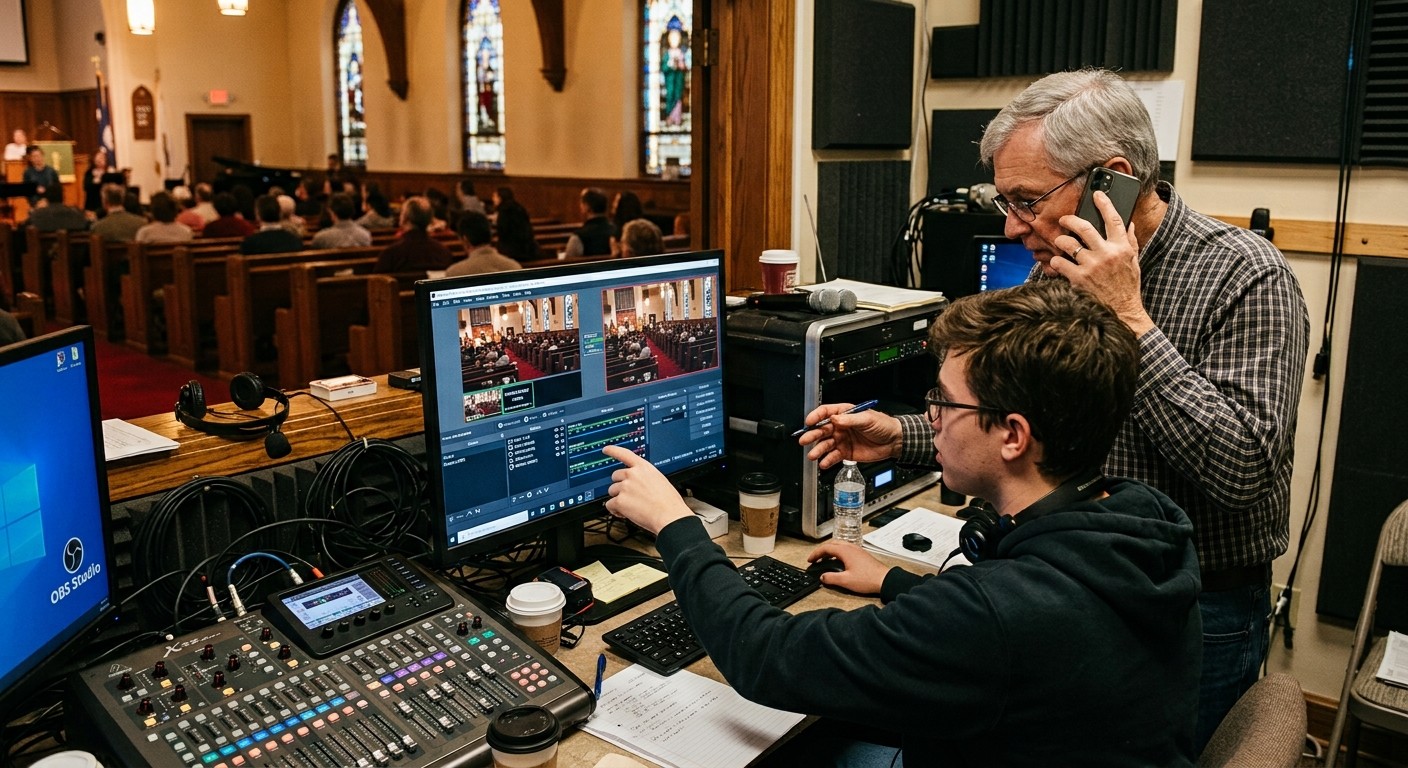
Every support arrangement a church has ever made gets graded by exactly one exam, and it’s never scheduled: the pre-service failure. It’s 8:45. The stream won’t start, or OBS won’t launch, or the encoder is throwing warnings — and the congregation arrives in seventy-five minutes.
Now run your current support plan against that clock. The forums that helped so much on Tuesday are asleep. The integrator’s voicemail says Monday–Friday. The manufacturer’s line opens at 9 a.m. Pacific. And the volunteer who always fixes it is at their niece’s wedding, phone silenced, which is the single point of failure the whole plan was quietly resting on. This is the gap that makes church tech support different from every other kind: your failures have a service time, and it’s the one time nobody answers.
Here’s what a plan that passes the 8:45 test looks like — in the order the layers actually engage.
First responder: the automation that already answered
The best 8:45 call is the one that never happens. Before a human dials anything, Self Healing has been on duty all morning: the moment a stream or recording stops unexpectedly, it says so on the booth and in Alerts on your phone, with a one-tap Restart. Often the whole fix is that tap — so the honest first move at 8:45 is to check the dashboard before assuming crisis. A meaningful share of Sunday emergencies are twenty seconds of buffering wearing a scary costume.
Second responder: the line that answers at any hour
For what automation can’t fix, 910-WORSHIP answers — and at 8:45 on a Sunday, that means Journey, the AI that picks up the phone around the clock. The word AI undersells what makes it useful: Journey knows your actual system — the same live inventory and Signal Map it reads in the app, down to cable and port labels — so “the confidence monitor is dark” gets an answer about your confidence monitor, its cable, and its port. AI phone support comes with Pro ($49/mo, 2 hours a month) and Max (5 hours), and Sunday Assurance makes it unlimited: 24/7, no queue, no “have you tried turning it off.”
For a volunteer alone in the booth — increasingly a student, which is exactly as it should be — a line that always answers and already knows the system is the difference between a scary morning and a guided one.
Third responder: the human whose Sunday is your Sunday
Some mornings need a person — judgment, experience, a calm voice that’s seen this before. That’s the Sunday Assurance add-on, and it’s built for precisely this exam: a person on call every Sunday, 5 am to 2 pm CT, who can see your booth — live telemetry, stream state, the settings this stream is running, what Self Healing already offered — the moment the call connects. No describing your setup. No archaeology. The call starts at “I can see it — here’s what we’re doing.”
And it’s worth knowing who’s behind the number, because it explains the design: there’s no call center. WorshipMetrics is a pastor, an engineer, and an AV educator who’ve spent their careers in church production. The support was built by people who’ve had the 8:45 morning, which is why every layer of it assumes the clock is running.
The layer under all of it: your own bench
One more honest note, because this whole series keeps arriving at it: the churches that sail through 8:45 mornings usually didn’t need the call at all — because a second trained person was in the booth, or a mentor was watching from home and fixed it in a text. External support is the floor, not the plan. The plan is a team, with a floor under it that never sleeps.
Run the 8:45 test on your church this week — on a calm Tuesday, ask “who would we actually call?” out loud. If the answer is one name and a prayer, you now know exactly which layers to add, and every one of them can be live before Sunday.
Next: see what a tech director knows at 8:40 am before leaving the house, from System Health to the one-tap restart, on the Sunday at a glance page.
Related questions
- Is there tech support that answers on Sunday mornings for churches?
- Yes, at two depths: Journey — the AI on 910-WORSHIP that knows your actual system — answers around the clock, with 2 hours a month on Pro and 5 on Max; and the Sunday Assurance add-on puts a person on call Sundays, 5 am to 2 pm CT, with your booth on their screen the moment the call connects.
- What should we try before calling anyone on a Sunday?
- Often nothing — check your alerts first. If a stream or recording stopped, Tech Manager has already offered a one-tap restart: tap Restart from your phone, and about 20 seconds later the booth confirms whether it's running again. If it is, breathe. If something genuinely needs a human, the phone line starts from your system's live state, not from a description.
- What does the person who answers actually see?
- Your system, not a blank ticket: live telemetry from the booth machine, stream and recording state, the settings this stream is running, the Self Healing log of what's already been offered and tried, and your Signal Map down to cable labels. The call starts at diagnosis.
The Church Social Media Volunteer's Guide to Sunday Reels
NextNo Social Media Person? How to Train a Church Clips Volunteer
Related Articles
Build the Church Tech Schedule in 20 Minutes: Positions First, Then People
The schedule that takes all week is the one that starts with people. Start with positions, let availability narrow the list, and invite one person per slot. A month of Sundays in twenty minutes.

What Church Leadership Should See on Monday: Attendance Trends That Mean Something
A single Sunday number tells leadership almost nothing. Here's what to put in front of the elders on Monday instead: in-person and online together, total reach per service, the trend by month and year, and the one list that turns a number into a phone call.
One Sunday, Four Audiences: The Lobby, the Room, the Feed, and the Living Room
Every Sunday a church talks to four audiences on four kinds of screen, usually with four tools and four people. Here's what each audience actually needs, and how one platform covers all four without a media team.