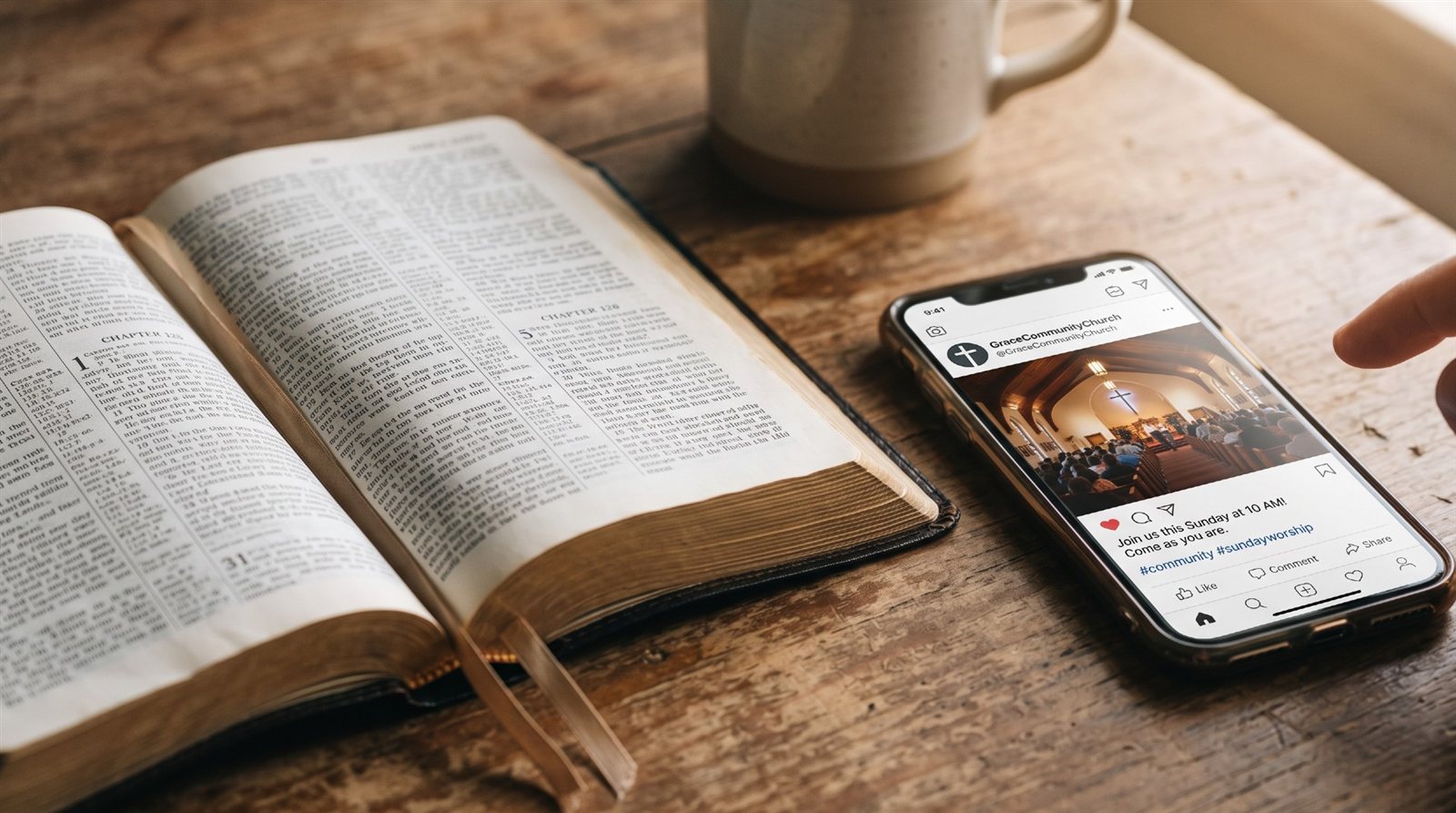
A revolution the church has seen before
In the mid-1400s, Johannes Gutenberg’s movable-type printing press changed how ideas moved. Before it, books were copied by hand, slowly and expensively, and few people ever owned one. Within a few generations, printed Bibles, sermons, hymns, and short pamphlets were spreading faster than anyone could have imagined.
The church felt that change deeply. When Martin Luther’s writings began circulating in 1517, printers turned them into short, inexpensive pamphlets in the language ordinary people spoke. Within a few years he was one of the most printed authors in Europe. Scripture in everyday languages, from Luther’s German New Testament to William Tyndale’s English one, reached people who had never held a Bible.
Whatever your tradition thinks about the Reformation itself, one lesson is hard to miss: a new way of communicating changed who could hear the message, and the people who learned to use it shaped their time.
The revolution we’re living in
Social media is a change of the same scale, and in some ways bigger:
- It’s free. No press, no paper, no postage. A phone is enough.
- It’s global. A clip filmed in a small-town sanctuary can be watched on the other side of the world tonight.
- It’s two-way. People can respond, ask questions, share, and request prayer. A pamphlet couldn’t do that.
- It travels through relationships. The most powerful posts spread because one person sends them to another.
For the first time in history, almost any church can reach almost anyone, every day, for nothing. That’s an extraordinary opportunity for people whose mission is to share good news.
Why many churches hesitate
The hesitation is understandable. Social media has a reputation for outrage, comparison, misinformation, and distraction, and some of that reputation is earned. (We take it seriously in is social media bad for the church?.)
But the printing press had a dark side too. It spread pamphlets full of slander and propaganda alongside Bibles and hymnals. The answer then wasn’t to stay away from print. It was to use the medium well, with conviction and care. The same is true now.
The other reason churches hesitate is practical: they don’t know where to start, they don’t have staff for it, and their messages are locked inside long livestreams nobody outside the church will watch. (See your best sermon moments are buried.) Those are solvable problems.
What “using it well” looks like
Share what you already have. Your church produces meaningful content every week: the sermon. Short, captioned clips of the strongest moments reach people a 75-minute video never will. (See how to turn your livestream into Shorts.)
Be consistent, not loud. Two or three honest posts a week build more trust than a burst of activity that fades. (See a sermon clip posting schedule.)
Lead with oversight. A short, clear policy tells everyone who posts, who approves, and what never goes online. (See a church social media policy template.)
Involve young people. Students and young adults often understand these platforms best, and serving this way can deepen their place in the church. (See the Youth Clip Team.)
Make it two-way. Answer comments. Invite prayer requests. Treat the comment section as part of your ministry, not a billboard.
Point to something real. Every post should lead somewhere: the full message, a prayer link, or a page that tells first-time visitors what to expect. Online presence matters because of where it leads. (See from livestream to front door.)
Tools for the moment
Printers needed presses, type, and paper. Churches today need reliable tools that fit volunteer teams. That’s why we built WorshipMetrics: a platform designed for churches, where the pieces connect.
- Tech Manager runs on your streaming computer, and monitoring alerts the team when the stream or recording stops, so Sunday gets captured.
- Reels (formerly Worship Clips) connects to your YouTube livestream and suggests the moments worth sharing, then renders captioned, branded clips in vertical, square, and horizontal. It’s free and unlimited in Tech Manager; cloud Reels on the Pro or Max plan lets volunteers work from home.
- People and QR check-in welcome the guests who find you online, and Service Metrics shows in-person and online attendance together.
The tools matter less than the message. But good tools make it possible for an ordinary volunteer team to keep sharing it, week after week.
The question for this generation
Every generation of the church has had to decide how to carry an unchanging message through the communication tools of its day: letters carried by hand, codices, printed books, radio, television. Ours is social media.
The question isn’t whether people are there. They are. The question is whether the church will be there with them, with something true, hopeful, and worth sharing.
Start here: social media for churches.
Go deeper: a biblical case for church social media.
Related questions
- Why compare social media to the printing press?
- Both changed who could publish and how far a message could travel. The printing press let ideas spread beyond what scribes could copy by hand; social media lets anyone reach people around the world for free, instantly. In both cases, communities that learned to use the new medium shaped their era.
- Should churches be on social media?
- Most people now spend part of every day there, including many who will never visit a church website or watch a full service. Churches don't need to be everywhere or post constantly, but a steady, honest presence lets their message reach people where they already are.
- How can a church start using social media well?
- Start with what you already have: your Sunday sermon. Share a few short, captioned clips each week, write a simple policy so leaders and volunteers know the rules, and make sure every post points somewhere real: the full message, a prayer link, or a page for first-time visitors.
How Social Media Algorithms Work: A Plain-English Guide for Pastors
NextHow to Start a Youth Clip Team in 30 Days
Related Articles

Making a Complicated Church AV System Easy to Run, Without Hiring an AV Company
Many church AV systems aren't too old or too small. They're too complicated for a volunteer. A simple button panel built with Bitfocus Companion can hide that complexity behind plain-word buttons, and a church can often build it themselves. Here's when that works, when to call a professional, and how to start.

Your Church Livestream Team, Connected Even When They're Not at Church
A three-person livestream team only works if everyone shares the same plan, the same wiring diagram, and the same news when something breaks. Here's how WorshipMetrics connects the director, slides, and camera volunteers through the week: chat, alerts, documentation, AI help, scheduling, and cloud control for OBS and vMix.

The Three-Person Church Livestream Team: Director, Slides, and Cameras
A church livestream runs best with three clear jobs: a director on OBS or vMix, a slides operator, and a camera operator. Here's what each role does before, during, and after the service, what skills it takes, and how the three talk to each other.