Minute 38
On Sunday, your pastor said something that could change someone’s week. Maybe it was a sentence about grief, or forgiveness, or what to do when you feel like you’ve failed. People in the room felt it.
That sentence is now 38 minutes into a livestream recording. Your members who missed Sunday might find it. Almost nobody else will, because almost nobody else is going to press play on a 75-minute video from a church they’ve never visited.
The problem isn’t the content. It’s the container.
Long videos serve your members. Short clips reach everyone else.
Full livestreams and replays matter. Homebound members, people who travel, and families with sick kids rely on them. Keep them. Organize them into playlists so they’re easy to find.
But a full service asks a lot of a stranger: an hour of attention before they know if your church is for them. Short clips ask for 45 seconds. That’s why the same message can reach a few dozen people as a livestream and many more as a handful of clips.
| Full livestream | Short clips | |
|---|---|---|
| Who watches | Members who missed Sunday | People who’ve never heard of your church |
| Time it asks for | 60–90 minutes | 30–90 seconds |
| Where it shows up | Your channel, your website | Feeds on Instagram, YouTube Shorts, TikTok, Facebook |
| How it spreads | Rarely shared | Easy to share with a friend |
What “buried” costs you
When the best moments stay inside long recordings:
- New people never hear your pastor at their best. They see a thumbnail and a runtime, and scroll past.
- Your members can’t easily share what moved them. “Watch from 38:12” is a hard sell to a friend.
- The message ends on Sunday. By Wednesday, the sermon is gone from everyone’s mind, including your own congregation’s.
Getting the moments out
Turning a sermon into clips involves four jobs:
- Find the moments that stand on their own.
- Cut each to one complete thought.
- Format it for phones: vertical, captioned, branded.
- Share it, steadily, through the week.
Doing all four by hand takes hours a week, which is why many churches try clips for a month and stop.
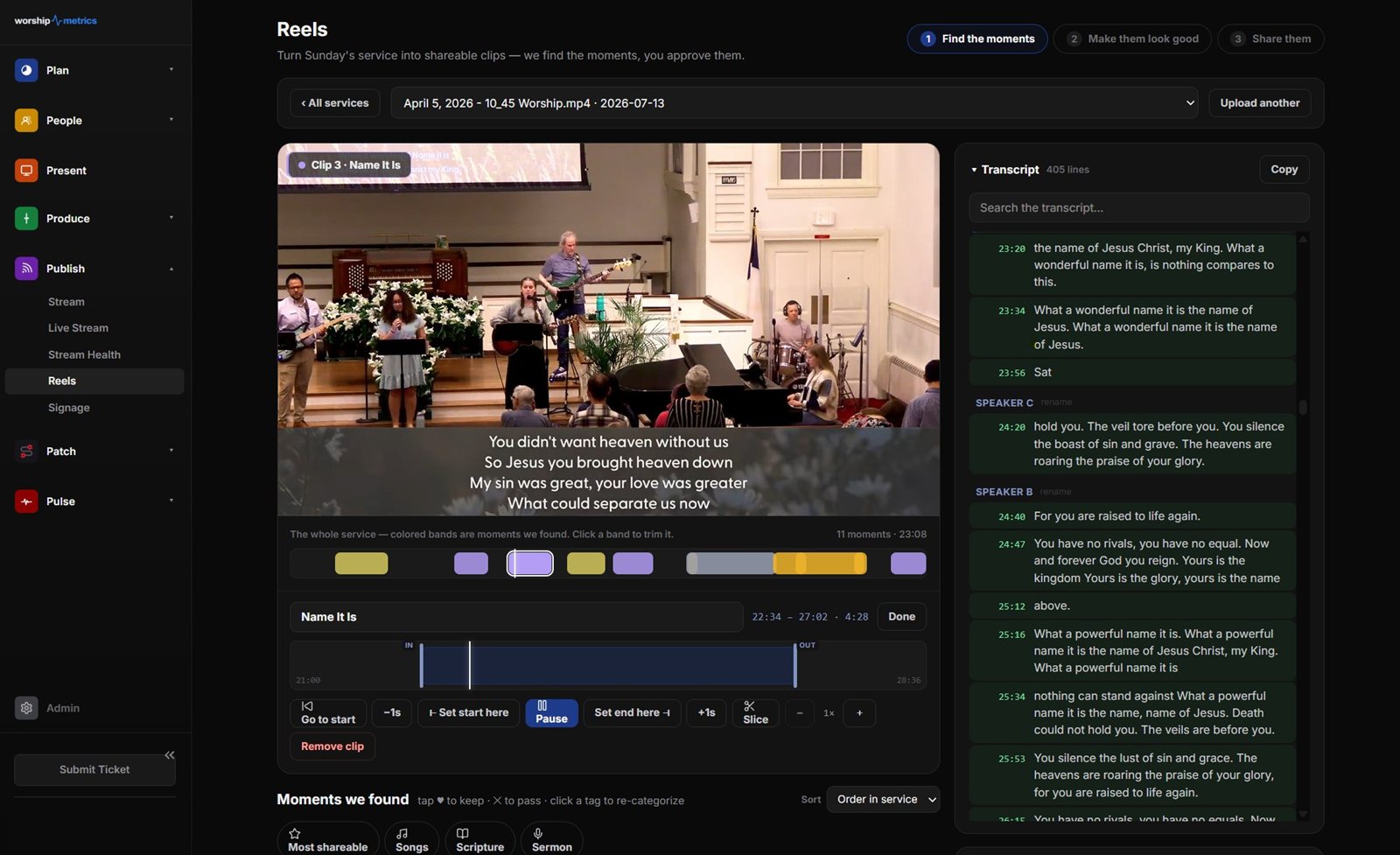
Reels (formerly Worship Clips) in WorshipMetrics takes on most of the first three. It reads the service and suggests the moments, then renders the clips you choose in vertical, square, and horizontal formats, with captions and your church’s branding. Your team’s job becomes choosing well and sharing consistently.
Who should do the choosing?
Someone who knows what connects on social media and has an hour a week. In many churches, that’s not a staff member. It’s a student.
Young people have spent years watching short video. They can tell in seconds whether a clip will hold attention. And because WorshipMetrics lets volunteers work on clips from home through cloud Reels, they can do it whenever they have time. (See why students find better sermon clips and serving from home.)
That’s how a buried sermon becomes a week of clips, and a clip job becomes a way to involve the young people your church wants to reach. More on that idea in the youth media flywheel.
Try it with last Sunday
Open last week’s livestream and find three moments that would make sense to someone who’s never been to your church. Write down the timestamps. Then ask: who in our church could do this every week?
The answer might be sitting in your youth group. Start with the Youth Clip Team overview.
Next: see how every step connects, from Sunday’s livestream to clips to a first-time guest walking in the door, on the Grow Your Church Online page.
Related questions
- Why don't people watch our church's full livestream replay?
- Most people won't commit 60 to 90 minutes to a video, especially from a church they don't know yet. Regular members who missed Sunday may watch, but newcomers rarely press play on a long service. Short clips of the best moments reach far more people.
- What should a church do with its livestream recordings?
- Keep the full service for members and searchers, organize it into playlists, and cut the strongest moments into short clips for Reels, Shorts, and TikTok. Each clip should link back to the full message.
- Who should clip the sermon?
- Someone with good judgment about what connects, and a little time each week. Many churches find that students are ideal: they know short-form video well, and the job can be done from home on their own schedule.
How Many Sermon Clips Should a Church Post? A Simple Weekly Schedule
NextShooting Your Church Service for Vertical Clips
Related Articles
A Content Engine That Stays Personal: More Clips, Better Titles, Better Thumbnails
Keeping up online means more content than most church teams can make by hand. Clipping every service, with AI help on titles, descriptions, and thumbnails, turns one sermon into a week of posts. Here's how to build a church content engine that stays personal, controllable, and true to your voice.
Which Sermons Resonate? What Clip Metrics Tell Pastors
When you clip every service, each clip becomes a small signal: what people watched, finished, shared, and came back to. Here's how pastors can read sermon clip metrics to learn what's connecting with their congregation and community, without letting the numbers write the sermon.

Which Worship Songs Does Your Congregation Love? Song Insights From Clips
Worship leaders usually choose songs by feel, familiarity, and theme. Clip metrics add another view: which songs people play again and again, at church and online. Here's how to read worship song insights to plan stronger sets, and the licensing to check along the way.