The Monday dump
Here’s a common pattern: a volunteer spends Monday cutting five clips, posts all five that afternoon, and nothing goes up again until next Monday. The first clip gets some views. The other four mostly compete with each other. By Thursday, the church has disappeared from people’s feeds.
Clips work better spread across the week. The same five clips, posted on different days, keep Sunday’s message in front of people until the next Sunday.
How many is enough?
| Clips per week | What it’s like |
|---|---|
| 1 | Easy to keep up, but tends to get lost in the feed |
| 2–3 | Sustainable for most volunteer teams; keeps the church visible all week |
| 5–7 | Strong presence, but usually needs a dedicated person or a small team |
Start with two or three. It’s better to post three clips every week for a year than ten clips for a month and then stop.
A simple weekly schedule
| Day | Clip | Why |
|---|---|---|
| Monday | The strongest sermon point | Catches people while Sunday is fresh |
| Wednesday | A second sermon point, a scripture reading, or a short prayer | Midweek encouragement |
| Friday | A worship moment, testimony, or invitation to Sunday | Gets people thinking about this weekend |
On weeks with something special, like a baptism or a guest speaker, swap one slot. Add a fourth or fifth clip only when the team can keep it up.
Mix the kinds of clips
If every clip is the pastor making a point, your feed starts to look like one long sermon. Mix in:
- Scripture readings: a minute of someone reading a psalm well can stop people scrolling.
- Prayer: a short prayer people can pray along with. These often get saved and shared.
- Worship moments: the room singing a song everyone knows shows people at home what your church feels like. Check your music licensing first: see can churches post worship song clips?.
- Baptisms and testimonies: often the most powerful clips, and they always need written consent first.
- Welcome or behind-the-scenes: the greeters, the kids’ wing, the booth team. These answer “what’s it like there?”
Put clips where people can find them later
Clips that disappear after a day are a waste. On YouTube, put Shorts in playlists by topic or series, and link the full sermon in each description. Over time, your channel becomes a library someone can explore at 2 a.m. when they’re searching for help.
Track what’s working
Views alone don’t tell you much. Once a month, look at:
- Completion: how many people watched to the end
- Shares and saves: the best sign a clip meant something to someone
- Comments: especially questions and prayer requests (answer them)
- The visitor question: ask first-time guests “how did you first hear about us?” and note when they mention clips
Then do more of what people finish, share, and save.
Making three clips a week realistic
The schedule only works if making clips doesn’t eat a volunteer’s whole Monday. Reels (formerly Worship Clips) reads the service and suggests moments, so the volunteer starts with a shortlist instead of a 75-minute timeline. Clips render with captions and your branding in vertical, square, and horizontal formats, and you can schedule YouTube posts ahead of time or download clips for other platforms.
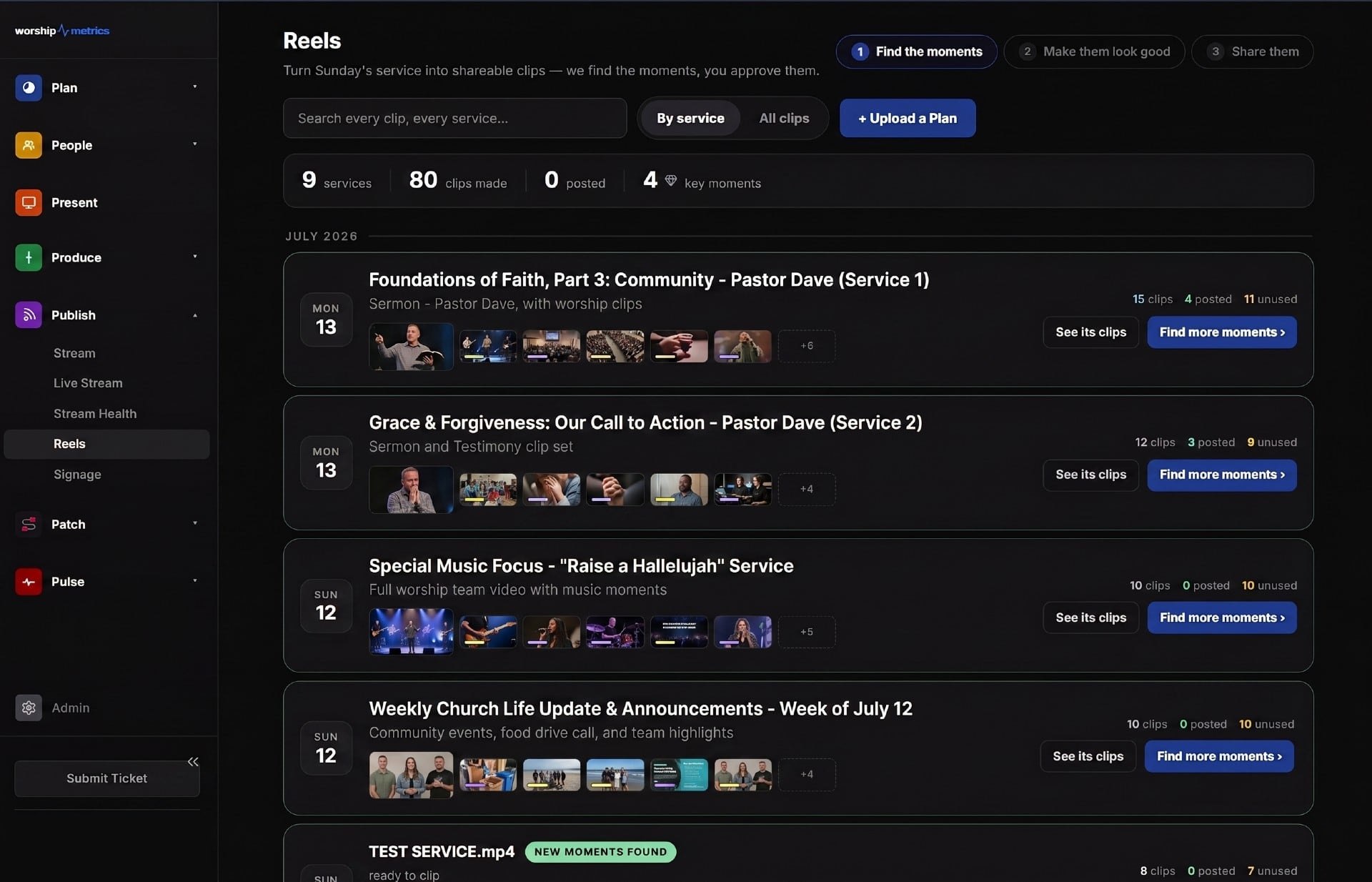
That turns “find, cut, caption, and format three clips” into “choose three clips and check the captions.” It’s the difference between a schedule that lasts a month and one that lasts a year. See how to train a church clips volunteer to hand the job to someone new.
Related questions
- How many sermon clips should a church post each week?
- Two or three a week is sustainable for most volunteer teams and keeps your church visible between Sundays. One a week tends to disappear; daily posting usually needs a dedicated team. Consistency matters more than volume.
- What kinds of clips should a church post besides sermon points?
- Mix it up: scripture readings, short prayers, worship moments (if your music licensing allows it), baptisms or testimonies with consent, and the occasional welcome or behind-the-scenes clip. Different clips reach different people.
- How do we know if our church clips are working?
- Look past views. Watch how many people finish the clip, how many share or save it, and whether new visitors mention clips when you ask how they first heard about your church.
Sermon Clip Hooks: How to Make the First Three Seconds Count
NextYour Best Sermon Moments Are Buried in a 75-Minute Livestream
Related Articles
A Content Engine That Stays Personal: More Clips, Better Titles, Better Thumbnails
Keeping up online means more content than most church teams can make by hand. Clipping every service, with AI help on titles, descriptions, and thumbnails, turns one sermon into a week of posts. Here's how to build a church content engine that stays personal, controllable, and true to your voice.
Which Sermons Resonate? What Clip Metrics Tell Pastors
When you clip every service, each clip becomes a small signal: what people watched, finished, shared, and came back to. Here's how pastors can read sermon clip metrics to learn what's connecting with their congregation and community, without letting the numbers write the sermon.

Which Worship Songs Does Your Congregation Love? Song Insights From Clips
Worship leaders usually choose songs by feel, familiarity, and theme. Clip metrics add another view: which songs people play again and again, at church and online. Here's how to read worship song insights to plan stronger sets, and the licensing to check along the way.