The ask that gets a “no”
“We really need help with the livestream.” To most people, that sounds like:
- A technical job they don’t know how to do
- Every Sunday, forever
- Something they could break, in front of the whole church
So they smile and say they’ll pray about it. (See how to ask for tech volunteers so people actually say yes.)
The ask that gets a “yes”
“Could you run the lyrics on the second Sunday of the month? You’d sit next to Maria for the first two weeks.”
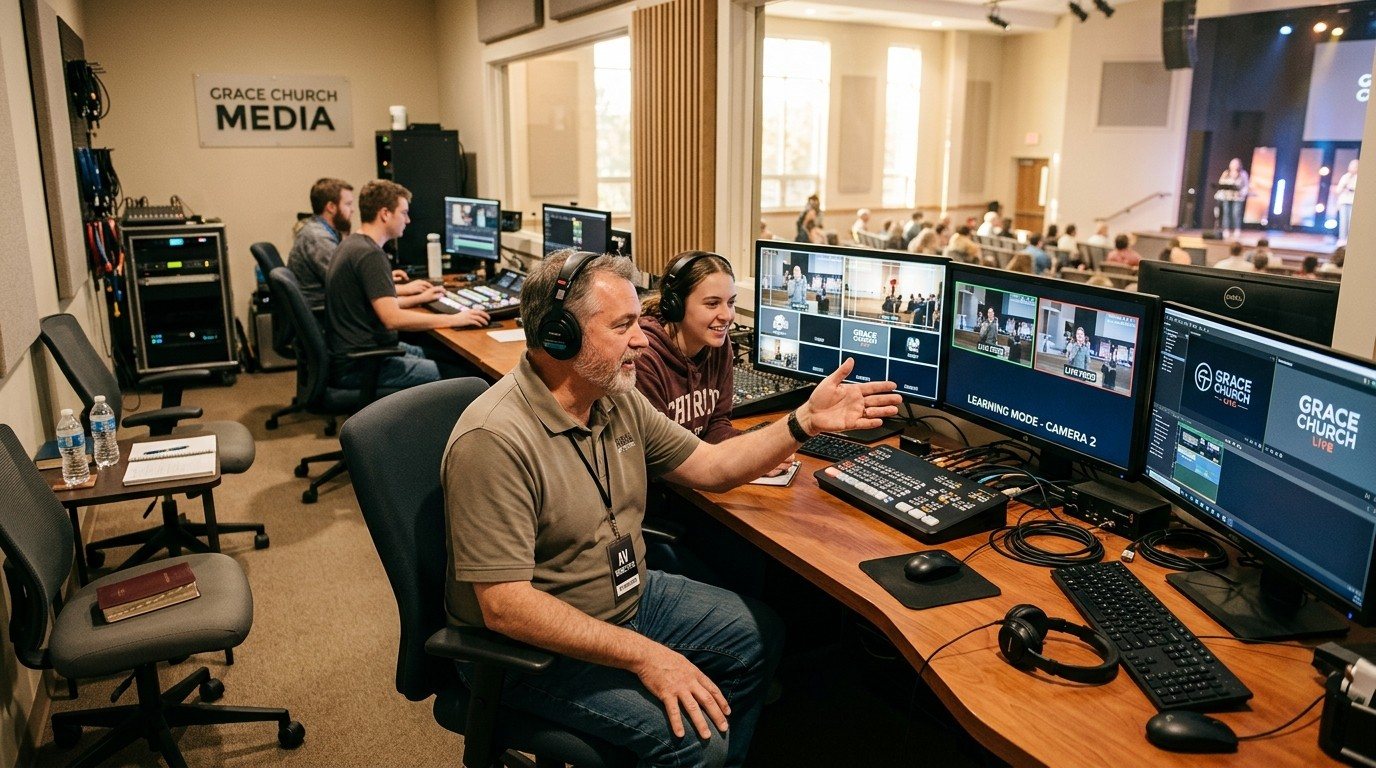
That’s a job someone can picture. It’s small, it’s specific, and it has a safety net. You can only offer that kind of ask when the booth is split into seats. (See the three-seat setup.)
Three seats, three kinds of people
| Seat | Who it suits | The pitch |
|---|---|---|
| Slides | Anyone who’s attentive and loves worship | ”Follow along and click at the right time.” |
| Cameras | Patient people with a good eye, often students | ”Help people at home see the service.” |
| Director | People who’ve grown through the other seats | ”Run the stream with a team behind you.” |
And three groups who are often overlooked:
- Students often learn OBS and vMix faster than anyone. (See your youth group already knows OBS and need volunteers for your vMix livestream?)
- Retirees bring patience and show up reliably.
- People who don’t want the stage often love the booth.
Make the first Sunday easy
- A one-page checklist for their seat.
- Someone beside them for the first few weeks. (See the 90-day onboarding path.)
- A booth that’s easy to walk into. (See the volunteer-friendly booth and make room for one more.)
- A clear way to get help when the experienced person isn’t there.
Where WorshipMetrics helps
Volunteer scheduling lets people accept or decline Sundays a month at a time, by position. Team chat gives new volunteers a place to ask questions. The Signal Map and checklists mean nothing depends on one person’s memory, and Luminos or Journey on 910-WORSHIP answers the questions a new volunteer is shy to ask out loud.
Next: the three-person church livestream team, or how to train OBS volunteers.
Related questions
- How do you recruit volunteers for a church livestream?
- Ask for a specific, small job instead of 'the booth.' 'Run lyrics on the second Sunday of the month' is easier to say yes to than 'help with the livestream.' Splitting the work into slides, cameras, and director seats creates jobs that new people can picture themselves doing.
- Why don't people volunteer for church tech?
- Mostly because it looks like one big, technical job that only experts can do, and they're afraid of breaking something during worship. Smaller seats, a clear checklist, and someone beside them for the first few Sundays remove most of that fear.
- Who makes good livestream volunteers?
- Students, who often learn the software quickly; retirees, who bring patience and reliability; and people who want to serve but not on stage. Each can start in a different seat.
When Your Church Outgrows the ATEM Mini: Signs, Options, and Next Steps
NextGetting Your Church Sound Board into OBS, vMix, or an ATEM: USB, Dante, and Analog
Related Articles

Making a Complicated Church AV System Easy to Run, Without Hiring an AV Company
Many church AV systems aren't too old or too small. They're too complicated for a volunteer. A simple button panel built with Bitfocus Companion can hide that complexity behind plain-word buttons, and a church can often build it themselves. Here's when that works, when to call a professional, and how to start.

Your Church Livestream Team, Connected Even When They're Not at Church
A three-person livestream team only works if everyone shares the same plan, the same wiring diagram, and the same news when something breaks. Here's how WorshipMetrics connects the director, slides, and camera volunteers through the week: chat, alerts, documentation, AI help, scheduling, and cloud control for OBS and vMix.

The Three-Person Church Livestream Team: Director, Slides, and Cameras
A church livestream runs best with three clear jobs: a director on OBS or vMix, a slides operator, and a camera operator. Here's what each role does before, during, and after the service, what skills it takes, and how the three talk to each other.