Clips are one step, not the whole job
AI clip tools have gotten very good. Upload a long video, and a few minutes later you have a set of short, captioned, vertical clips. For a creator or a podcaster, that’s most of the job.
For a church, it’s one step in a longer chain:
- Sunday has to be captured reliably, every week, by volunteers.
- The service has to get from the booth to wherever clips are made.
- Someone has to choose moments wisely, skipping prayer requests and pastoral moments.
- Clips have to be shared consistently, by a team that changes over time.
- Viewers need a clear next step, and a welcome when they arrive.
- Leaders want to know whether any of it is bringing people in.
A standalone clip tool handles step 3 well, and some of step 4. Everything else is up to you.
What a church platform adds
It starts where your service starts. In WorshipMetrics, Tech Manager is installed on your church’s streaming computer. It runs the booth, and monitoring alerts the team if the stream or recording stops. When your YouTube livestream is connected, Sunday’s service is ready in Reels (formerly Worship Clips) without anyone downloading, renaming, or uploading files.
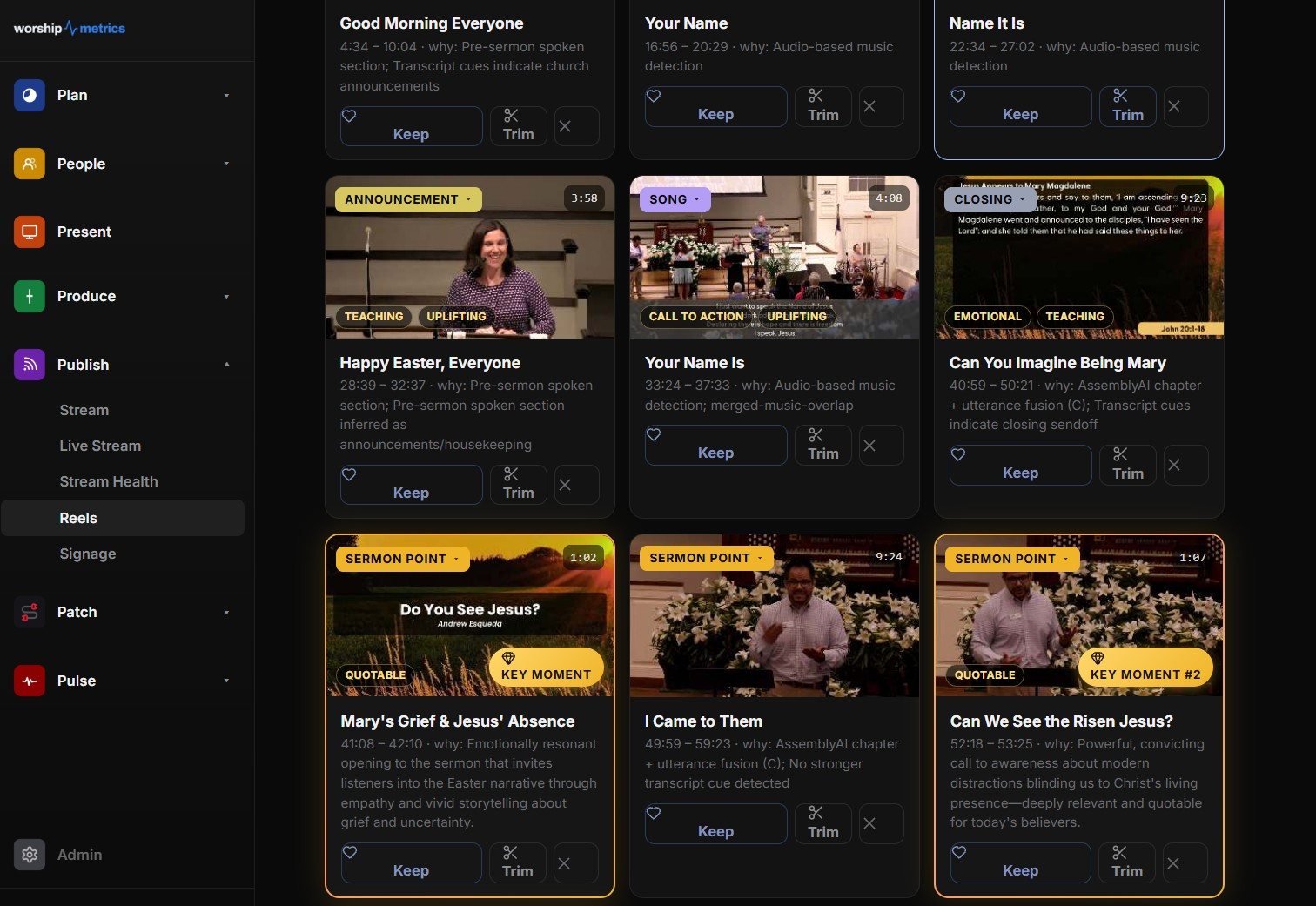
It understands a worship service. Reels is built around the shape of a service: sermon points, scripture, worship, and more. The AI suggests moments; your team decides what represents your church.
It respects what shouldn’t be posted. Services include prayer requests, children, and pastoral moments. Reels can run entirely on the booth computer, so service video can stay on your machine, and every clip is chosen by a person. (See privacy for sermon clips.)
It’s built for volunteers. Add as many team members as you need and decide who can access what, so students can prepare clips without holding the church’s passwords. Volunteers can work from home with cloud Reels on Pro and Max. (See serving from home.)
It connects to the visit. When someone who found you through a clip finally walks in, QR check-in adds them to People, your directory, and recognizes them when they come back.
It shows the result. Service Metrics puts in-person and online attendance on one dashboard, so you can see whether online growth is turning into people in the room. (See are your clips bringing people in?.)
A platform you can grow into
You don’t need everything on day one. Many churches start with one piece:
- Reels free on the booth computer in Tech Manager, to start clipping
- Present for lyrics, scripture, and slides
- Monitoring and alerts, free, so Sunday stops breaking
Then they add volunteer scheduling, team chat, check-in, cloud Reels, or streaming as they’re ready. Each new piece connects to what’s already there, instead of becoming another login. (See one platform instead of six subscriptions.)
When a standalone tool is the right choice
To be fair, a general clip tool can be the better fit if:
- You only need clips, and your streaming, check-in, and other tools already work well for you.
- Your clips volunteer already knows a tool like CapCut and is happy with it.
- You want written content like devotionals and discussion guides generated from every sermon. Some sermon-specific tools focus on that.
There’s no wrong answer if clips get made and posted every week. The question is how much connecting you want to do by hand. (See AI sermon clip tools compared.)
The real difference
A clip tool makes clips. A church platform helps your church reach people and welcome them when they come. If the goal is more people walking in the door, the steps between the clip and the door matter as much as the clip itself.
See how it fits together: grow your church online.
Related questions
- Is there an AI clip tool made specifically for churches?
- Yes. Several tools focus on sermons, and WorshipMetrics Reels is part of a full church production platform: it connects to your livestream, runs free on the booth computer in Tech Manager, and works alongside presentation, volunteer scheduling, check-in, and attendance.
- Should our church use a general AI clip tool like OpusClip or CapCut?
- If you only need clips and someone is happy to move files between tools, a general tool can work well. If you want clips to come straight from your service, with church-aware suggestions, volunteers with their own access, and a way to measure growth, a church platform fits better.
- What does 'church-aware' AI clipping mean?
- It means the tool understands the shape of a worship service: sermon points, scripture readings, worship, prayer, and altar calls, and it's built with church concerns in mind, like keeping prayer requests and pastoral moments off social media.
Instagram for Churches: A Simple Weekly Plan
NextChurch Social Media Policy: A Simple Template You Can Adapt
Related Articles
A Content Engine That Stays Personal: More Clips, Better Titles, Better Thumbnails
Keeping up online means more content than most church teams can make by hand. Clipping every service, with AI help on titles, descriptions, and thumbnails, turns one sermon into a week of posts. Here's how to build a church content engine that stays personal, controllable, and true to your voice.
Which Sermons Resonate? What Clip Metrics Tell Pastors
When you clip every service, each clip becomes a small signal: what people watched, finished, shared, and came back to. Here's how pastors can read sermon clip metrics to learn what's connecting with their congregation and community, without letting the numbers write the sermon.

Which Worship Songs Does Your Congregation Love? Song Insights From Clips
Worship leaders usually choose songs by feel, familiarity, and theme. Clip metrics add another view: which songs people play again and again, at church and online. Here's how to read worship song insights to plan stronger sets, and the licensing to check along the way.