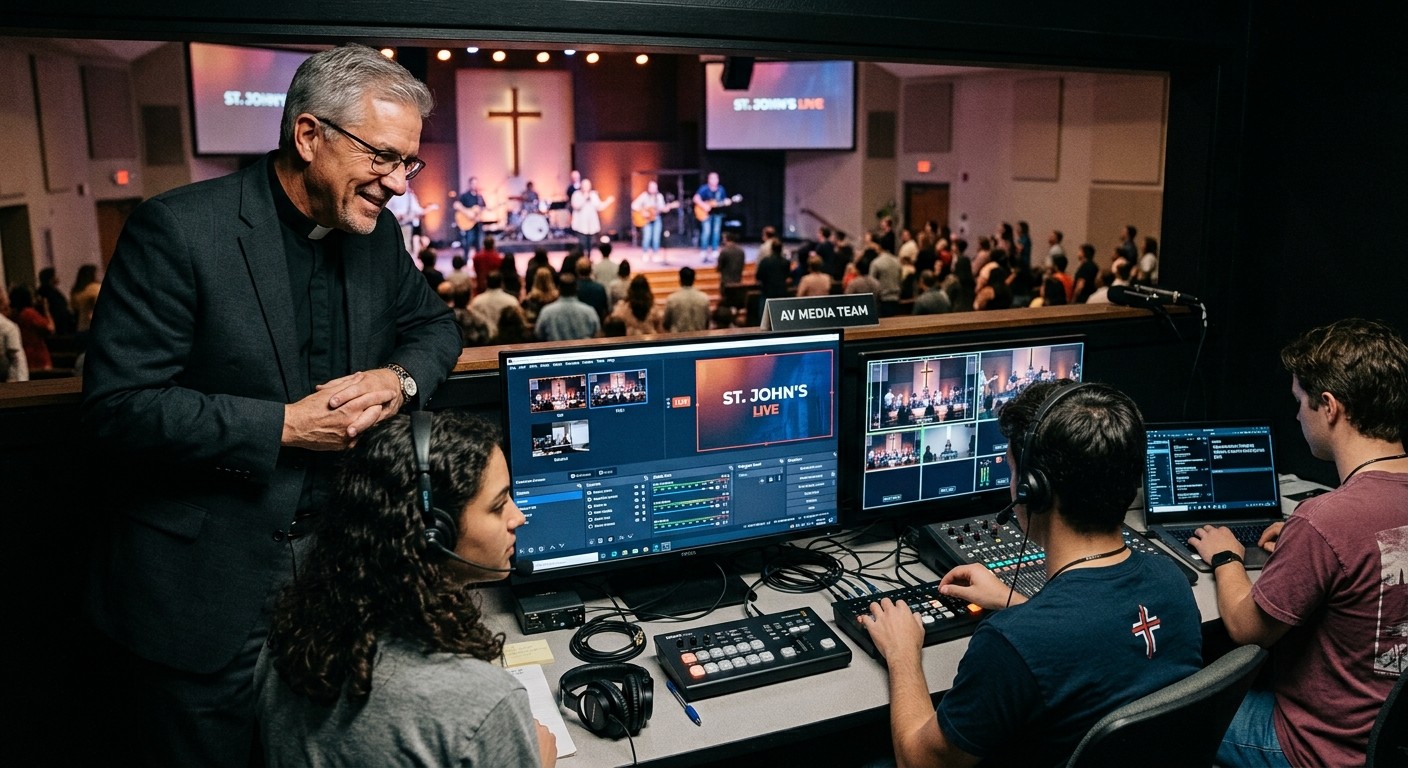
The fear that keeps the booth empty
Every youth pastor who’s eyed the tech booth as a place for students has hit the same wall — not the students’ willingness, but the stakes. The booth felt like the one ministry where a beginner’s mistake happens live, in front of everyone, with no undo. So the seats stayed with the one exhausted adult, and the students who’d have thrived there stayed in the seats, watching.
Here’s what changed, and why it belongs in the “AI in church” conversation from the youth-ministry side: an AI that knows your church’s actual system functions like a mentor who never gets tired, never makes a student feel dumb, and is available at the exact moment courage wavers. It doesn’t replace the student. It removes the fear that kept the student out.
What it feels like for the student
Picture a sixteen-year-old on the stream seat, second Sunday. Something looks off and she isn’t sure — and she’s too self-conscious to broadcast her uncertainty to the whole team on the headset. So she quietly asks Luminos in the app, or steps aside and calls 910-WORSHIP where Journey answers, and gets an answer about her booth — her camera, her cable, her telemetry — in plain language, in seconds. She fixes it herself. Nobody had to hover; nobody had to be embarrassed; and she just learned something she’ll keep.
That’s the texture of it: the AI answers the question students are too nervous to ask a person, which is precisely the question that, unanswered, makes them quit. And because the whole generation already lives in this software — 85% of teens game, most speak streaming natively — an AI assistant isn’t alien to them. It’s the most natural interface a church could hand them.
Why this makes you more comfortable handing over responsibility, not less
The instinct might run the other way — if they need AI, are they ready? Flip it. The student running the booth now has more support than your veteran ever did solo: an assistant that knows the system, an instant heads-up and one-tap restart when a stream or recording stops, so no rookie has to hero through it alone, human backup a call away, and — crucially for you and the parents — you can see the booth’s live state from your phone during the service. The full safety case for student operators was already strong; context-aware AI is the layer that makes it feel obvious.
And note what this does to the discipleship math. Discipleship in the booth was never at risk from students having good tools — it was at risk from students having no place to serve. Every technical fear that shrinks the number of seats a teenager can hold shrinks the ministry. AI removes the biggest of those fears, which means more students get the real, needed, mentored responsibility that actually forms a young person’s faith.
The line that keeps it healthy
Say the honest boundary out loud, because your students and their parents deserve it: the AI helps with the technical — the wiring, the settings, the “why is this dark.” It does not disciple your students. That’s you, the mentor beside them, the crew they belong to, the pastor who thanks them from the stage. This is the same booth-not-pulpit line the whole platform is built on, applied to youth ministry: let AI carry the technical weight so the human weight — belonging, mentorship, being needed — is what your students actually feel.
The tool that was supposed to make us fear for the next generation turns out, used this way, to be the thing that finally lets them serve. Ask your AV lead which three students to start with, and let the booth — assistant and all — become one of the best youth-ministry rooms in your church.
Related questions
- Does AI in the tech booth mean students aren't really learning?
- It's the opposite when it's built right. An AI that knows your system works like an infinitely patient mentor sitting beside a student — answering the question they're too nervous to ask an adult, explaining why, and leaving the doing to them. It lowers the fear that keeps students from starting, and accelerates the learning once they do.
- Is it safe to let a teenager run the stream with AI support?
- Safer than without it. The student has a helper that knows your exact wiring and telemetry available in the app or by phone, instant alerts with a one-tap restart if the stream or recording stops, and human backup a call away — while youth pastors and AV leads can see the booth's live state. Real responsibility, real safety net, real oversight.
- Doesn't relying on AI undercut discipleship?
- Discipleship was never threatened by a student having good tools — it's threatened by students having no place to serve. AI removes the technical fear that kept the booth off-limits to beginners, which means more students get the mentored, needed, real-stakes serving that actually forms them.
AI in the Church: For the Booth, Not the Pulpit
NextAI That Knows Your Wiring: How Luminos and Journey Actually Work
Related Articles

Making a Complicated Church AV System Easy to Run, Without Hiring an AV Company
Many church AV systems aren't too old or too small. They're too complicated for a volunteer. A simple button panel built with Bitfocus Companion can hide that complexity behind plain-word buttons, and a church can often build it themselves. Here's when that works, when to call a professional, and how to start.

Your Church Livestream Team, Connected Even When They're Not at Church
A three-person livestream team only works if everyone shares the same plan, the same wiring diagram, and the same news when something breaks. Here's how WorshipMetrics connects the director, slides, and camera volunteers through the week: chat, alerts, documentation, AI help, scheduling, and cloud control for OBS and vMix.

The Three-Person Church Livestream Team: Director, Slides, and Cameras
A church livestream runs best with three clear jobs: a director on OBS or vMix, a slides operator, and a camera operator. Here's what each role does before, during, and after the service, what skills it takes, and how the three talk to each other.