The question deserves better than a verdict
Somewhere this year, your board will discuss AI — if Barna’s numbers hold, most of the room will already be using it quietly (only 13% of pastors abstain entirely) while most of the room also feels uneasy about it (71% express hesitation). That combination — adoption plus unease — is exactly when leadership frameworks earn their keep, because the alternative is drift: a hundred small AI decisions made by whoever got there first, with no shared line and no shared language.
Here’s a framework built for that meeting: three zones, five vendor questions, and one worked example. It doesn’t tell your church what to believe; it gives the room a way to disagree precisely instead of anxiously.
The three zones
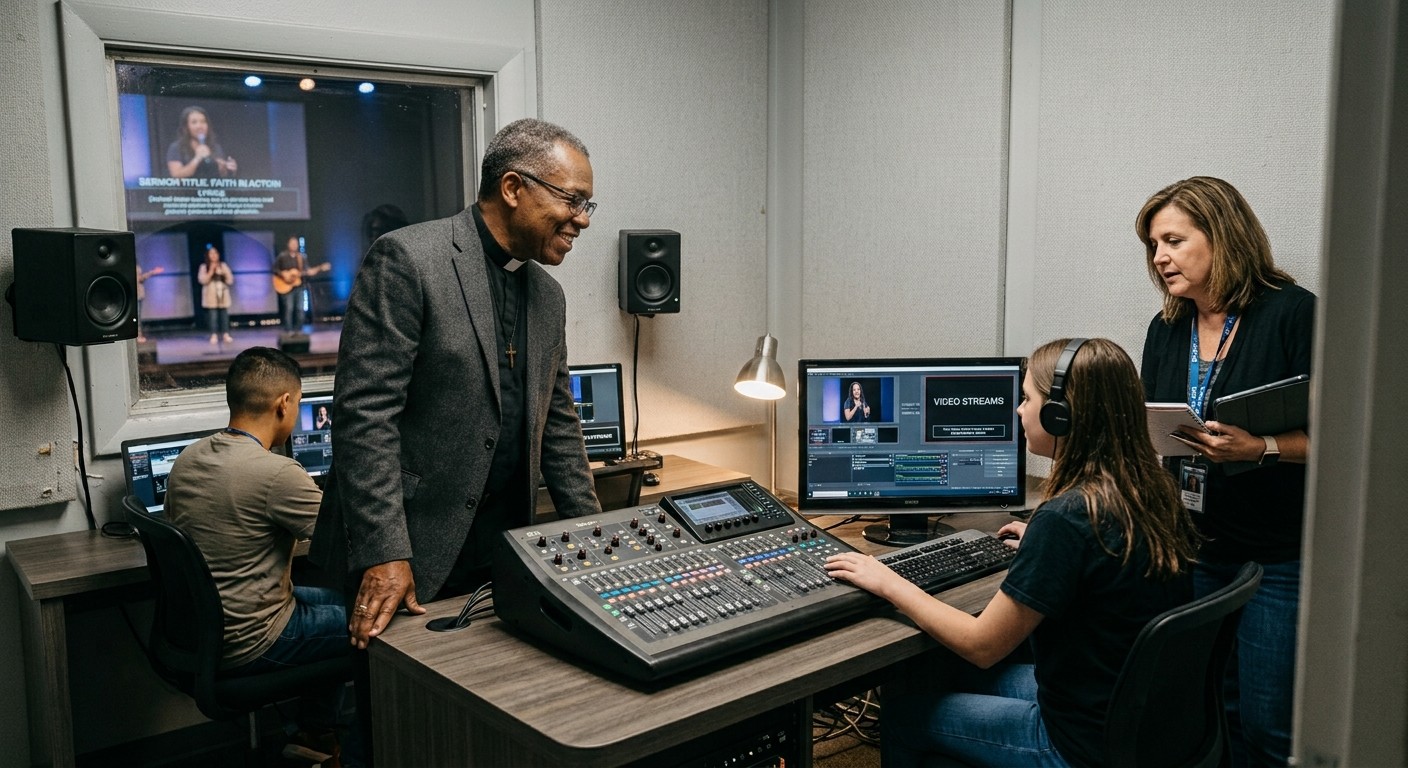
Zone one: technical and operational — where AI clearly serves. Equipment support, system monitoring, scheduling logistics, troubleshooting guidance. Work with objective right answers, no spiritual authority, and enormous volunteer pain behind it. This is where pastors already use AI most — behind the scenes — and where the case is strongest: an AI that knows your actual wiring answering a volunteer’s question at 8:45 on a Sunday is serving the church the way a hymnal or a soundboard serves it. Our whole position on this zone: AI for the booth, not the pulpit.
Zone two: public-facing content — proceed with guardrails. Social clips, graphics, summaries, drafts. Useful, but it carries the church’s voice, so the guardrail is non-negotiable: AI proposes, humans decide. (Worked example: the sermon-clips pipeline ranks moments and suggests captions; a person chooses what represents your church.)
Zone three: preaching, prayer, pastoral care — conviction territory. This is where pastors themselves draw the line, and where your church’s theology, not a vendor’s roadmap, should rule. Some churches will use AI for sermon research; others won’t let it near the study. Leadership’s job here isn’t to settle the question today — it’s to name the zone so nobody wanders into it by accident, and to choose partners who respect the line rather than blur it.
It also helps to say plainly what AI can’t do in any zone. It can’t decide what your church should emphasize. It can’t pastor a viewer. It can’t train a student to serve with care. It can’t build a team culture. Use it where it genuinely removes friction, like captions, finding clip moments, cleaning up audio, drafting a midweek summary, or walking a volunteer through a fix, and keep your energy on reliable systems and trustworthy people.
The five vendor questions
When anyone offers your church AI, these five questions sort the serious from the shiny:
- “What context does your AI actually have about us?” Generic AI gives generic answers. The useful kind has read your systems — your inventory, your Signal Map, your live telemetry. If the vendor can’t say what the AI knows, it knows nothing.
- “Where does our data live?” Ask specifically about sensitive media. (Design worth looking for: WorshipMetrics’ clip pipeline offers a local mode where service audio and video never leave the booth computer — only short text goes to the cloud for scoring.)
- “Does the AI act, or propose?” Autonomous AI in a church system should worry you. The right pattern: problems detected automatically, fixes proposed to a human, everything logged. (Self Healing’s own restraint — a stopped stream gets a one-tap restart offer, never an automatic restart, and a crashed app is reported, never relaunched — is what this looks like in practice.)
- “Who stands behind it when AI isn’t enough?” AI without a human ladder is an answering machine with confidence. Look for real escalation: weekday pros, Sunday on-call, a number that answers.
- “Who built this — and do they understand church?” Not as a gotcha; as due diligence. Tools built by people who serve in churches carry the zones in their bones. WorshipMetrics is a pastor, an engineer, and an AV educator, all integrally involved in their own congregations. That biography is why the pulpit line holds by design, not by policy memo.
A reasonable first step for a cautious board
Don’t start with a debate; start with a bounded experiment in zone one. The free tier includes Luminos AI chat (5 conversations a month for verified churches) — enough for your tech team to judge, against a real problem, whether AI-with-context is what this framework claims. Review it at the next meeting with evidence instead of vibes: the health reports will show exactly what the season looked like.
Leadership’s calling here isn’t to bless or ban a technology. It’s to put each use in its right zone, guard the zones that matter most, and let the booth — and the volunteers carrying it — receive the help that’s finally affordable. The pulpit stays yours. It was never for sale.
Sources: Barna Group — Pastors Are Using AI More Than You Think; Barna — How Church Leaders Are Using AI.
Related questions
- How should church leadership think about adopting AI?
- By zone, not verdict. Zone one — technical and operational work (AV support, monitoring, scheduling logistics) — is where AI clearly serves and most pastors already use it. Zone two — public-facing content — deserves guardrails and human review. Zone three — preaching, prayer, pastoral care — is where churches draw conviction lines, and a good vendor never pushes past them.
- What questions should we ask a vendor offering AI for our church?
- Five: What context does the AI actually have about us? Where does our data live, and can sensitive media stay on premises? Does the AI act on its own or propose to humans? Who stands behind it when AI isn't enough? And who built it — do they understand church, or just software?
- What's a reasonable first step for a cautious church?
- Start in zone one with something reversible and observable: AI-assisted tech support that your team can evaluate against real Sundays. The free tier includes Luminos AI chat (5 conversations a month for verified churches) — enough to judge quality before any commitment.
Related Articles

Making a Complicated Church AV System Easy to Run, Without Hiring an AV Company
Many church AV systems aren't too old or too small. They're too complicated for a volunteer. A simple button panel built with Bitfocus Companion can hide that complexity behind plain-word buttons, and a church can often build it themselves. Here's when that works, when to call a professional, and how to start.

Your Church Livestream Team, Connected Even When They're Not at Church
A three-person livestream team only works if everyone shares the same plan, the same wiring diagram, and the same news when something breaks. Here's how WorshipMetrics connects the director, slides, and camera volunteers through the week: chat, alerts, documentation, AI help, scheduling, and cloud control for OBS and vMix.

The Three-Person Church Livestream Team: Director, Slides, and Cameras
A church livestream runs best with three clear jobs: a director on OBS or vMix, a slides operator, and a camera operator. Here's what each role does before, during, and after the service, what skills it takes, and how the three talk to each other.