The mission field moved, and your church already has the content
For church leadership, the short-video conversation often starts in the wrong place — as a question about marketing, which feels beneath the calling. Reframe it as a question about where people are, and it becomes a question about mission, which is exactly the church’s business.
Here is the plain reality: the next generation discovers the world through short-form video. It’s how they find music, ideas, communities, and — the research on the religiously unaffiliated young adult keeps confirming this — increasingly how they’d first encounter a church, if a church were there to be found. Meanwhile, your church produces something most content creators would envy: an hour of genuinely meaningful material every single Sunday — teaching, worship, testimony, hope. The mission field moved to the phone, and you’re already generating exactly what belongs there. The only gap is between the long service and the short format, and that gap is now a solved technical problem, not a staffing impossibility.
The strategy: find the moments, don’t manufacture them
The instinct many churches resist — rightly — is producing content for content’s sake, chasing trends in a way that feels hollow. The strategy that avoids that trap is subtractive, not additive: you don’t manufacture new material, you find the moments already inside the real thing.
Every Sunday contains them: the sentence in the sermon that reframes everything, the bridge of the song where the room lifts, the thirty seconds of testimony that would stop a stranger’s scroll. AI finds and ranks those moments — scoring each for how well it stands alone to someone who’s never visited — so what reaches the feed is the authentic highlight, not a gimmick. The medium is short; the content stays substantive. You’re not becoming an entertainment channel. You’re carrying real things into the room where people already are.
The asset leadership should care about most: the catalog
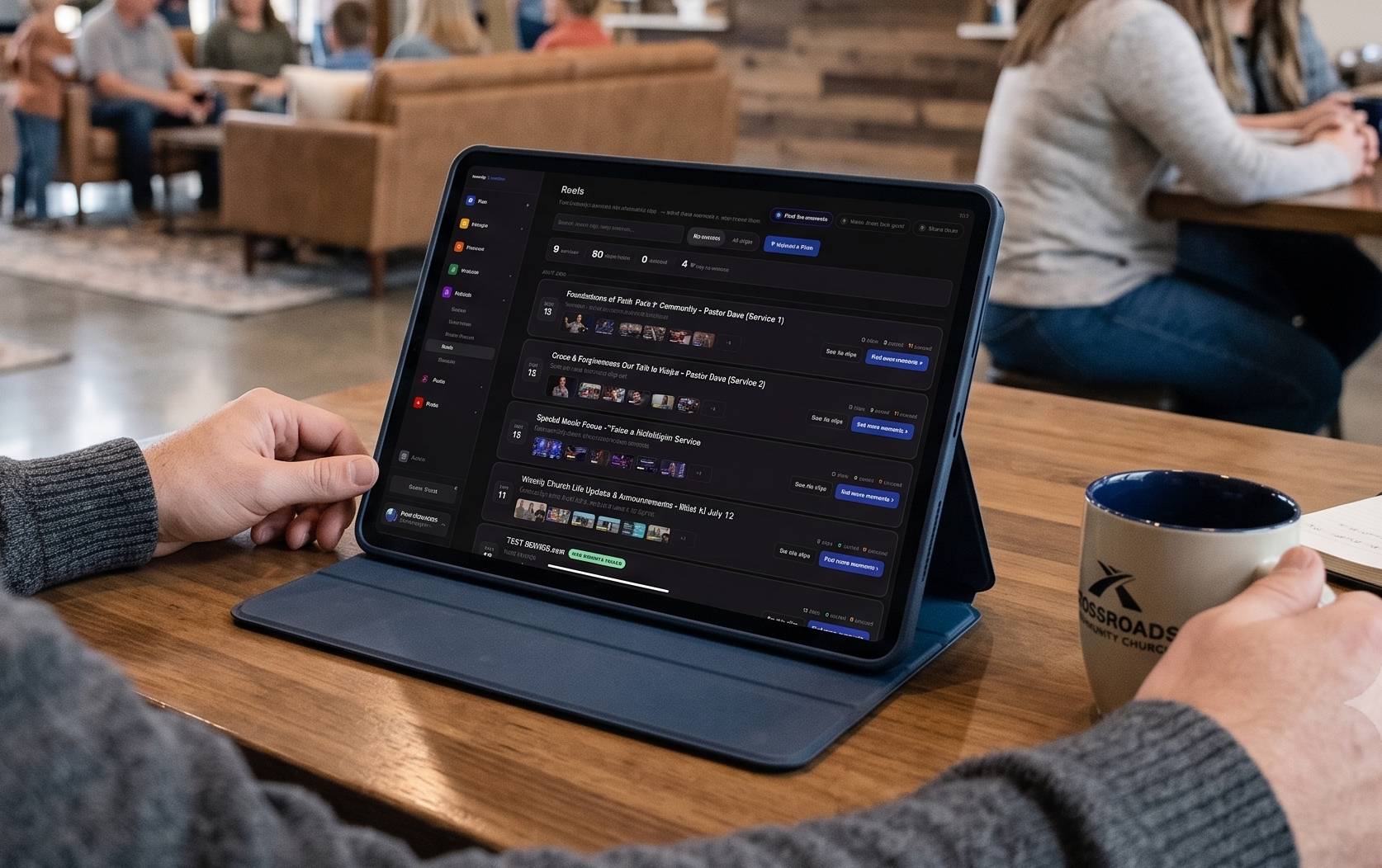
Here’s the part that turns a social media tactic into a leadership-grade strategy. Every clip your church makes is stored and cataloged, organized by service — which means you’re not just posting, you’re building an appreciating archive of your church’s best moments.
Think about what that compounds into. A year from now you have a searchable library of every sermon point that landed, every powerful testimony, every worship moment — ready to redeploy for the Christmas campaign, the sermon series relaunch, the “why our church” reel for newcomers, the anniversary looking back. Most churches’ content evaporates the day after posting; a cataloged library is an asset that grows in value and never resets to zero. That’s the difference between spending on social media and investing in it — and it’s the frame that makes this a line worth defending in a leadership meeting.
Making it sustainable — the honest requirement
Strategy dies without sustainability, and short video has killed more church accounts than any other content type — because the manual version (scrub, cut, caption, format, repeat) is genuinely unsustainable for volunteers. The whole strategy above depends on that labor being gone, which is precisely what the find-and-render pipeline delivers: a single trained volunteer, a couple of hours a week, a steady cadence.
And “trained volunteer” is not a hiring line — most churches don’t have a media person and don’t need one. The role recruits for taste, not editing skill, which means it’s fillable from your own congregation, often by a student who already thinks in this format. Leadership’s actual job here is small and strategic: bless the priority, name the person, and protect the two hours a week. The technology carries the rest.
The leadership decision
You don’t need to become a media company. You need to make one decision: that the meaningful moments your church already produces every Sunday are worth carrying to where the next generation actually is. Say yes to that, and everything downstream — the finding, the formatting, the cataloging — is already built. The growth case for pastors makes the evangelistic argument in full; the leadership case is simpler still: the content exists, the field has moved, and the bridge between them is finally something a volunteer can carry.
Next: see how students can find and share your sermon’s best moments, from church or from home, on the Youth Clip Team page.
Next: the bigger picture on using social media well, from the vision to a policy template and a Christmas plan, on the Social Media for Churches page.
Thinking about TikTok? See should our church be on TikTok?.
Related questions
- Why should church leadership care about short-form video?
- Because it's the proven format where the next generation discovers everything, including faith and community. Your church already produces meaningful content every Sunday; short video is how a fraction of it reaches people who would never watch a full service — and increasingly, who first encounter your church on a phone, not through a front door.
- Isn't chasing social media trends beneath the church's calling?
- The medium is a delivery method, not a message. Short video is simply where attention is — the modern equivalent of meeting people in the marketplace. The content stays substantive: a sermon point, a moment of worship, a testimony. You're not chasing trends; you're carrying real things into the room where people already are.
- How does a church sustain a short-video presence without a media team?
- By removing the labor that makes it unsustainable. When the service is transcribed, the moments are found and ranked by AI, and clips render finished and captioned, a single trained volunteer can maintain a steady presence — and every clip is cataloged for reuse, so the library compounds instead of resetting each week.
Can Sermon Clips Actually Grow a Church?
NextCan Church Tech Support Be Remote — and Actually Work?
Related Articles
A Content Engine That Stays Personal: More Clips, Better Titles, Better Thumbnails
Keeping up online means more content than most church teams can make by hand. Clipping every service, with AI help on titles, descriptions, and thumbnails, turns one sermon into a week of posts. Here's how to build a church content engine that stays personal, controllable, and true to your voice.
Which Sermons Resonate? What Clip Metrics Tell Pastors
When you clip every service, each clip becomes a small signal: what people watched, finished, shared, and came back to. Here's how pastors can read sermon clip metrics to learn what's connecting with their congregation and community, without letting the numbers write the sermon.

Which Worship Songs Does Your Congregation Love? Song Insights From Clips
Worship leaders usually choose songs by feel, familiarity, and theme. Clip metrics add another view: which songs people play again and again, at church and online. Here's how to read worship song insights to plan stronger sets, and the licensing to check along the way.