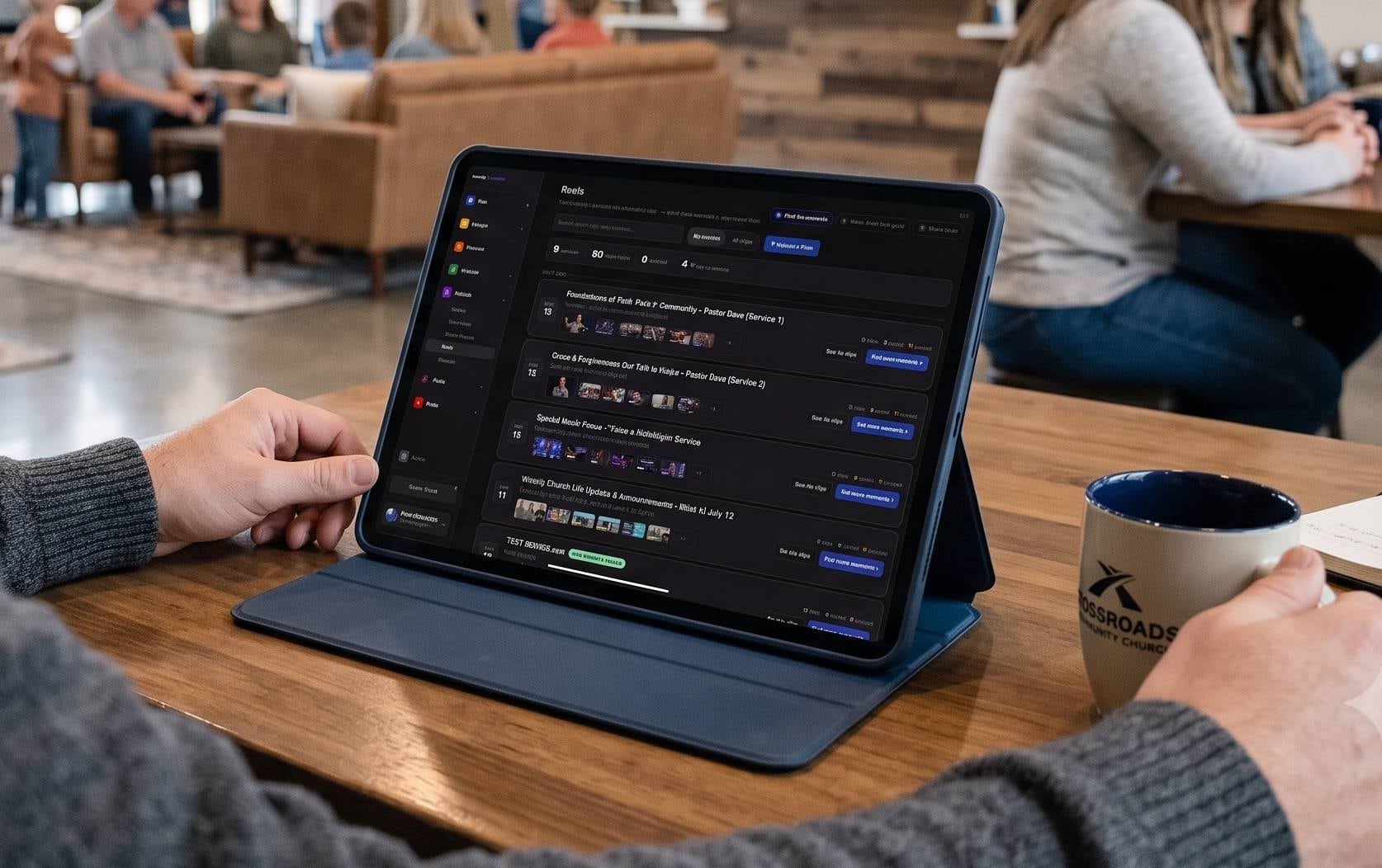
The front door is a phone now
Pastor, here’s a truth your growth strategy has to reckon with: almost nobody walks into your church cold anymore. They watch first. A guest visits your website, finds your Instagram, watches a clip or three — sometimes for weeks — and then, if something drew them, they walk through the physical door already half-belonging. The front porch of the church became a screen, and the people standing on it are exactly the ones you’re trying to reach.
Which raises the question worth a pastor’s attention: what’s on that screen? For most churches, not much — a service time, a stock photo, maybe a full-service video nobody watches to the end. Meanwhile the thing that would actually move a searching person — a real moment of your real preaching — stays buried in a 75-minute recording nobody scrolls. Sermon clips are simply the practice of putting the good moment where the searching person can find it. Done honestly, it’s not marketing. It’s meeting people at the door they’re actually standing at.
What a clip actually does for growth
Three mechanisms, none of them gimmicks:
Reach beyond the room. Your sanctuary seats a few hundred; a clip has no walls. A genuinely moving 30 seconds — a sermon point that reframes grace, a testimony of a marriage restored — reaches people who’d never have found you, in numbers your building can’t hold. Not vanity metrics: people, each one a screen where your church showed up.
Warm-up before the visit. The guest who’s watched five clips isn’t a stranger on their first Sunday — they’ve heard you teach, seen the room, taken your church’s temperature from a safe distance. Clips lower the terrifying activation energy of a first visit by making it feel like a return. The attendance data on online-first visitors keeps confirming this pattern.
A week of ministry from one Sunday. You pour a week into a sermon that’s “over” by noon Sunday. Clips extend that one faithful message across the whole week that follows — the moment that lands Wednesday for someone who wasn’t in the room, the line a member sends the friend they’ve been praying for. One sermon, preached once, ministering for seven more days.
The evangelism you can hand your congregation
Here’s an angle pastors love once they see it: clips turn your whole congregation into inviters. “Come to my church” is a heavy ask that most members never make. “This helped me — thought of you” attached to a 30-second clip is a light one, and people share it freely. Every clip you post is a low-friction invitation you’ve placed in the hands of every member who’s been quietly hoping to reach someone. That’s the church’s oldest growth engine — the personal invitation — rebuilt for the way relationships actually work now.
Without becoming a content machine
The fear is real and worth naming: I did not enter ministry to chase an algorithm. You don’t have to. The only thing required of you is the thing you already do — preach faithfully. The moment that reaches a searching person was going to be preached regardless; clips just carry it past the back wall. Everything else is handled downstream: the service records itself, AI finds the moments, and a volunteer picks and posts — a role most churches can fill from their own pews, often with a student. Your plate doesn’t grow. Your reach does.
And the reach compounds, because every clip is cataloged and kept — a growing library of your church’s best moments, ready for the next campaign, the next series, the next searching person who finds the exact words they needed.
The pastoral bottom line
Clips won’t grow a church on their own — no tool does. What draws and keeps people is the real thing: the gathered body, the faithful Word, the love that meets them when they arrive. But in an age where the journey to that front row now begins on a phone, refusing to be present on that screen isn’t humility — it’s absence from the mission field. Short clips of true moments are simply how a faithful church makes sure that when a searching person looks, there’s something real to find. The message was always the point. This is just making sure it’s carried to the door where people are actually knocking.
Next: see how students can find and share your sermon’s best moments, from church or from home, on the Youth Clip Team page.
Next: see how every step connects, from Sunday’s livestream to clips to a first-time guest walking in the door, on the Grow Your Church Online page.
Related questions
- Do sermon clips really help a church grow?
- They work the way the modern front door works: almost nobody walks into a church cold anymore — they encounter it online first. A well-chosen 30-second clip of a real sermon moment reaches people your building never could, warms up potential visitors over weeks, and gives your congregation something worth sharing with the friend they've been praying for.
- Isn't preaching to a phone screen a distraction from the real work?
- It's an extension of it. The clip isn't a replacement for the gathered church; it's a bridge to it. One faithful sermon becomes a week of reach, one moment finds the person who needed exactly those words on a Tuesday, and the goal is always the same: draw people toward the real thing — the gathered body, the full message, the front row.
- How does a pastor start using clips to reach people without adding to their plate?
- Not by becoming a content creator. The service is already recorded, AI finds the shareable moments, and a volunteer picks and posts — the pastor's only job is preaching faithfully, which they already do. The moment that reaches someone was going to be preached anyway; clips just carry it further.
OBS Won't Launch and the Service Starts in an Hour
NextReaching the Next Generation: Why Your Church Needs Short Video
Related Articles
A Content Engine That Stays Personal: More Clips, Better Titles, Better Thumbnails
Keeping up online means more content than most church teams can make by hand. Clipping every service, with AI help on titles, descriptions, and thumbnails, turns one sermon into a week of posts. Here's how to build a church content engine that stays personal, controllable, and true to your voice.
Which Sermons Resonate? What Clip Metrics Tell Pastors
When you clip every service, each clip becomes a small signal: what people watched, finished, shared, and came back to. Here's how pastors can read sermon clip metrics to learn what's connecting with their congregation and community, without letting the numbers write the sermon.

Which Worship Songs Does Your Congregation Love? Song Insights From Clips
Worship leaders usually choose songs by feel, familiarity, and theme. Clip metrics add another view: which songs people play again and again, at church and online. Here's how to read worship song insights to plan stronger sets, and the licensing to check along the way.