Your church is producing insight every week
A few years ago, most churches had one number: Sunday attendance. Now a church that streams and clips its services produces much more every week:
- In-person attendance
- Live and replay online viewers
- How each sermon clip performed
- How each worship song clip performed
- Comments, shares, and questions
- First-time guests, and how they heard about you
That’s valuable, but only if someone looks at it and decides something. A short monthly review turns information into ministry.
Before the meeting: one page
Ask your media or communications lead to prepare a one-page summary each month. In WorshipMetrics, most of it comes straight from the dashboards:
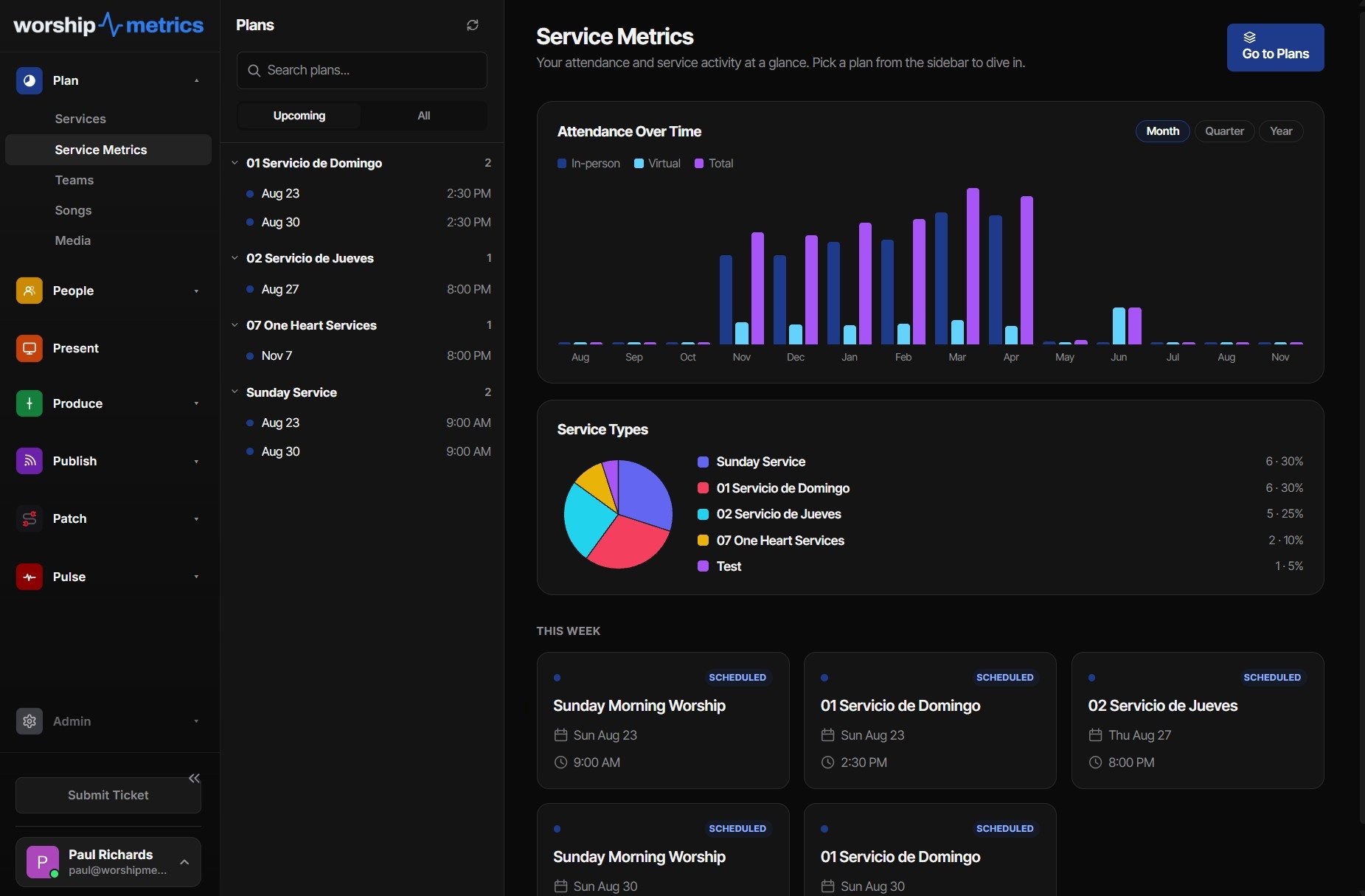
- Attendance: in-person and online, compared with the same month last year (Service Metrics)
- Top sermon moments: the three clips your congregation and the public finished and shared most (which sermons resonate?)
- Top songs: the worship songs people played most (song insights)
- Your people vs. the public: where your private WorshipMetrics congregation and YouTube viewers responded differently
- First-time guests: how many, and how they found you (are your clips bringing people in?)
- Questions from comments: the two or three things people kept asking
The 45-minute agenda
1. Celebrate (5 minutes). Start with a story, not a number: a comment, a guest who found you through a clip, a volunteer who stepped up.
2. Attendance (10 minutes). Are in-person and online moving together? What’s different from last year?
3. What resonated (10 minutes). Look at the top sermon moments and songs. What do they have in common? What does that say about what people are carrying?
4. What people are asking (10 minutes). Do the questions in comments suggest a future sermon, a small group topic, or a FAQ for the website?
5. Decide (10 minutes). Choose one or two actions for next month, with a name next to each. For example:
- Share more clips like the month’s top performer
- Rest a song that’s run its course
- Address a recurring question in a future message
- Improve the welcome for first-time guests
Questions that keep it healthy
- Is this helping us care for people better?
- Are we listening to what people need, or chasing what’s popular?
- What does this tell us about our community that we didn’t know?
- What will we do differently because of it?
Keep ministry ahead of metrics
Numbers can show you where to look. They can’t tell you what’s faithful. A sermon that gets fewer views can still be exactly what your church needed. A song that’s less popular can still be the right one to sing. Use insights to communicate better and care better, not to chase attention. (See measurement supports discernment.)
Make it a habit
- Same week every month, so it becomes routine
- Same one-page format, so trends are easy to spot
- Keep a running list of decisions and check them next month
- Share wins with the team, especially the volunteers who make the clips
How WorshipMetrics organizes it
WorshipMetrics brings the pieces into one place for leadership: Service Metrics for in-person and online attendance, Reels (formerly Worship Clips) for clips and insights on which sermons and songs resonate, split between your private WorshipMetrics congregation and YouTube, and People with QR check-in for first-time guests. Instead of gathering numbers from five places, your team spends the meeting deciding what to do.
Related questions
- What should church leadership review each month?
- In-person and online attendance trends, which sermon and song clips resonated most with your congregation and the public, first-time guests and how they found you, and what questions people asked in comments. Then decide one or two actions.
- How long should a monthly media review take?
- About 45 minutes, if someone prepares a one-page summary beforehand. The point is to discuss what the numbers mean and decide what to do, not to read spreadsheets together.
- Who should attend a church media insights review?
- The senior pastor, the worship leader, the communications or media lead, and anyone responsible for guest follow-up. Keep it small enough to have a real conversation.
A Content Engine That Stays Personal: More Clips, Better Titles, Better Thumbnails
NextWhich Sermons Resonate? What Clip Metrics Tell Pastors
Related Articles

Making a Complicated Church AV System Easy to Run, Without Hiring an AV Company
Many church AV systems aren't too old or too small. They're too complicated for a volunteer. A simple button panel built with Bitfocus Companion can hide that complexity behind plain-word buttons, and a church can often build it themselves. Here's when that works, when to call a professional, and how to start.

Your Church Livestream Team, Connected Even When They're Not at Church
A three-person livestream team only works if everyone shares the same plan, the same wiring diagram, and the same news when something breaks. Here's how WorshipMetrics connects the director, slides, and camera volunteers through the week: chat, alerts, documentation, AI help, scheduling, and cloud control for OBS and vMix.

The Three-Person Church Livestream Team: Director, Slides, and Cameras
A church livestream runs best with three clear jobs: a director on OBS or vMix, a slides operator, and a camera operator. Here's what each role does before, during, and after the service, what skills it takes, and how the three talk to each other.