The problem with isolated numbers
Most churches measure their stream with one number: views. It’s easy to find and easy to celebrate. It’s also nearly useless for ministry on its own. A view might be a member watching the whole service, a stranger who left after ten seconds, or a phone left playing in an empty room.
In-person attendance has the same problem when it sits alone in a spreadsheet. When online and in-person numbers live in different places, nobody can see the most important patterns: Are online viewers coming back? Are they visiting in person? Is the online congregation growing, or quietly shrinking?
The goal is count what helps you care better.
The six-metric weekly report
One page, updated every week, in about fifteen minutes:
1. In-person attendance (adults, kids, total). The number your pastor already watches.
2. Live online reach: peak concurrent viewers and total unique viewers. These measure how many people you reached.
3. Replay views in the seven days after the service. These measure whether the content kept serving people after Sunday.
4. Prayer requests received, and prayer requests answered. This measures pastoral care, not production quality. If you track only one number from this list, track this one, and watch the gap between received and answered.
5. Private community activity: new members, messages, and who stays. This applies if you run a group chat, an online small group, or a community space like Discord.
6. Follow-up actions completed: personal replies sent, calls made, first visits that began online.
Add one or two short notes about what changed or needs attention: “Prayer requests doubled after we added the lower third.” “Three online viewers visited this month; two came from the same small group.” The notes are often the most useful part of the report.
What the numbers actually tell you
Each number answers a different question. Don’t let one stand in for another.
| Metric | The question it answers |
|---|---|
| In-person attendance | Who gathered in the room? |
| Peak concurrent viewers | How many people were with us live at the same time? |
| Unique viewers | How many different people did we reach? |
| Replay views (7 days) | Did the service keep serving people during the week? |
| Prayer requests answered | Did people who reached out get cared for? |
| Follow-up completed | Did we do what we said we’d do? |
Metrics to actively avoid
Some numbers are loud but tell you little about ministry:
- Social media follower count. Measures promotion, not impact.
- Total impressions. Mostly measures the platform’s algorithm.
- A single week’s spike without context. Easter and Christmas Eve will always be big. Compare them to last year’s Easter and Christmas Eve, not to the Sunday before.
- “Views” with no definition. Platforms count views differently, so a three-second view and a full service can be the same “1”. (See how churches know how many actually watched.)
Measurement supports discernment
Numbers can tell you where to look. They can’t tell you what it means. A drop in online viewers could mean people are coming back in person, which is good news. A rise in prayer requests could mean a hard season in the community, which calls for care, not celebration. Read the report together as a team, and let the numbers start conversations rather than end them.
Students can help steward this well
The weekly report is a great job for a student or a detail-minded volunteer: a data tracker seat on the media team. It’s real responsibility, it teaches careful work, and it gives leadership a better picture of the ministry every week. See all the seats in the AV team role guide.
Pull the numbers automatically
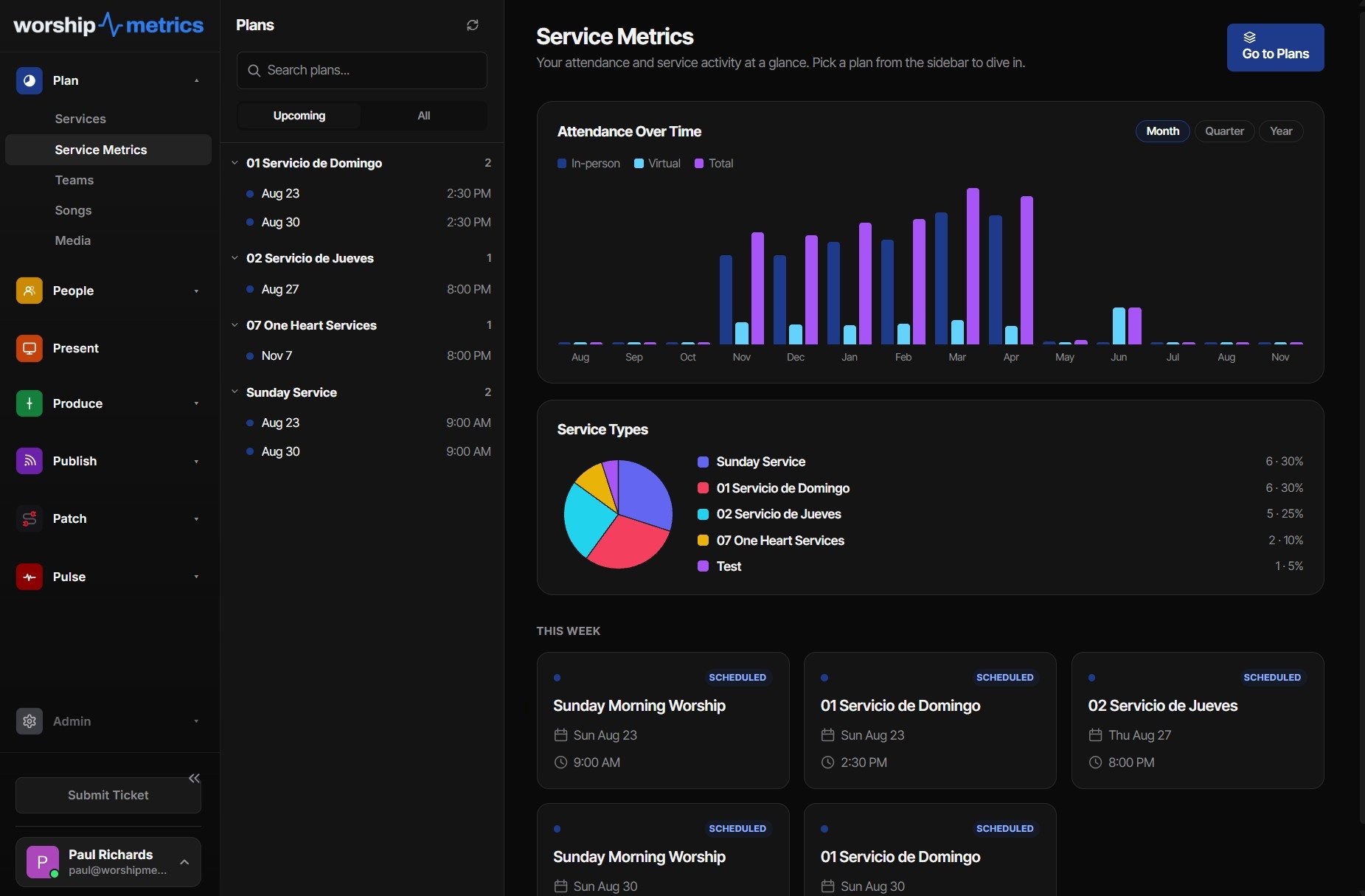
The report only lasts if it’s quick to fill in. Service Metrics in WorshipMetrics puts in-person and online attendance on one dashboard. With the Max plan, it connects to your YouTube or Facebook broadcast and counts concurrent viewers every minute, then adds the peak and average to that day’s attendance when the broadcast ends. Year-over-year comparisons by service type are built in, so Christmas Eve is compared with last Christmas Eve automatically. Read more about church livestream analytics and what counts as online attendance.
If you’re the pastor, the volunteer, or the tech director
Pastor: ask about number four first. “How many people asked for prayer, and did each of them hear back?” tells your team what you care about.
Volunteer: if you keep the report, write the notes. Anyone can copy a number. Noticing what changed is the ministry.
Tech director: automate everything you can, so the fifteen minutes go to the notes, not to copying numbers between tabs.
Print it: the free Online Ministry Checklist puts this and the rest of the weekly online routine on one page for your team.
Go deeper: see which sermons and songs resonate in what clip metrics tell pastors, and bring it together in the monthly media insights review.
Related questions
- What metrics should a church track for its live stream?
- Track six things each week: in-person attendance, live online reach (peak concurrent and unique viewers), replay views in the following seven days, prayer requests received and answered, private community activity, and follow-up actions completed. Add one or two notes about what changed.
- Which church metrics should we ignore?
- Numbers that measure promotion instead of people: follower counts, total impressions, and single-week spikes without context. They're loud but rarely tell you whether anyone was reached or cared for.
- How long should a weekly ministry report take?
- About fifteen minutes. If it takes longer, it won't last. Pull attendance and viewer numbers automatically where you can, and spend your time on the notes.
The Pre-Service Welcome Loop: What Your Stream Shows Before the Service Starts
NextHow to Engage Online Church Viewers (Without Hype)
Related Articles

Making a Complicated Church AV System Easy to Run, Without Hiring an AV Company
Many church AV systems aren't too old or too small. They're too complicated for a volunteer. A simple button panel built with Bitfocus Companion can hide that complexity behind plain-word buttons, and a church can often build it themselves. Here's when that works, when to call a professional, and how to start.

Your Church Livestream Team, Connected Even When They're Not at Church
A three-person livestream team only works if everyone shares the same plan, the same wiring diagram, and the same news when something breaks. Here's how WorshipMetrics connects the director, slides, and camera volunteers through the week: chat, alerts, documentation, AI help, scheduling, and cloud control for OBS and vMix.

The Three-Person Church Livestream Team: Director, Slides, and Cameras
A church livestream runs best with three clear jobs: a director on OBS or vMix, a slides operator, and a camera operator. Here's what each role does before, during, and after the service, what skills it takes, and how the three talk to each other.