The short answer: count both, separately, the same way every week
Every hybrid church eventually has this meeting. Someone reports “we had 185 on Sunday,” someone else asks “does that include online?”, and twenty minutes later the room has invented three incompatible definitions of attendance. The way out is a simple counting policy:
- Count the room with a consistent method at a consistent moment.
- Count the stream as peak concurrent viewers during the live window.
- Report both numbers side by side, plus their sum — one Total Reach, with the in-person and online halves always visible.
- Never change the method — because the trend matters more than any single Sunday’s total.
That’s the whole policy. The rest of this article is why each piece matters and how the counting actually happens without adding work to anyone’s Sunday.
Why “separately” is the load-bearing word
The temptation is to pick one grand total and move on. But a single blended number hides exactly the stories leadership needs to see: in-room attendance dipping over the summer while online grows; online stagnating while the room recovers; a service type that reaches few people in person but travels far on the stream.
There’s also an honesty problem with equivalence. A screen isn’t a seat — one connection might be a college student alone or a family of five on a living-room TV. Rather than inventing a multiplier you can’t defend, keep the units clean: people counted in the room and screens watching live. Both are real, both are measured, and neither pretends to be the other. When the numbers sit side by side every week, everyone learns to read them fluently — and the sum, Total Reach, gives the one-line answer for the board report without erasing the detail.
And behind the online number are people worth counting well: the member who gave faithfully for fifty years and now worships from a recliner, the family that moved away, the traveling parent in a hotel, the not-yet-visitor quietly deciding whether to walk in. They aren’t an asterisk on attendance. They’re the congregation.
Counting the room without the clipboard
Consistency in the room comes down to method and moment.
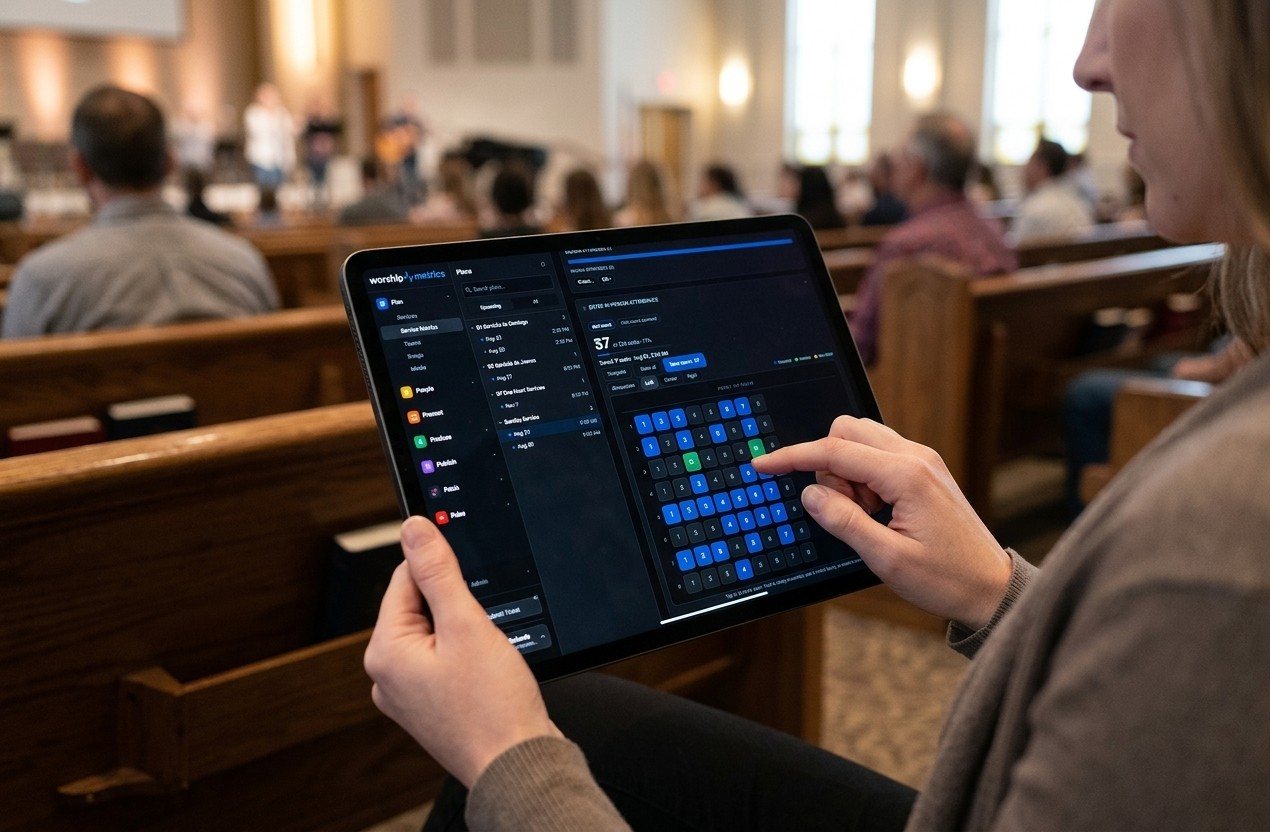
Method: WorshipMetrics gives you two, and they work together. The seat-map counter in Tech Manager is a saved map of your actual room — sections, rows, seats — that a volunteer taps on Sunday: tap a seat to toggle it, hold to assign a member or mark a first-time visitor. Camera Auto-Count goes further and removes the human arithmetic entirely: an RTSP camera or webcam looks at the room and the booth computer counts, on a schedule or on demand. Most churches run the camera for the main room and keep seat maps for the places no camera sees — the balcony, the cry room, the overflow.
Moment: the auto-counter’s schedule is the quiet hero. A count taken twenty minutes in, every single week, is a measuring stick; a count taken “whenever the usher was free” is a guess. Pick a settled moment — not the opening song, not greeting time — and never change it. The full setup, including framing the camera and validating against manual counts, is in the camera Auto-Count guide.
If you run multiple services, each gets its own count attached to its own service — the 9:00 and the 11:00 stay distinct numbers instead of blurring into one Sunday total.
Counting the stream without screenshots
The online half is even less work: connect your YouTube or Facebook broadcast and concurrent viewers are sampled every minute during the service, with the peak and average rolled into that day’s attendance automatically when the broadcast ends. Streams through the WorshipMetrics player count the same way. No one screenshots a dashboard, and no one forgets.
Why peak concurrent rather than the platform’s “views” number? Because views accumulate replays, partial watches, and repeat visits over days — it’s a content metric, not an attendance metric. The full argument, and what the minute-by-minute curve reveals about when your online congregation actually shows up, is in how churches know how many people watched the livestream.
What the policy unlocks: trends you can act on
Once both halves are measured consistently, Attendance Over Time turns the weekly numbers into the comparisons leaders actually ask for — in-person, virtual, and total by month, quarter, or year, broken out per service type. Did Easter beat last Easter? What did the sermon series do? Is the online congregation growing or quietly going stagnant? These stop being impressions and become lookups.
That’s also when attendance data starts feeding ministry rather than just reporting. First-time visitors marked at the seat map or captured through QR check-in land in the directory where your follow-up team can actually reach them — counting, done well, is the front end of hospitality.
How WorshipMetrics handles this
The counting policy above is how the platform is built: Tech Manager counts the room by seat map or camera at your chosen moment, live streaming samples connected broadcasts every minute, and Service Metrics stores each service’s in-person, online, and Total Reach numbers side by side with the year-over-year charts on top. Seat-map counting ships in the free platform; camera Auto-Count comes with Pro and Max, and automatic online viewer analytics with Max. One policy, zero Monday data entry, and an answer to “are we growing?” that everyone in the meeting can trust.
Related questions
- Should online viewers count the same as people in the room?
- Count them separately and report both. A screen may hold one person or a family, and presence in a room differs from presence on a stream — so the honest policy is two clean numbers measured consistently, rolled into one Total Reach, rather than a debate about equivalence.
- How do we count the room without an usher and a clicker?
- Two ways, both in Tech Manager: a seat-map counter volunteers tap on a tablet — with seats assignable to members and visitors markable — or camera Auto-Count, which tallies the room from an RTSP camera or webcam on a schedule, at the same moment every week.
- What about people watching one stream as a family?
- Peak concurrent viewers counts screens, not people, and that's fine — as long as you measure the same way every week, the trend is real. Consistency, not a per-screen multiplier, is what makes attendance data trustworthy.
Why Does Our Livestream Look Fine at 9:00 and Stutter by 9:40?
NextHow Can a Pastor Check That Sunday Went Okay Without Asking the Tech Team?
Related Articles

Making a Complicated Church AV System Easy to Run, Without Hiring an AV Company
Many church AV systems aren't too old or too small. They're too complicated for a volunteer. A simple button panel built with Bitfocus Companion can hide that complexity behind plain-word buttons, and a church can often build it themselves. Here's when that works, when to call a professional, and how to start.

Your Church Livestream Team, Connected Even When They're Not at Church
A three-person livestream team only works if everyone shares the same plan, the same wiring diagram, and the same news when something breaks. Here's how WorshipMetrics connects the director, slides, and camera volunteers through the week: chat, alerts, documentation, AI help, scheduling, and cloud control for OBS and vMix.

The Three-Person Church Livestream Team: Director, Slides, and Cameras
A church livestream runs best with three clear jobs: a director on OBS or vMix, a slides operator, and a camera operator. Here's what each role does before, during, and after the service, what skills it takes, and how the three talk to each other.