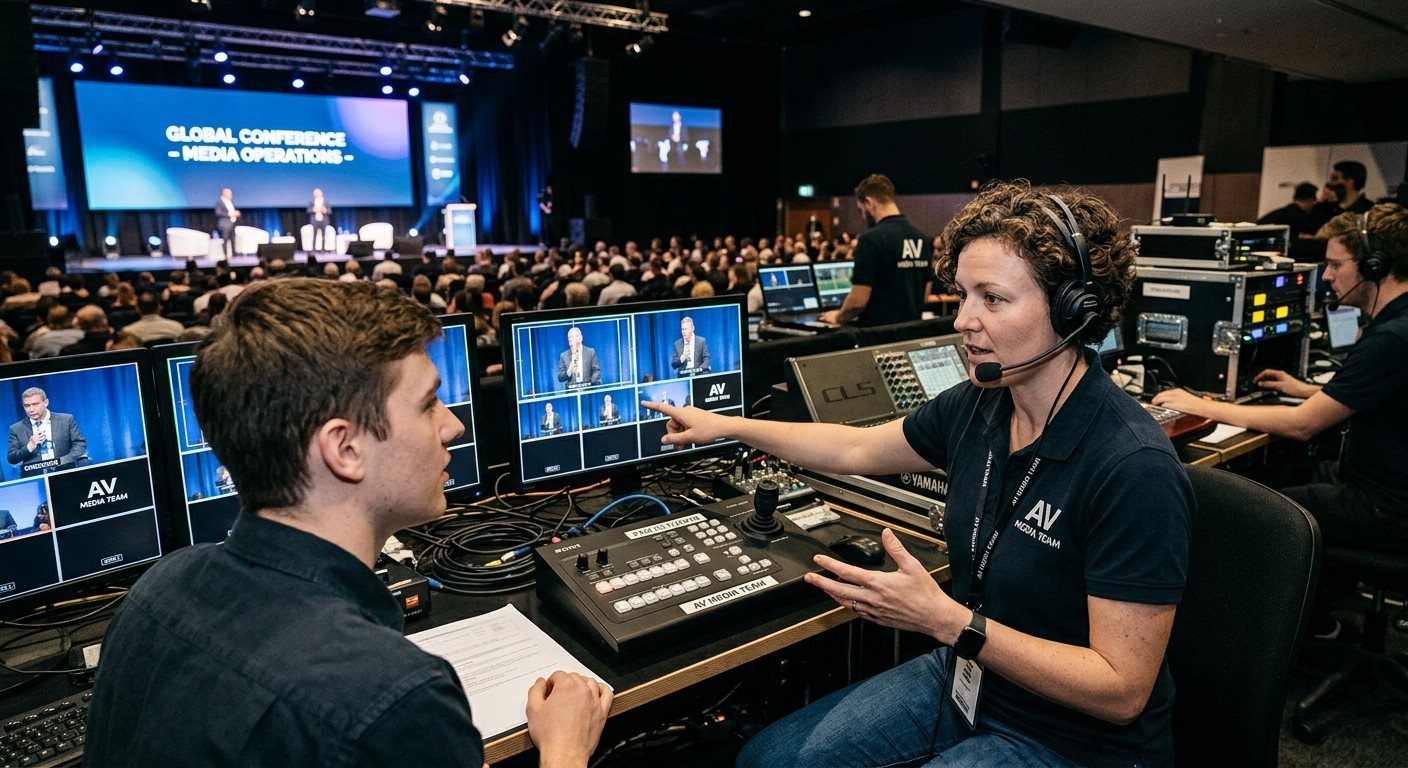
The short answer
A house of worship AV integrator designs, installs, and supports the systems a church uses to gather: what people hear, what they see, and what reaches people who aren’t in the room. Depending on the church and the integrator, that can include:
- Sound: microphones, the sound board, speakers, and the mix for the livestream
- Video: cameras, a switcher or production computer, and the screens in the room
- Livestream: encoding, streaming to your platforms, and recording every service
- Presentation: lyrics, scripture, and sermon slides on the screens and on the stream
- Room outputs: lobby TVs, overflow rooms, and the stage’s confidence monitor
- The network that ties it together
- Documentation and training, so the system makes sense to whoever runs it next
Some integrators do all of it. Many specialize. The word that matters is the one in the title: worship.
Event AV and worship AV are not the same job
Many great AV companies cut their teeth on conferences, corporate events, and concerts. The equipment overlaps a lot with a church booth. The job doesn’t.
| Event and corporate AV | Worship AV | |
|---|---|---|
| Who runs it | A professional crew | Rotating volunteers |
| How often | Once, or a short run | Every week, for years |
| Training | Already trained | An hour, maybe two |
| When something breaks | A technician is on site | Maybe nobody who knows the system is in the room |
| What success looks like | The show went well | Anyone on the team can run Sunday, and the stream reaches people at home |
That’s why “we also do houses of worship” and “we specialize in houses of worship” can mean very different things.
What “worship specialist” should mean
When an integrator says they specialize in churches, here’s what you should be able to see:
- They design for volunteers. Plain-word buttons (“Pastor Wide,” not “Scene 4”), fewer screens to watch, a printed Sunday checklist. (See the volunteer-friendly booth.)
- They plan for the stream as well as the room. A separate stream mix, cameras placed for people watching at home, and lyrics and slides that reach the stream.
- They respect the calendar. Work is scheduled around Sundays, Christmas, and Easter, and nothing is left half-finished on a Saturday night.
- They respect the room. Quiet gear during prayer, equipment that disappears from the sanctuary, cable runs that don’t trip anyone.
- They work with church software. Your slides software, your planning tools, your streaming platform.
- They plan for turnover. Documentation, training, and support that survive the day your best volunteer moves away. (See the handoff checklist.)
Questions that reveal real specialization
- “Show me what a first-time volunteer sees on Sunday morning.”
- “What happens if the stream stops at 10:40 and our tech director is out of town?”
- “How do you train a band member or a pastor, not just the booth?”
- “Can you show me a church like ours that you’ve worked with?”
The answers will tell you quickly whether worship is a specialty or a line on a website.
Where WorshipMetrics focuses
WorshipMetrics is a house of worship AV integrator focused on livestreaming, video, and presentation, the part of church AV that has changed the most in the past few years and that small and mid-size churches most often struggle to find help with. We also make the platform that ties it together, so your slides, stream, clips, documentation, and monitoring live in one place your whole team can use.
If your project is mainly a new sanctuary speaker system or acoustic treatment, we’ll tell you so and help you scope it, because that’s a different specialty. If your next step is a livestream that works every Sunday and a booth anyone can learn, that’s what our Livestream Systems are built for.
Next: livestreaming and video are a specialty, or how to choose a church AV integrator.
Related questions
- What does a house of worship AV integrator do?
- A house of worship AV integrator designs, installs, and supports the audio, video, livestream, presentation, and related systems a church uses for services. A good one also documents the system and trains the volunteers who will run it.
- What makes an AV integrator a worship specialist?
- A worship specialist designs for rotating volunteer operators, plans for the livestream as well as the room, schedules work around Sundays, works with church software like slides and planning tools, and has a plan for training and support as the team changes.
- Is church AV different from event or corporate AV?
- Yes. Event and corporate AV is usually run by professional crews for a single event. Church AV is run by volunteers every week for years, so it has to be simpler to operate, easier to train, and more resilient when the most experienced person isn't there.
Consumer vs. Commercial-Grade AV Gear for Churches: When Paying More Saves Money
NextFinding an AV Integrator for the Long Term: What Happens After Install Day
Related Articles
Build the Church Tech Schedule in 20 Minutes: Positions First, Then People
The schedule that takes all week is the one that starts with people. Start with positions, let availability narrow the list, and invite one person per slot. A month of Sundays in twenty minutes.
What Church Leadership Should See on Monday: Attendance Trends That Mean Something
A single Sunday number tells leadership almost nothing. Here's what to put in front of the elders on Monday instead: in-person and online together, total reach per service, the trend by month and year, and the one list that turns a number into a phone call.
One Sunday, Four Audiences: The Lobby, the Room, the Feed, and the Living Room
Every Sunday a church talks to four audiences on four kinds of screen, usually with four tools and four people. Here's what each audience actually needs, and how one platform covers all four without a media team.