The real price is price divided by Sundays
A $30 keyboard that fails in a year has cost more per Sunday than a $120 one that lasts six. Church equipment lives a hard life:
- Many hands. Different volunteers every week, each with their own habits.
- Every week, for years. Some booths run the same gear for a decade.
- In public. It’s seen, heard and relied on during worship.
- Hard to replace quickly. A failure on Saturday night is a problem on Sunday morning.
That’s why commercial-grade gear usually costs less over its life, even though it costs more on day one. Cheap gear often gets replaced before it ever delivers its full value.
What commercial grade gets you
- Durability. Built for continuous use, many users and years of service.
- Better warranties and parts that are still available years later.
- Easier to clean and support. Designed for shared environments.
- A professional look. Matched, clean equipment tells volunteers and visitors this ministry matters.
- Consistency. Buy the same model again in three years and it matches.
Where it matters most
Keyboards and mice
The most-touched objects in the booth, shared by everyone. Choose sealed, washable keyboards and mice, the healthcare-grade kind made for hospitals and clinics. They wipe clean with disinfectant, survive a spilled coffee, and many are quiet.
And make them quiet. Loud, clicky mechanical keyboards are distracting during prayer and quiet moments. Look for low-profile or “silent” keys and silent-click mice.
Monitors
Use matched, color-calibrated professional monitors, not a mix of whatever’s available. (Medical-grade monitors are a different tool, built for X-rays; see why your booth monitors don’t match.)
Cables and connectors
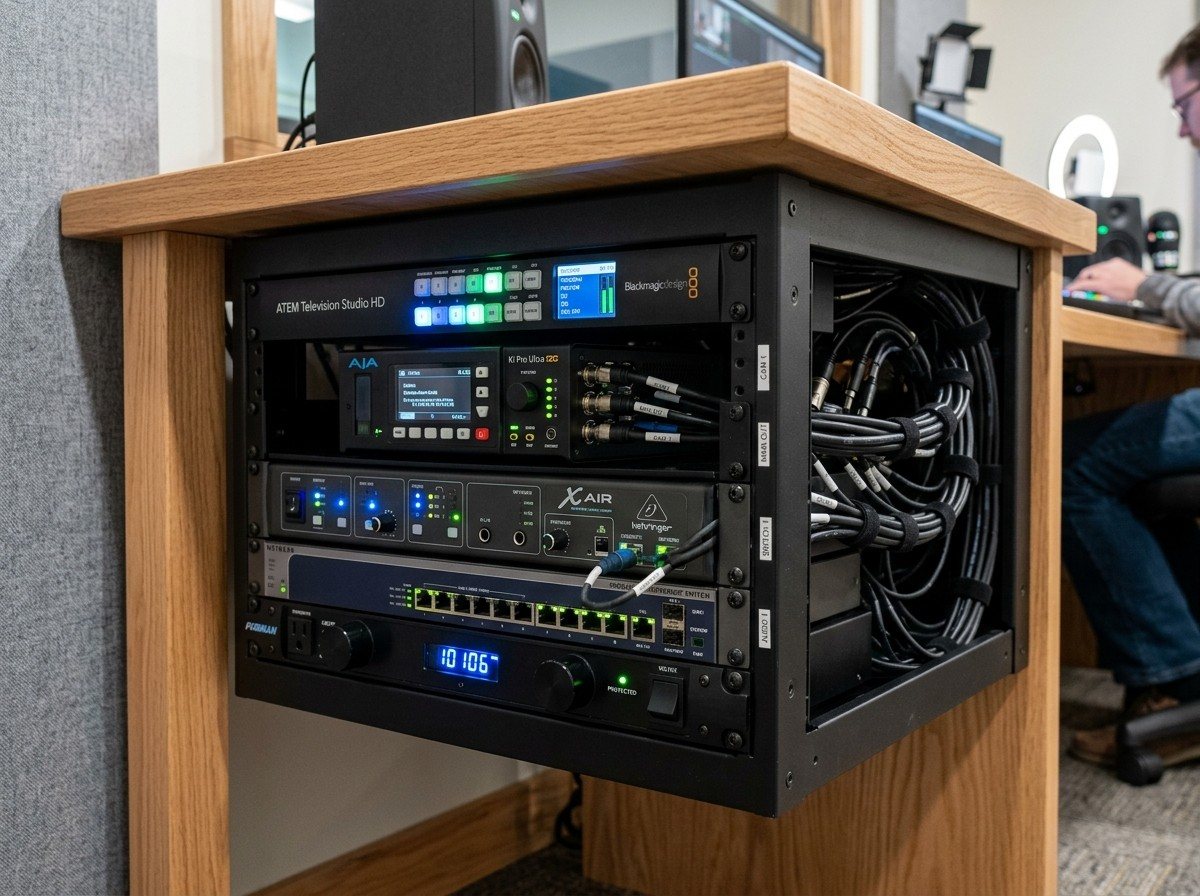
Good cables with solid strain relief, locking connectors where you can (SDI’s BNC connectors lock), and network cable that’s rated for the run. A $5 cable can take down a $5,000 system.
Power
A rackmount UPS and a proper power strip in the rack, not a chain of household extension cords under the table.
The computer
A purpose-built, rack-mounted streaming computer with professional capture, not an old office tower. (See what’s the best computer for church livestreaming?)
Where consumer gear is fine
- Spare and training equipment, like a practice laptop for the AV Club
- Low-stakes screens, like a classroom TV
- Things that are cheap to replace and don’t stop the service
Make old gear count
When you upgrade, the old consumer gear still has value. Donate it to your AV Club for training, or repurpose a laptop as an overflow or confidence screen.
Built in
Our Livestream Systems are built from commercial-grade parts: a 4U rackmount computer, Magewell capture built for 24/7 operation, and a 3-year warranty. Map your current system and we’ll tell you what’s worth keeping and where commercial grade would pay off first.
More tips in the volunteer-friendly booth.
Related questions
- Why should a church buy commercial-grade AV equipment?
- Church gear is shared by many volunteers and used every week, often for years. Commercial-grade equipment is built for that: it lasts longer, carries better warranties, is easier to clean and support, and looks professional. Consumer gear often has to be replaced before it delivers its full value.
- What are medical-grade keyboards and mice?
- Sealed, washable keyboards and mice made for hospitals and clinics. They can be wiped with disinfectant, resist spills, and many are quiet, which is exactly what a shared church booth needs.
- Where is consumer gear good enough?
- For things that are easy to replace, rarely used, or not critical to Sunday: a spare webcam, a training laptop, or a TV in a classroom. Spend on the gear that's touched every week or would stop the service if it failed.
Church Livestreaming and Video Are a Specialty: How to Find an Integrator Who Builds for the Stream
NextWhat Does a House of Worship AV Integrator Do? (And What 'Worship Specialist' Should Mean)
Related Articles

Making a Complicated Church AV System Easy to Run, Without Hiring an AV Company
Many church AV systems aren't too old or too small. They're too complicated for a volunteer. A simple button panel built with Bitfocus Companion can hide that complexity behind plain-word buttons, and a church can often build it themselves. Here's when that works, when to call a professional, and how to start.

Your Church Livestream Team, Connected Even When They're Not at Church
A three-person livestream team only works if everyone shares the same plan, the same wiring diagram, and the same news when something breaks. Here's how WorshipMetrics connects the director, slides, and camera volunteers through the week: chat, alerts, documentation, AI help, scheduling, and cloud control for OBS and vMix.

The Three-Person Church Livestream Team: Director, Slides, and Cameras
A church livestream runs best with three clear jobs: a director on OBS or vMix, a slides operator, and a camera operator. Here's what each role does before, during, and after the service, what skills it takes, and how the three talk to each other.