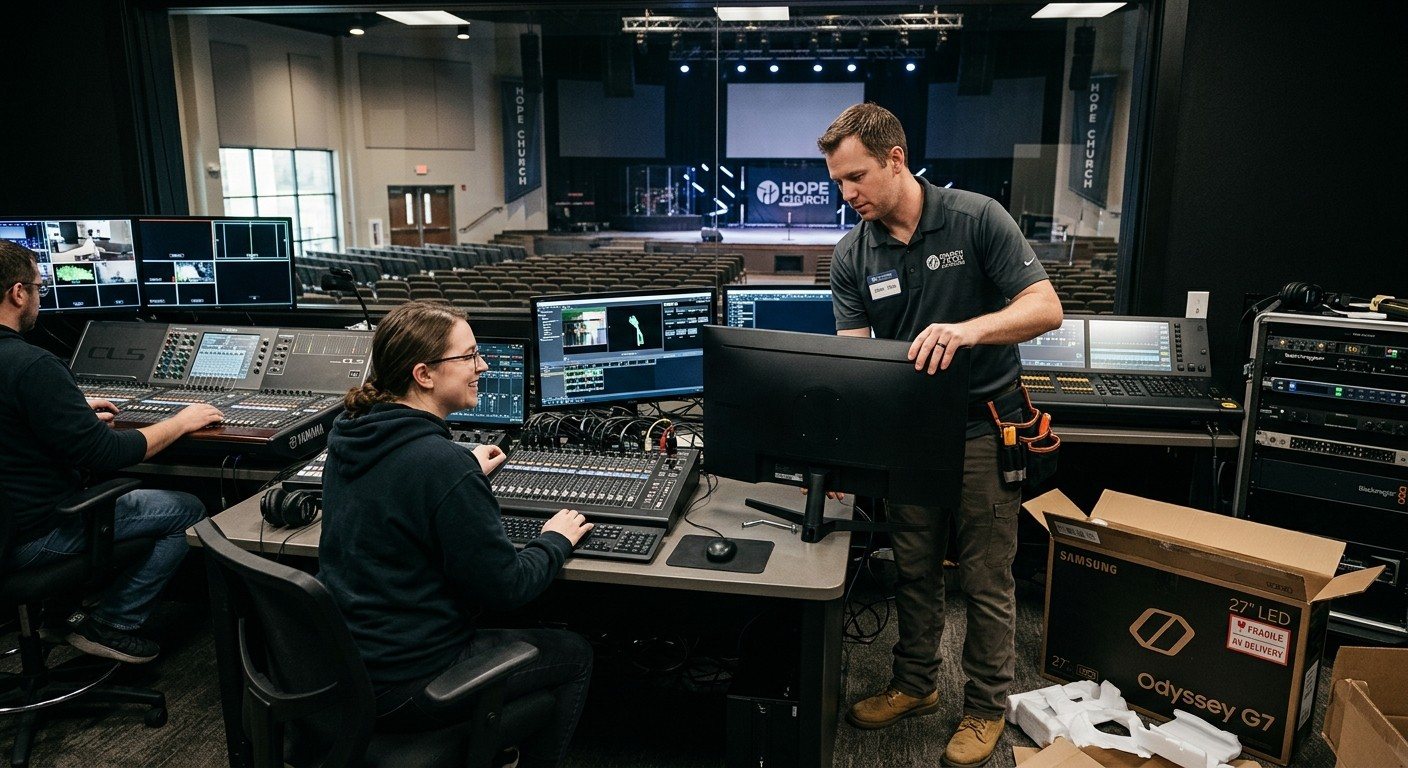
Churches are a different kind of client
Most AV integrators are excellent at what they do. But a church asks something of a system that a conference center or a concert venue doesn’t:
- Volunteers run it. Not a hired crew. Different people, different weeks, often with an hour of training.
- Sunday comes every week. There’s no “we’ll fix it before the next show.” The deadline is fixed and it’s public.
- The livestream is a ministry. For shut-ins, travelers, and the family deciding whether to visit, the stream is the church on Sunday.
- The budget is an offering. Every dollar was given, and the system has to justify it for years, not months.
- It has to outlast the person who bought it. The tech director moves, the volunteer graduates, and the system still has to make sense to whoever comes next.
An integrator who understands churches designs for all five. One who doesn’t can deliver beautiful equipment that only one person in the building knows how to run.
The three kinds of AV companies you’ll meet
When you start calling around, you’ll usually find three kinds of firms. None is wrong; they’re built for different jobs.
| Type | What they’re built for | Best fit |
|---|---|---|
| Large-venue and commercial integrators | Big custom projects: arenas, campuses, corporate buildings, very large churches | Multi-million-dollar builds with professional staff to run them |
| Audio-first installers | Speakers, consoles, acoustics, sound reinforcement | Rooms where the main problem is how it sounds in the room |
| Worship media integrators | Livestream, cameras, presentation, room outputs, and the volunteers who run them | Churches whose next step is a reliable stream and a booth anyone can learn |
Many churches need more than one at different times. The mistake is hiring one kind for a job that belongs to another, then wondering why the result doesn’t fit. (For the bigger question of whether to hire anyone, see do we need to hire a church AV company?)
Ten questions to ask any integrator
Bring these to every conversation. The answers tell you more than the brochure.
- Who will run this on Sunday, and how will you train them? A good answer names your volunteers, not just “your tech person.”
- Do you design for the livestream as well as the room? The stream needs its own audio mix, camera plan, and monitoring.
- Can we reuse what we already own? If every quote starts from zero, ask why.
- What documentation do we get? Every device, connection, and cable, labeled and mapped, in a form that stays current. (See the handoff checklist.)
- Who is our one point of contact during the project? You want a name, not a shared inbox.
- What happens after install day? Monitoring, remote help, warranty, and who picks up the phone on a Sunday morning.
- What’s the warranty, and how fast is a replacement? Downtime on a Sunday costs more than the part.
- Can a new volunteer learn this in a Sunday or two? Ask them to show you what the volunteer actually sees.
- Will it work with what we already use? Your slides software, your streaming platform, your sound board.
- Do you work with churches our size? Ask for a reference from a church like yours.
Green flags
- They ask about your people and your Sundays before they talk about gear.
- They want to see what you have before they quote.
- They show you a standard design they’ve built before, then adjust it, instead of inventing everything from scratch on your dime.
- They talk about training and handoff as part of the project, not an add-on you discover later.
- They have a plan for year two: monitoring, support, and an upgrade path.
How WorshipMetrics approaches it
WorshipMetrics is an AV integrator built for small and mid-size churches, with livestreaming and video as our specialty. We also make the platform that ties your church media together: slides, the stream, clips, documentation, monitoring, and scheduling in one place. That combination is the point. The system we build and the software your team uses every week come from the same people.
Here’s what that looks like in practice:
- A quote that starts from what you already own. Map your current system and we’ll show you what to reuse, what to upgrade, and what to add.
- Livestream Systems in Good, Better, and Best versions, built on proven reference designs and adjusted to fit your room.
- A project manager for your church, plus one on-site contact on your side who takes the system handoff.
- Remote setup included. On-site installation and training for your team (volunteers, band members, leadership staff, and operations) are quoted separately, so you choose what you need.
- Built, tuned, and tested before it ships, then burned in under a real multi-camera load, with a 3-year warranty.
- Watched over after install day. Every system reports its health to WorshipMetrics monitoring, so we can often spot a problem before your team does.
Prefer to build it yourself? Every system’s parts list is on the page, free to read and print. We’re glad to help either way.
Next: what to expect from a church AV project, step by step, or request a system quote.
Next: see how an upgrade works from the first call to Sunday morning, and what every system includes, on the Upgrade the booth page.
Related questions
- What should a church look for in an AV integrator?
- Look for an integrator who asks about your volunteers before your gear, designs for the livestream as well as the room, reuses equipment you already own where it makes sense, leaves complete documentation, gives you one point of contact during the project, trains the people who will run the system, and has a clear plan for support after install day.
- Do church AV integrators work with small churches?
- Some do and many don't, usually because their business is built around large custom projects. Small and mid-size churches do best with an integrator that uses proven reference designs, offers remote setup and support, and is happy to build around the equipment the church already has.
- How much does it cost to hire a church AV integrator?
- It depends on the scope. A focused livestream upgrade for a small or mid-size church often lands in the low-to-mid thousands to around $12,000, while full sanctuary audio, video and lighting projects run much higher. Mapping what you already own before you ask for quotes is the most reliable way to lower the number.
Why Windows Updates Break Church Livestreams (and How LTSC Helps)
NextWhat to Expect From a Church AV Project, Step by Step
Related Articles
Build the Church Tech Schedule in 20 Minutes: Positions First, Then People
The schedule that takes all week is the one that starts with people. Start with positions, let availability narrow the list, and invite one person per slot. A month of Sundays in twenty minutes.
What Church Leadership Should See on Monday: Attendance Trends That Mean Something
A single Sunday number tells leadership almost nothing. Here's what to put in front of the elders on Monday instead: in-person and online together, total reach per service, the trend by month and year, and the one list that turns a number into a phone call.
One Sunday, Four Audiences: The Lobby, the Room, the Feed, and the Living Room
Every Sunday a church talks to four audiences on four kinds of screen, usually with four tools and four people. Here's what each audience actually needs, and how one platform covers all four without a media team.