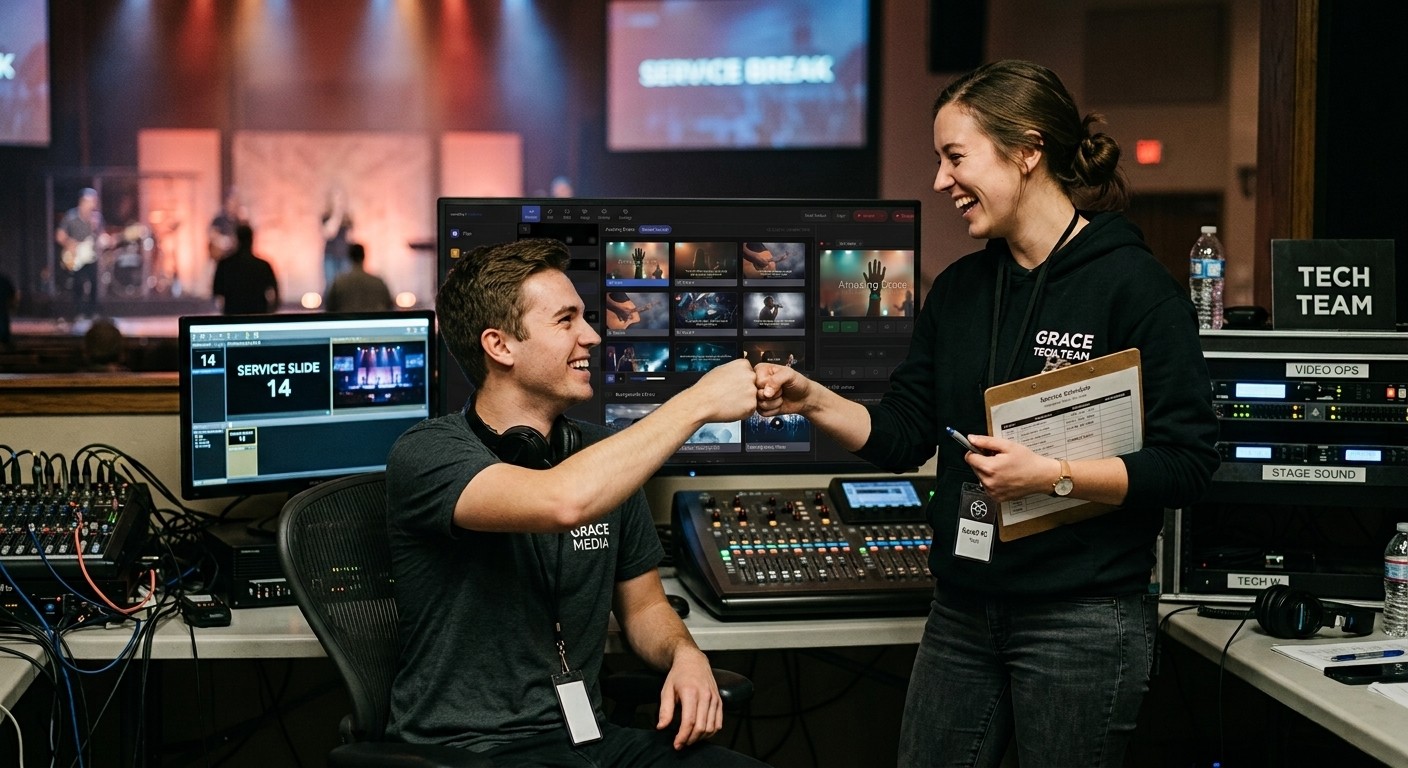
Name the seats
“We need help with tech” is hard to say yes to. Nobody knows what it means, how much time it takes, or whether they’re qualified. “We need someone to run lyrics at the 9:00 service twice a month. We’ll train you, and here’s what the job looks like” is easy to say yes to.
That’s what a role card does. It turns a vague need into a seat someone can picture themselves in.
The four questions every card answers
- What does this person do?
- Why does it matter, practically and spiritually?
- What does success look like on a normal week?
- What does growth in this role look like over time?
The fourth question is the one most churches skip. Without a visible growth path, volunteers plateau and drift. With one, a fifteen-year-old on lyrics can see a future as a director.
Seven starter role cards
Adapt these to your church. Small teams will combine some roles; that’s fine as long as it’s on purpose.
Camera operator
- Does: frames shots, follows the service, anticipates transitions.
- Why it matters: decides what the person at home actually sees.
- A good week: steady shots, no surprises, ready for the moments the pastor flagged in the story huddle.
- Grows toward: director. Level: entry-level friendly.
Graphics / lyrics operator
- Does: advances slides, triggers lower thirds, keeps lyrics in sync.
- Why it matters: if the lyrics are late, the room stops singing.
- A good week: every slide on time, and nobody noticed the operator.
- Grows toward: director, or building the service in Present. Level: entry-level. Often the best first seat.
Audio operator
- Does: manages the house mix and the stream mix.
- Why it matters: people at home forgive soft video; they don’t forgive bad audio.
- A good week: clear speech, balanced music, the congregation audible when it matters.
- Grows toward: audio lead, trainer. Level: intermediate.
Director / switcher
- Does: calls cameras, triggers scenes, owns the pacing.
- Why it matters: decides when the moment turns.
- A good week: cuts that follow the story, a calm booth, a team that knew what was coming.
- Grows toward: service director, team leader. Level: advanced.
Online host
- Does: welcomes viewers in chat, receives prayer requests, escalates sensitive moments.
- Why it matters: often the first real person an online viewer meets.
- A good week: nobody who spoke up was ignored. (See the chat host guide.)
- Grows toward: online ministry leader. Level: intermediate; warmth matters more than tech skill.
Clipper / editor
- Does: cuts short clips from Sunday’s service for the week.
- Why it matters: clips carry Sunday into people’s Tuesday.
- A good week: two or three clips posted by Thursday that tell the story of the day.
- Grows toward: content lead, testimony producer. Level: intermediate.
Stream coordinator
- Does: runs pre-service checks, watches stream health, handles problems during the service.
- Why it matters: if the stream fails, everything else is invisible.
- A good week: checks done early, problems caught before viewers notice.
- Grows toward: tech director. Level: advanced.
Bonus: data tracker. Keeps the weekly report. A great seat for a detail-minded student or retiree.
Use the cards, don’t file them
- Print them. Hand them out when you recruit, hang them in the booth, and use them in training. Digital-only role cards get forgotten.
- Recruit with them. A card answers the “what would I actually do?” question before it’s asked. (See how to ask for tech volunteers.)
- Train from them. Each card is the outline for that role’s 90-day onboarding path.
- Revisit them yearly. Gear and services change. The cards should too.
Match people to seats
Not sure which seat fits a new volunteer? The AV seat finder asks a few questions and suggests a role. Each seat also has a full guide in the AV team role library, with what the role controls in WorshipMetrics and how it fits a student’s growth. And once seats are named, scheduling fills them a month at a time.
Related questions
- What roles does a church media team need?
- Seven core roles cover most churches: camera operator, graphics or lyrics operator, audio operator, director or switcher, online host, clipper or editor, and stream coordinator. Small churches combine roles; larger ones split them further. A data tracker who keeps the weekly report is a useful eighth.
- What should a volunteer role card include?
- Four things: what the role does, why it matters, what success looks like on a normal week, and what growth in the role looks like over time. The growth path is the part most churches skip, and without it volunteers plateau.
- What's the best first role for a new media volunteer?
- Usually graphics or lyrics. It's entry-level, teaches timing and focus, and the operator sees how the whole service flows. Camera operator is another good first seat.
Setting Up a Church Discord Server: Channels, Moderation, and Safety
NextThe Seven-Day Church Media Calendar: A Ministry That Shows Up All Week
Related Articles

Making a Complicated Church AV System Easy to Run, Without Hiring an AV Company
Many church AV systems aren't too old or too small. They're too complicated for a volunteer. A simple button panel built with Bitfocus Companion can hide that complexity behind plain-word buttons, and a church can often build it themselves. Here's when that works, when to call a professional, and how to start.

Your Church Livestream Team, Connected Even When They're Not at Church
A three-person livestream team only works if everyone shares the same plan, the same wiring diagram, and the same news when something breaks. Here's how WorshipMetrics connects the director, slides, and camera volunteers through the week: chat, alerts, documentation, AI help, scheduling, and cloud control for OBS and vMix.

The Three-Person Church Livestream Team: Director, Slides, and Cameras
A church livestream runs best with three clear jobs: a director on OBS or vMix, a slides operator, and a camera operator. Here's what each role does before, during, and after the service, what skills it takes, and how the three talk to each other.