Introduction
AVKANS and Tenveo are the two most popular affordable PTZ camera brands for church production. Both offer optical zoom, remote control capability, and reliable performance at prices that work for church budgets. Yet they approach camera design differently, which makes them better suited to different church workflows.
Understanding the strengths and weaknesses of each brand helps you choose equipment that fits your specific production needs, your technical infrastructure, and your team’s skill level. This comparison covers the key differences and guides you toward the best choice for your church.
AVKANS Overview: Network-First Approach
AVKANS cameras prioritize network integration, with most models featuring full NDI support. The AVKANS PTZ-U100 and PTZ-U200 are designed first as NDI sources that appear to OBS and vMix, with secondary video outputs via HDMI or SDI.
This network-first approach means AVKANS cameras integrate seamlessly with software-based workflows. If your church uses OBS, vMix, or similar software for production, AVKANS cameras appear as native sources in your software without capture cards or complicated configuration.
The AVKANS PTZ-U100 is particularly affordable (around $400) and offers 20x zoom with solid NDI support. The PTZ-U200 adds Power over Ethernet, eliminating the need for separate power infrastructure at the camera location. The PTZ-U30 steps up to 30x zoom with SDI/HDMI outputs for professional switcher integration.
Tenveo Overview: Flexibility and Affordability
Tenveo cameras take a more flexible approach, offering models with USB, HDMI, or NDI output depending on the model. The VHD30U and VHD20U emphasize HDMI connectivity and USB webcam mode, making them work with virtually any production setup without requiring network infrastructure or multicast configuration.
Tenveo cameras do not require network planning or IT coordination. A VHD30U connects via USB to any computer and appears as a standard webcam, or via HDMI to any switcher. The simplicity is a significant advantage for churches without strong IT support or for churches using hardware switchers.
Tenveo’s NDI camera (TEVO-NDI) exists for churches wanting network-based video but preferring Tenveo hardware. Like AVKANS NDI cameras, it requires network infrastructure and multicast configuration.
Integration and Workflow Comparison
AVKANS cameras integrate most naturally with software-based production (OBS, vMix) through NDI. If your workflow centers on OBS, AVKANS cameras feel like the native choice. They are discoverable automatically and require no special drivers or configuration beyond network setup.
Tenveo cameras integrate most naturally with hardware switchers through HDMI, or with any software through USB. If your workflow uses an ATEM Mini, Roland V-Mixer, or similar hardware switcher, Tenveo HDMI cameras are straightforward to connect. If your workflow uses software but lacks strong network infrastructure, Tenveo USB cameras provide simplicity.
The Tenveo NDI camera bridges this gap but requires network configuration similar to AVKANS, so it loses some of Tenveo’s simplicity advantage.
Network Infrastructure Requirements
AVKANS cameras (except the U30) require network infrastructure: they must be connected to your network, configured with static IP addresses, and be on the same subnet as your production computer. NDI multicast must be allowed on your network.
If your church has weak network infrastructure, AVKANS cameras can become frustrating. Troubleshooting NDI discovery issues, multicast blockage, or IP addressing problems requires IT knowledge that may not be available in your church.
Tenveo USB cameras require no network infrastructure at all. Connect via USB to your production computer and the camera works. Tenveo HDMI cameras require only that you can route a cable from the camera to your switcher. This simplicity is valuable for smaller churches or churches without IT support.
Cost Comparison
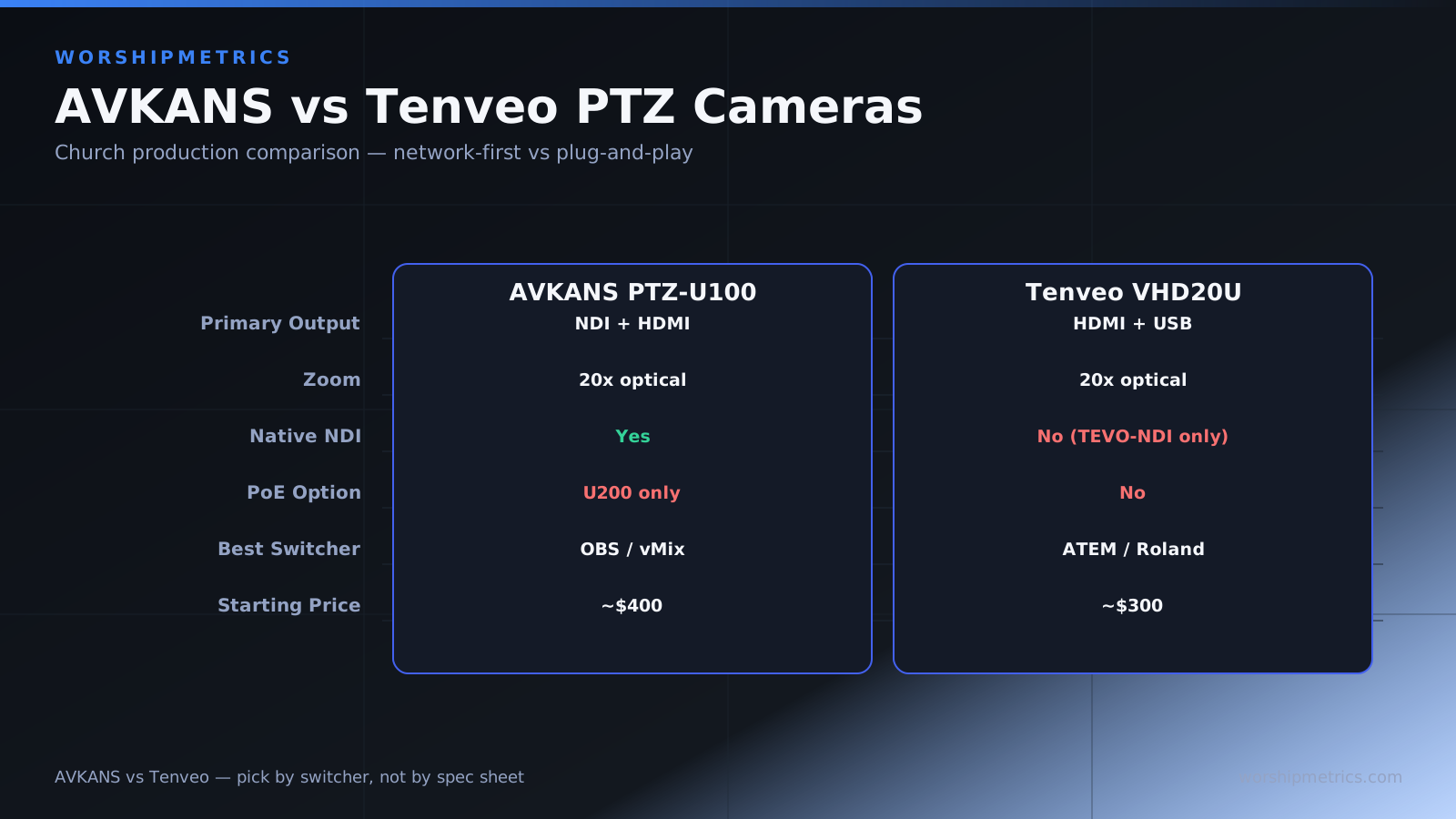
AVKANS PTZ-U100: ~$400, 20x zoom, NDI + HDMI, excellent value for OBS workflows
Tenveo VHD20U: ~$300, 20x zoom, HDMI + USB, excellent value for hardware switchers
AVKANS PTZ-U200: ~$500, 20x zoom, NDI + PoE, premium for eliminating power infrastructure
Tenveo VHD30U: ~$350, 30x zoom, USB + HDMI, excellent value with superior zoom
AVKANS PTZ-U30: ~$600, 30x zoom, SDI/HDMI, professional quality for larger churches
Tenveo TEVO-NDI: ~$450, 20x zoom, NDI, comparable to AVKANS U200
For similar feature sets and zoom levels, pricing is comparable. The main cost difference comes from infrastructure: AVKANS cameras may require network infrastructure investment that Tenveo cameras do not.
Zoom Capability Comparison
AVKANS U100/U200: 20x optical zoom, suitable for most churches, adequate for framing distant speakers
Tenveo VHD20U: 20x optical zoom, equivalent to AVKANS U100/U200
AVKANS U30: 30x optical zoom, professional-grade for large sanctuaries or distant stage areas
Tenveo VHD30U: 30x optical zoom, equivalent to AVKANS U30
For zoom capability, both brands offer comparable options. The 20x cameras handle most churches; 30x cameras are for large sanctuaries or when extreme zoom is essential.
Power and Installation Considerations
AVKANS U100: Requires power outlet at camera location, separate power supply needed
AVKANS U200: Power over Ethernet, single cable provides power and network, simpler installation
AVKANS U30: Requires power outlet and network cable, most complex installation
Tenveo VHD20U/VHD30U: Require power outlet, separate power supply, HDMI is only cable needed for video
For installation simplicity, the AVKANS PTZ-U200 with PoE is excellent (single cable for power and network). For hardware switchers without network infrastructure, Tenveo HDMI cameras require only power and one HDMI cable.
Which Brand for Your Church?
Choose AVKANS if your church uses OBS or vMix for software-based production and has adequate network infrastructure (or is willing to develop it). AVKANS cameras appear natively in your production software and feel like the intended choice for software workflows.
Choose AVKANS if you want to deploy multiple cameras on your network and prefer managing a coherent NDI ecosystem.
Choose Tenveo if your church uses hardware switchers (ATEM Mini, Roland V-Mixer) for switching. Tenveo HDMI cameras connect directly without network considerations.
Choose Tenveo if your church has weak or nonexistent IT support and you want camera equipment that works without network configuration complexity.
Choose either brand if your church is just starting with PTZ cameras. Both are reliable and well-supported. The choice between them should be based on your production workflow (software vs hardware switching) and your network infrastructure.
Support and Documentation
Both AVKANS and Tenveo provide reasonable documentation and customer support. AVKANS documentation tends to emphasize NDI and network configuration. Tenveo documentation tends to emphasize USB and HDMI simplicity.
For integration support with your specific production software or switcher, both brands have community resources and forums. Professional integrators support both brands equally.
Conclusion
AVKANS and Tenveo PTZ cameras are both capable and affordable choices for church production. AVKANS excels in network-based software workflows. Tenveo excels in simplicity and in hardware-switcher integration.
The best choice for your church depends on whether you are building around software (OBS, vMix) or hardware (ATEM, Roland) switching, and whether your network infrastructure supports multiple connected devices. Neither choice is wrong; they are simply optimized for different production paradigms.