The Three-Camera Inflection Point
When your congregation grows beyond 300 seats, a two-camera system starts straining. You can’t capture worship from enough angles. Your pastor moves around the stage and you lose framing. Your congregation expects more sophisticated production.
Three cameras give you genuine flexibility. Wide shot, medium shot, and tight shot—all available to your operator simultaneously. You can stay on a wide shot during worship, cut to a tight shot during an emotional moment, and return to medium shot without losing coverage.
This is the system that makes your production look genuinely broadcast-quality. It’s the system that growing churches actually use.
Three AVKANS PTZ Cameras
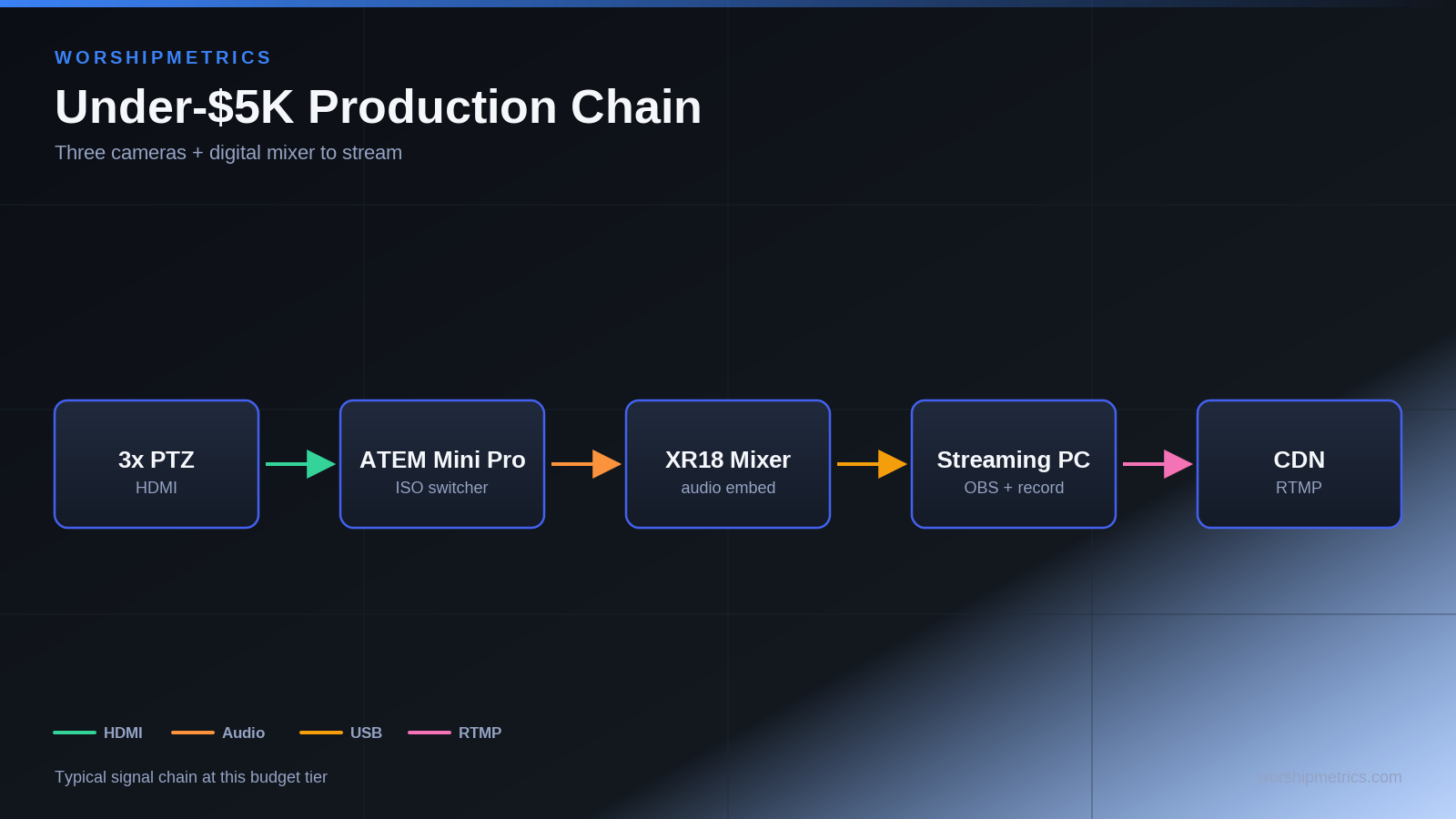
Three AVKANS cameras (mix of U100 and higher-end models, around $1,500 total) positioned throughout your sanctuary. Wide on the entire stage, medium on the pastor, tight on the worship leader or congregation.
All three connect to a managed PoE network switch. One cable per camera. They’re all under control of joysticks at your switcher position. Your operator has unprecedented framing flexibility.
By this point, your cameras are positioned optimally. You’ve learned where they need to be for your specific sanctuary. You’re not rearranging equipment weekly. You’re working with a proven setup.
ATEM Mini Pro ISO
The ATEM Mini Pro ISO (around $700) is the serious recording switcher. “ISO” is short for “isolated”—it records each camera individually while you’re switching them in real time. This means you’re recording four simultaneous feeds: Camera 1, Camera 2, Camera 3, and your program output (what people see on YouTube).
Why does this matter? After the service, you can use these ISO recordings to create edited highlight videos. You can pull a tight shot of an emotional moment from Camera 3, transition to a wide shot from Camera 1, and create a professional-looking sermon clip for social media. You’re getting broadcast-quality archive footage, not just archiving the live output.
The ISO recording is stored on a local SSD, independent from your streaming output. While you’re streaming 4 Mbps to YouTube, you’re recording 200+ Mbps locally. Your archives are pristine.
Behringer X32 Compact
The X32 Compact (around $2,000) is a professional digital mixing console. It’s overkill for just streaming, but for growing churches with sophisticated audio requirements, it’s perfect.
The X32 Compact handles 40 channels of mixing (though you’re only using maybe 12-15 for a worship service). It has motorized faders so you can recall complex mixes instantly. With the optional X-DANTE card (which replaces its standard USB card), it can send audio across a Dante network. It has separate outputs for Main PA, Monitor Mix, Streaming Mix, and Recording Mix—everything can be optimized for its destination.
Most importantly, the X32 Compact signals that you’re serious about audio. Your audio engineer has professional tools. Your sound is genuinely broadcast quality.
Capture Option
At this budget level, a Magewell USB Capture HDMI (around $350) is a reliable way to bring your switcher’s output into the streaming PC. It’s a capture device, not a hardware encoder: OBS on the PC still encodes the stream, so if the PC crashes, the stream stops. Streaming that survives a PC crash takes a standalone hardware encoder.
It connects over USB 3.0 and works with OBS and other streaming apps.
Complete System Total at Under $5,000
- Three AVKANS PTZ Cameras: $1,500
- ATEM Mini Pro ISO Switcher: $700
- Behringer X32 Compact Mixer: $2,000
- Magewell USB Capture HDMI: $350
- Network switch, cables, monitoring: $300
Total: $4,850
You’re at the limit of your budget, but you have a complete, professional, broadcast-quality system.
What This System Delivers
Three-camera production with independent ISO recording for post-production editing. Professional audio mixing with separate outputs for different destinations. Dedicated capture for the streaming PC. Local archive recording at full quality while streaming simultaneously.
You’re not just streaming a service—you’re producing television-quality output. Your volunteer production team is operating broadcast equipment. Your online audience is experiencing something that matches the production values of professional churches with much larger budgets.
Your post-production workflow is now viable. You can create social media clips from the ISO recordings. You can produce highlight reels. You can edit sermon clips for sharing. Your streaming investment creates ongoing content marketing value.
Training and Team Structure
At this level, you need a trained production team:
- Switcher operator (dedicated to camera operation and switching)
- Audio engineer (dedicated to mixing and audio levels)
- Streaming operator (monitors encoding and internet connectivity)
- Graphics operator (optional, creates lower-thirds and fullscreen graphics)
This isn’t volunteer chaos anymore. This is a coordinated technical team, each with a specific role and responsibility. Your volunteers feel professional because they are.
Operational Resilience
The ISO recording means if something goes wrong during the stream, you still have perfect local recordings. If YouTube hiccups, you have backup video. If audio drops from streaming, your local recording has clean audio. You can re-stream from the ISO files if needed.
If you need the stream to survive a PC crash, add a standalone hardware encoder; the USB capture device in this list depends on the streaming PC.
Your three cameras mean losing one camera doesn’t stop production. You’re still covering your service with two cameras. It’s not ideal, but it’s functional.
Post-Production Workflow
Here’s where this system becomes strategically powerful: every Sunday, you’re creating content. The ISO recordings are high-quality, ready for editing. You can assign a part-time editor to pull sermon clips every week.
Typical workflow:
- Monday morning: Copy ISO recordings to edit PC
- Monday afternoon: Editor creates 3-5 thirty-second highlight clips
- Tuesday: Post clips to YouTube, Instagram, Facebook, church website
- Wednesday: Embedded clips in email newsletter and social media
This weekly content pipeline keeps your audience engaged throughout the week. People who missed Sunday see the message through social clips. Lapsed members see evidence that church is happening. Visitors discover you through social content.
This post-production workflow is only viable at this budget tier. At lower tiers, you’re streaming but not creating ongoing content. At this tier, you’re running a complete media ministry.
Prefer It Built and Tested?
This guide builds around a hardware switcher. If you’d rather have one rack-mounted computer that switches, streams, records and runs your graphics, see our Livestream Systems. The Good tier, Essentials, is a 4-input vMix/OBS system with Magewell capture at a reference price close to this budget, and we’ll build it around the cameras and audio you already own.
Scaling to the Next Level
After running at $5,000 investment for a year, you’ll understand what a $10,000 system would add. Maybe it’s a fourth camera. Maybe it’s vMix for advanced graphics instead of OBS. Maybe it’s an ATEM Mini Extreme for more inputs and features.
But you’re not at an inflection point. You have plenty of headroom for growth. Your system can handle a congregation growing to 500+ seats. You’re not pinched by equipment limitations.
The Professional Mindset
At this investment level, your church has made a clear statement: “Media ministry is real ministry.” You’re not doing streaming as an afterthought. You’re investing in broadcast-quality infrastructure.
This investment attracts volunteers who want to do serious technical work. It attracts people with broadcast experience who might be attending your church and wondering if their skills could be useful. It builds credibility that you’re a modern, professionally-run ministry.
The real power of the $5,000 investment isn’t just the gear. It’s what it signals about your church’s priorities and professionalism.