The Inflection Point to Professional Broadcasting
At $10,000, you’re no longer running a church streaming system. You’re running a broadcast operation that happens to serve a church. The distinction matters. You’re operating at the same technical level as professional broadcast facilities, just with a smaller footprint and volunteer staff.
Your congregation probably exceeds 500 people. Your online audience might be thousands. You’re not a boutique streaming operation—you’re a significant media presence. You’re serving global audience that tunes in across time zones and platforms.
This is the investment that transforms streaming from “something we do” to “a primary ministry channel.”
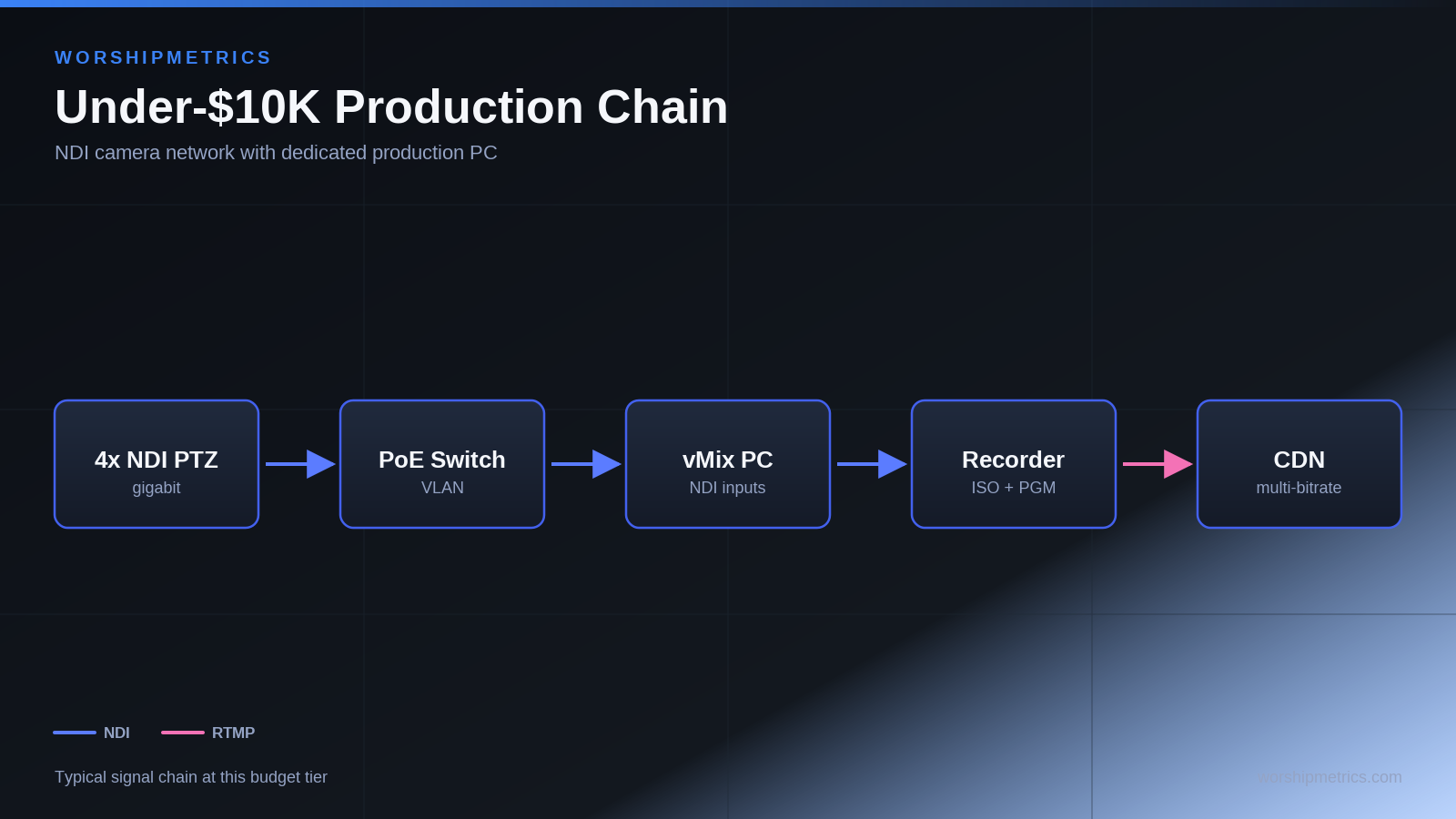
Four-Camera PTZ System
Four cameras (mix of AVKANS, SMTAV BX30N, or similar models, around $2,000 total) positioned for comprehensive coverage. Wide on the entire stage. Medium on the pastor. Medium on worship leader. Tight on audience or specific worship moments. You have every angle covered simultaneously.
Your switcher operator isn’t scrambling to frame shots. They’re choosing from four perfect angles and switching between them intentionally. Your camera work is sophisticated because you have the tools and time to frame properly.
All four cameras connect to your PoE network. One cable per camera carries power and video. They’re all controlled via joysticks at your switcher position.
ATEM Mini Extreme
The ATEM Mini Extreme (around $750) is the most advanced switcher in the Mini series. Eight HDMI inputs (you can connect all four cameras plus ProPresenter, backup camera, video playback, and graphics). Two independent program outputs. Full internal mixing capabilities.
More importantly, the Mini Extreme gives you enough complexity to handle sophisticated productions without becoming overwhelming. You can create nested scenes, complex transitions, and multi-layer effects if you want them. But you can also keep it simple if you prefer.
Allen & Heath SQ-5 Professional Console
The SQ-5 (around $3,500) is a professional digital mixing console designed for venues. It’s not overkill for a church—it’s exactly right for a service that’s being mixed for both in-room PA and broadcast simultaneously.
The SQ-5 has 48 input channels, motorized faders, touchscreen interface, and separate outputs for Main PA, Monitor Mix, Streaming Mix, and Recording Mix. You’re mixing professional-grade audio infrastructure.
Most importantly, with the optional Dante card the SQ-5 joins a Dante network, which means audio can flow across your network alongside video. Your audio engineer doesn’t need a rat’s nest of analog cables running across your facility. Everything is network-based, which is more reliable and more flexible.
Hardware Encoding: Magewell Ultra Encode HDMI
The Magewell Ultra Encode (around $800) is a dedicated hardware encoder that takes your ATEM Mini Extreme’s HDMI output and encodes it to H.264 at broadcast quality. Unlike software encoders, the Magewell is a specialized device that handles encoding as its only job.
If your PC crashes, your stream doesn’t drop. If OBS has a driver issue, your Magewell keeps streaming. You’re getting streaming that’s independent from your PC, which means it’s more resilient and more reliable.
The Magewell outputs simultaneously to YouTube, Facebook, and your church website (or any other streaming platform). Each platform gets optimized bitrate and quality settings automatically.
vMix Production Software
vMix (around $800 for a license) is production software designed for broadcast. It’s more powerful than OBS and more intuitive than command-line encoding tools. vMix handles multiple input sources, graphics, automation, and multi-platform streaming from a single interface.
More importantly, vMix is NDI-native, which means it integrates beautifully with your network infrastructure. Your cameras send video over the network, vMix receives NDI feeds natively, and you’re operating a modern, integrated system.
vMix also handles advanced features like live chat overlay, chroma key (green screen), and streaming to multiple platforms with different graphics and aspect ratios for each. You’re not limited to “same graphics for YouTube and Facebook.” You can optimize each platform independently.
Complete System Total at Under $10,000
- Four PTZ Cameras: $2,000
- ATEM Mini Extreme Switcher: $750
- Allen & Heath SQ-5 Console: $3,500
- Magewell Ultra Encode HDMI: $800
- vMix Production Software License: $800
- Network infrastructure (switch, cables, monitoring): $400
- Storage and backup (SSD, network storage): $300
- Joystick controllers and accessories: $250
Total: $9,400
You’re at professional equipment levels, all within a $10,000 budget.
What This System Delivers
Four-camera, multi-angle production with professional switching and mixing. Dedicated hardware encoding that’s independent from your PC. Professional production software (vMix) that handles graphics, automation, and multi-platform streaming. Dante-networked audio that’s broadcast quality and flexible.
You’re producing television-quality output. Your volunteer production team is operating broadcast equipment at a level that would be considered professional in smaller markets. Your service looks like a broadcast because it is.
Your archive is comprehensive. You’re recording the full service at high quality, plus you can generate ISO recordings of individual elements. Your post-production workflow is sophisticated.
Your streaming is resilient. If one element fails, others continue. You have backup paths. Your congregation’s experience is rarely disrupted by technical issues.
Training and Team Structure
You now have a professional production team:
- Production Director (oversees the entire operation, coordinates between technical and pastoral staff)
- Switcher Operator (operates cameras and switcher)
- Audio Engineer (manages mixing for both PA and streaming)
- Graphics Operator (creates lower-thirds, full screens, and graphics)
- Streaming Technical Director (monitors encoding, internet, and troubleshoots streaming issues)
These might be four people or three or even two people juggling roles. But the roles are distinct and the responsibilities are clear. This is a coordinated technical operation, not volunteer chaos.
Advanced Features
At this level, you’re thinking about things like:
- Live chat integration (displaying viewer comments in graphics)
- Chroma key (green screen for graphics overlays)
- Remote camera operation (PTZ cameras controlled from secondary location)
- Advanced graphics automation (lower-thirds that appear automatically)
- Multi-bitrate streaming (same content at different quality levels for different networks)
- Interactive polling or engagement (viewers vote on hymn selections or sermon topics)
You’re not doing all of these, but you have the infrastructure to do them. You’re not limited by equipment constraints.
Post-Production and Content Creation
Your post-production workflow is sophisticated:
- Monday: Archive ISO recordings are backed up to network storage
- Tuesday: Editor reviews and pulls highlight moments
- Wednesday: Create 5-10 social media clips (30 seconds to 2 minutes each)
- Thursday-Friday: Create longer-form content (full sermon, worship package, team interview)
- Weekly: Post content to YouTube, Instagram, Facebook, TikTok, church website, newsletter
You’re not just streaming a Sunday service. You’re creating a week’s worth of content that keeps your audience engaged. Your media ministry becomes strategically important to your overall ministry.
The Competitive Advantage
At this investment level and with this production quality, you’re competing with professional churches that have massive budgets. Your volunteer-operated broadcast matches the output of churches with paid production staff.
This attracts people. Visitors discover you through social content or by stumbling across your YouTube channel. Members feel proud to invite friends to services that they know will be professionally produced. New volunteers see an operation worth participating in.
Your church’s reputation as a modern, professional ministry grows. This reputation becomes a draw for both members and community partners.
A Software-Switched Alternative
If vMix is already part of your plan, consider letting the computer do the switching too. Our Livestream Systems are built for that: the Better tier, Studio, has 8 SDI inputs and outputs for IMAG and confidence monitors. Map your current system and we’ll show you what you can reuse.
Sustainability and Scalability
At $10,000, your system is built for the long term. You’re not going to outgrow it. You’re not going to hit limits where you need to completely rebuild. You can add features, upgrade components, and expand capacity, but the foundation is solid.
If your congregation grows to 1,000 people, you’ll add a fifth camera, maybe upgrade the switcher, but your core architecture remains. You’re not starting over. You’re growing on proven infrastructure.
The Strategic Perspective
The $10,000 investment is less about the equipment and more about the statement: “This church takes media ministry seriously. We’re investing in broadcast-quality production. We’re reaching people far beyond our physical facility.”
This mindset change attracts the right volunteers, impresses the right visitors, and sets the stage for your church to become a media presence in your region. The equipment enables this, but the mindset is what matters.